
There was a great article in the Globe & Mail on Saturday about the closing of Quality Meat Packers, which was a one-hundred year-old slaughterhouse that stood the test of time, and was the last remaining plant of its kind left in an area once dominated by industry.
Of course, it has me wondering, “How long until this site becomes a condo?”
Would you live in a condo built where a slaughterhouse once stood, or could you possibly care less?

Every Saturday, I look forward to reading the “Globe T.O.” section of the Globe & Mail newspaper, which, as the name clearly suggests, deals specifically with issues affecting our dear city.
It also usually has photos of Toronto’s cultural and social elite out at some gala, as if the rest of us care in the slightest, but that aside, I usually find 2-3 insightful articles about Toronto politics, economics, business, or something combining the lot.
The headline in Saturday’s Globe read “THE END OF HOGTOWN,” in big, red lettering that you couldn’t miss.
Before I read the sub-heading, or any of the article itself, I kind of wondered, “The end of…..what? Toronto? Huh?”
I think we’re all familiar with “Hogtown” as one of many nicknames for our city, but we don’t ever stop to think about how it got the name, and why it stuck for so long.
The sub-heading of the article read:
“With the closing of Quality Meat Packers, cheered by many condo-dwellers, Toronto has lost its last pig plant – a century-old slaughterhouse that handled a quarter of Ontario’s pork production – and a link to the city’s industrial past.”
Lost in the cheering from residents of King West, who can’t wait to say “good riddance” the putrid smell resonating from Tecumseth Street on 35-degree summer days, is a bit of Toronto’s history, and an understanding of how the city was founded, and why it flourished.
While killing 6,000 pigs per day in 2014 doesn’t warm your heart, it was part of the reason Toronto flourished in the late 1800’s.
I read a really good article on the nickname “Hogtown” on www.blogto.com a couple years ago. Let me see if I can find it……..ah, HERE it is!
As the article states, the the business of raising and slaughtering pigs began in the 1850’s, and by 1900, over 500,000 pigs per year were being shipped out of Toronto’s waterfront area.
Toronto was the mecca of pig-slaughter in the 1800’s and early 1900’s, and it employed thousands of people through the years, but the industry eventually moved out of Toronto – save for ONE location, which, of course, was the Quality Meat Packers building located at 2 Tecumseth Street.
I’m going to be perfectly honest here, admit something that makes me sound somewhat ignorant. It’s incredibly embarrassing, but hopefully you’ll find it funny…
One of the very first open houses I did when I got into the business back in 2004 was for a condo on King Street West, which I believe might have been 833 King Street.
I was standing in the unit, on a hot summer day, and a young couple walked inside and began to chat me up. I knew very little about King West (I probably had to find it on a map to get there….), and I was trying my best to answer this couple’s questions while being both honest, and trying not to sound stupid.
They asked me about the area, and things like, “Is that an off-leash dog park over there?” I said, “Yes, it is! It’s awesome! Do you have a dog?”
They asked me, “Do you go out a lot to the bars and restaurants in the area? Are they nice?” I told them truthfully, “Yes, I do actually! They keep popping up, and this seems to be slowly turning into the new entertainment district!”
Then the young lady asked, “What do you think about the abattoir?”
I smiled and replied, “It’s awesome. I love it.”
Eek.
I had absolutely no clue what an abattoir was.
I was so caught up in the conversation, and so afraid of being exposed as somebody that had been licensed as a Realtor for about three weeks, that I simply responded with what I thought they wanted to hear.
Much to my dismay, I found out that day that “abattoir” was a synonym for “slaughterhouse.”
Oops!
I did, however, learn a very important lesson that day (aside from the obvious “don’t put your foot in your mouth”), which was that King West condos can be greatly affected by the smell resonating from that abattoir, and savvy condo buyers are very aware of this.
I’ve been in units at 833 King Street west on hot summer days when a small gust of wind can deliver a smell to your balcony, the likes of which you have never experienced before.
I’ve stood on the sidewalk outside 15 Stafford Street, and had my clients ask, “What the HELL is that smell?”
I’ve been running open houses further east – on the other side of Spadina, and still had people ask, “Can you smell the slaughterhouse from here?”
Torontonians know about that slaughterhouse, believe me!
But the question of what will become of the slaughterhouse has never really been an “if,” but rather a “when.”
Rumours have been flying around for the last decade about who owns the property, what the plan is, and when it will be sold.
I’ve always heard, “It’s owned by some old man and his kids are waiting for him to die so they can sell it to a condo developer.” I can’t say that there is even 1% truth to that, or likewise – that there isn’t. But speculating as to what will happen to the abattoir is almost as popular a past-time as browsing for properties on MLS!
It’s amazing to consider that amidst dozens of condominiums, high-end restaurants, Starbucks’, and scores of other points of interest, there is an archaic “killing floor” that just never seemed like it would go away.
We know that the plant is officially closed, but I personally don’t know if the property was sold, if it will be sold, how much it will sell for etc.
I do know that the property at 2 Tecumseth Street is approximately 4.76 acres, and that is a large enough site to build several new condominiums.
Here is a map of the property from Geowarehouse:
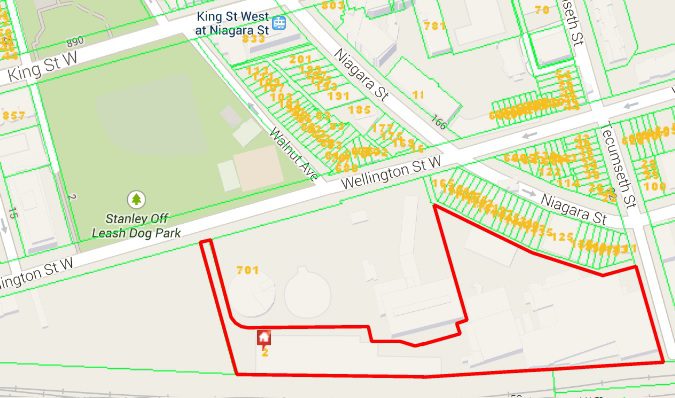
Interstingly enough, that property immediately north of 2 Tecumseth Street – that’s labeled “701,” is owned by the City of Toronto, and is also over 4 acres in size.
I believe this is subsidized housing, or what people in the know call “that sketchy pink building,” where even sketchier people hang out.
So is it completely out of the realm of possibilities to suggest that these two properties, totalling close to ten acres of land, could merge at some point and be repurposed for the greater good?
Or can we simply assume that Freed Developments Corp will swoop in and purchase the slaughterhouse, as most people have long assumed?
And what if this property did turn into a host of condos. Would YOU want to live there?
I asked this question a couple weeks ago when Streetcar Developments bought the iconic building at Broadview & Queen where “Jilly’s Adult Entertainment” has been located for quite some time.
Do you care what stood on the site of your primary residence before the residence was constructed?
Would you want to live in a house built atop an old burial ground or cemetery?
Do you get a kick out of knowing that your loft at 993 Queen Street West was once where candy was produced, or that you live in an old feather factory or toy factory?
Or could you possibly care less?
While I’m fairly certain that the “Jilly’s building” will remain, and any condo development will incorporate that historic facade into its construction, I’m also fairly certain that the slaughterhouse at 2 Tecumseth Street will be torn right down, and the only trace of the former kill-shop will be found in articles on the internet, and perhaps in the souls of millions of pigs that still haunt the neighbourhood, if you believe in that sort of thing.
A LOT of Torontonians have been calling for an end to Quality Meat Packers for quite some time, and not just those who live in King West. A lot of folks think that, while the business does date back to Toronto’s early days, and it was there before all the condos, that doesn’t give it the right, or necessity, to remain.
The area has changed drastically in the last decade, and while there once was a place for the abattoir, it’s seemingly out of place today.
Wait……what was that? Did you hear that sound?
I assure you – that wasn’t the sound of a pig sqealing; it was the sound of property values at 833 King Street going up….
























myeo
at 7:51 am
I couldn’t possibly care less.
Chroscklh
at 1:06 pm
I disagree. Mayo could care less if not be compelled to post comment. BOOM.
Donald J. Trump
at 3:05 am
Actually, he was referring to the question posed by the article not the article itself.
KABOOM.
Joe Q.
at 8:48 am
Can anyone comment about what’s going on in the Stockyards area these days (St Clair west of Keele / Weston) — obviously a lot of development going on there, but when did / will the last slaughterhouse there close down?
jeff316
at 9:38 am
I think the big ones have shut down and the Palletta plant burned down in 2006, but there are still four or five smaller ones out there a bit west of the new stockyard shopping centre development.
FroJo
at 11:04 am
There was a Monty Python skit that went the other way. Ah, memories.
Mike
at 12:00 pm
I would only recommend this site to my clients if the floorplans have the the cuts of the pig as names, shoulder for the corner units, shank for lower floor units, pork belly for the overpriced ones.
Joe Q.
at 2:42 pm
I can just imagine the marketing literature. “Living here will make you squeal!”
GinaTO
at 12:39 pm
I used to live at 15 Stafford (great building, btw), and sold two years ago for a nice profit. The abattoir hasn’t stopped property values from going up – apart from the smell, the neighbourhood is still a fantastic place to live.
The pink building is right at the corner of Wellington and Strachan, so most probably not the “701” on the map.
lulu
at 2:03 pm
All the*sketchy* pocket in core downtown toronto or downtown toronto means profit, the sketchier the better, is a matter of how brave you will buy it as an investment or live in there wait for the appreciation.
Niagara is a whole lot different 10 years ago, used to be a ghost town and no one want to hang around after 6 or 7pm, but look at it now, it booming like flowers.
As long as within the city core or surrounding edges, i think it wont go wrong, just be patience, hold on to it and rewards always surprise you.
George
at 3:51 pm
Although it wasn’t humans who died, it still feels a bit creepy. I would think about it. It’s kind of like walking around the old World Trade Centre site or the beaches of Normandy. When life vanishes from a spot, one often can’t help but think about it.
As for the smell of the plant…I played a softball game in a nearby park there one evening. We lasted four innings before intentionally forfeiting just to get out of there. Give me manure or skunk odour any day over the smell of a slaughterhouse.
Peter
at 6:34 pm
To compare a slaughterhouse to Normandy is insanely irresponsible, 9/11 site as well.
Guess what, life has vanished from almost every spot you have ever been in the world. Therefore, in reality what should make you think is when you are in a place where death hasn’t happened. Like….. the moon, or …. hmm thats about it.
George
at 3:36 am
There is nothing irresponsible about saying how I feel. You don’t have to feel the same way. I don’t see any belittling or lack of compassion in my comments.
Boris
at 12:11 pm
I hope your dreams are forever filled with smells of raw sewage.
Paully
at 10:56 pm
Why do people buy homes near abattoirs, airports, paper mills, highways, etc., and then complain about it?
jeff316
at 9:52 am
It is interesting that consumer preferences have changed to such an extent that these establishments are considered to be incompatible with residential development.
Don’t get me wrong – I’m sure no one has ever preferred to live right beside a factory or something – but for many years people lived mixed in with these developments.
Look at the homes a stones throw from the steel mills in Hamilton. Small towns in southern Ontario used to be chock a block with factories mixed in with housing. Living with lumber yards, transfer stations, and small industrial was the norm for people living north of Eglinton, from the Allen to Caledonia and beyond. Living with the smell of the St Clair Ave West stockyards was a fact of life for people as far away as Keele and Eglinton or, on a bad day, Black Creek.
Doc Benway
at 12:00 pm
There are lots of places in this city that have a “smell” that is part of living in a large city. I know when the wind hits the beaches area on certain hot summer days, much of the neighborhood smells like sewage. Now this an est. affluent neighborhood.
This morning during my walk around the church village, all of mutual street smelled like urine and many of the smaller side streets. Again these streets have very nice victorian homes.
Personally the smell of an abattoir is a line I couldn’t cross, but for some people, it isn’t. As long as you knew what you were buying into when you bought, there shouldn’t be buyers remorse.
Great step for this neighborhood. More people will want to buy in now.
Geoff
at 12:46 pm
I think you have to be really freaked out by things to avoid buying because of what used to be there (short of you know, a nuclear power plant).
Anyone buying an old victorian home in Toronto should be able to figure out that by the age, there undoubtely would have been some kids born in that house, the age of which also means a higher likelihood of a stillborn birth occuring as well.
Chroscklh
at 1:12 pm
Close slaughterhouse breath new life in neighborhood. Is good for resident. No need for slaughterhouse to be in city. Too bad building such bad shape, could repurpose. I use live in converted crematorium, apart from poltergeist – is no problem
JP
at 4:08 pm
I had a client once that wanted to live in “The Stockyards” area. His words.
I found him a house that he was interested in placing an offer on, until he found out that there was/were actually slaughterhouses in an area referred to as “The Stockyards”.
Kyle
at 4:53 pm
People will get over what the site used to be faster than you can say, “bacon” and condo marketers will very quickly start pitching it as Toronto’s own Meat Packing district. If people pay $4.5M ($3153/sq ft) to live where animals died in New York, i’m pretty sure Torontonians won’t have any reservations.
http://streeteasy.com/building/345-meatpacking
Dan
at 2:23 pm
I know the abattoir has long ago closed, but are there any residual smells in the area? I’m looking at moving there.