

Why all the talk about corrections, crashes, and recoveries?
I assure you, I’m not trying to create a market narrative here, but rather the narrative has been created for us.
At least, that’s what I’ve been seeing in the media lately, as there have been countless articles in the major newspapers including the word “recovery.”
But as I noted in Monday’s blog, in order to consider, define, or discuss a recovery, it would be prudent to look at the market correction itself. Not only that, I feel as though the word “crash” is used far too often to describe a correction, and the word “correction” is used far too often to describe a fluctuation.
The one aspect of the term “correction” that we didn’t discuss on Monday was that it contains the word correct. This is to suggest that a market correction brings prices and/or sales back to a level where they “should” be, ie. to a correct level or evaluation.
I believe that, with the benefit of hindsight, we could use the term “correction” to describe some segments of our market.
I noted in Monday’s blog that the average home price in Durham Region increased by a whopping 87.4% in a two-year period. Perhaps the subsequent 31.6% decline could be the very definition of a “correction,” if we’re looking to suggest that the current price is, in fact, correct.
In any event, I wanted to go through some of the recent articles about the “recovery” in our market and look at what various pundits are saying or predicting.
Let’s start with an article featuring perhaps the most notable economist in our orbit, with a headline that makes the timing of the market recovery quite clear:
“Economist Benjamin Tal Sees Housing Market Recovery In 2027, And A New Normal”
The Globe & Mail
January 16, 2026
From the article:
“The way I look at it, I see 2026 as a transition year between something bad to something better,” said Mr. Tal, managing director and deputy chief economist for CIBC Capital Markets Inc.
“I think that the fundamentals are there. And the minute you have the supply story ending in the condo market – which would be two or three years from now – we will start to see some upward pressure.”
People had been hesitant to buy because they expected more rate cuts, he said.
“I think that the Bank of Canada made it very clear that they’re not going to cut any more. Something really bad will have to happen for them to cut. So, I think that you will see more people entering the market, realizing that that’s the bottom as far as the Bank of Canada is concerned. That will add a little bit to the spring market,” said Mr. Tal.
“The minute you reach this point, with interest rates more or less where they are, I think the housing market can show nice recovery in 2027.”
Interesting.
Mr. Tal describes 2026 as a “transition year,” which I personally thought 2025 was going to be.
But then he goes on to discuss the condo market, and I feel as though there’s so much discussion of the condo market either on its own, or within discussions about the overall housing market, that what’s getting lost in all this is the fact that the freehold market and the condo market can move in opposite directions.
Not only that, the pre-construction condo market can move out of synch with the resale condo market as well.
Mr. Tal also makes a bold prediction herein by using the word “bottom” to describe our current market.
Predicting a market recovery should follow the act of pinpointing a market bottom, right?
Now, before we move on to other predictions for a recovery, I want to draw your attention to a very important publication from Urbanation:
“New Condo Sales Fall For Fourth Year To Lowest Level Since 1991”
Urbanation
January 21, 2026
In Monday’s blog, I provided the following chart:
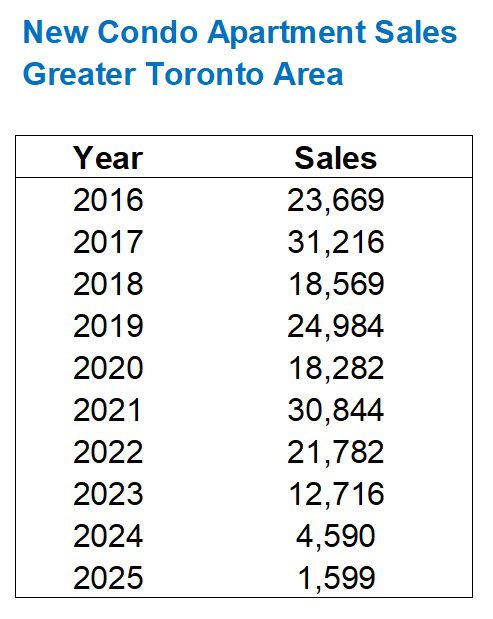
The Urbanation study provides us with two mind-blowing figures:
1) New condo sales in 2025 fell 91% below the 10-year average
2) New condo sales have dropped 95% from 2021
The author, Shaun Hildebrand, concludes with this take:
“As the condo market enters the fifth year of its largest ever correction, the duration of this downturn should be a significant cause for concern as it relates to future supply. By the end of the decade, we know with certainty that there won’t be any new condo completions. What we don’t know is how far into the 2030s the supply crunch will last. If rental construction can’t fill the void, this raises serious questions around the impact on affordability.”
This goes beyond talk of a recovery, doesn’t it?
We’re already talking about the next bull run?
Mr. Hildebrand notes there’s a “significant cause for concern as it relates to future supply,” which is the last thing that’s on most people’s minds, in the midst of a pre-construction condo market collapse and a weak resale condo market.
“By the end of the decade, we know with certainty that there won’t be any new condo completions,” he adds, which is something we’ve discussed here on TRB over the last two years.
This fascinates me because we have identified a problem a half-decade before it’s going to occur, and yet I don’t think that we’re going to do anything about it. All the warning signs are present. All the data is undeniable. But when demand massively outpaces supply in 2031 or 2032, we won’t be able to look back and say, “There was no way to see this coming.”
Our media has started to pick up on this, as written here in the Financial Post:
“What Toronto’s Worst Condo Correction Ever Will Look Like In Three Years”
Financial Post
January 26, 2026
This article essentially repeats what I’ve written above and quotes the Urbanation report, so we can move on to yet another article with the word “recovery” in the title:
“What Might A Condo Market Recovery Look Like?”
The Globe & Mail
January 22, 2026
Ah, yes!
Tell us what a recovery might look like!
From the article:
The conundrum for condo builders is that they can’t start marketing new projects until all that surplus “inventory” is acquired, which means there’s likely to be a several-year-long period in the near future when little is being built and nothing is being sold. “By 2029,” says Mr. Hildebrand, “there will be virtually no new condo supply entering the market.”
How long will the doldrums last? That question dominates industry conferences and the real estate bro podcasts that, not long ago, featured excited conversations about how to goose returns by flipping preconstruction condos.
“I would say three to five years,” says Mr. Cassano. “I know that there are people in the industry saying, `Nah, this is 18 months.’ I just don’t see it.”
Ms. Keesmaat agrees: “However long people think this is going to take,” she adds, “it’s going to take longer.”
First of all, I love the “bro podcast” reference.
That’s exactly who was flogging pre-construction condo garbage from 2018 to 2023.
As for the “predictions,” these are specifially aimed at the pre-construction condo market’s recovery, in case that’s not obvious.
Mr. Hildebrand suggests that the pre-sale market won’t recover until all the surplus inventory is absorbed, which could be 2029.
Mr. Cassano suggests 2029 to 2031.
And Ms. Keesmat provides an answer worthy of any politician by not providing an answer at all.
What I found more interesting in this particular article, however, was that there were “predictions” of how the new model of pre-construction condo development might look.
You’ve heard me muse the following: “In 2009, after the Financial Crisis, nobody walked into their investment advisor’s office and asked to purchase a mortgage-backed security. So in 2030, why would anybody walk into a condo sales centre and purchase a pre-construction condo at a 40-50% premium to resale prices?”
The article offers some insight into how developments might be financed in the future:
For decades, condo builders and Canadian lenders relied on a financing model designed to attract small investors. They presold about three-quarters of the units in a building and used the deposits to secure construction loans, which would be paid off as soon as the building was completed and transferred to the condo corporation and the owner/investors.
Mr. Greenberg says this approach, which has come under criticism for fostering a speculation-driven market dominated by investors, was imported to Toronto in the 1980s by a local lawyer who’d seen it in action in Hong Kong and applied it to early Harbourfront projects.
By contrast, condo ventures are financed more conventionally in Europe, i.e., with the builder relying on deeper reserves of equity to secure larger mortgages. In the U.S., in turn, federal mortgage insurance rules cap the number of investor-owned units in a given project – a regulation that has limited condo development in many larger urban markets.
“My contention is that this idea was fatally flawed from the start – that what it did lead to, in fact, was a speculative market for investors, instead of people who would actually live in the units,” says Mr. Greenberg. A growing number of industry players concede the point – an acknowledgment that, at a time when it has become almost impossible to presell a condo, this particular financing model has brought the sector to its knees.
Institutional capital, on the other hand, is flowing into large new rental projects, which require developers to stake a lot more equity and accept a longer payback period with lower returns. A popular Canada Mortgage and Housing Corp. (CMHC) rental subsidy program has prompted many builders to convert planned condos into rental ventures in order to secure such funding.
Mr. Cassano and others say that CMHC programs geared at non-profit housing providers such as WoodGreen have created a third option, with condo developers establishing joint ventures as a means of accessing the CMHC funding. “These other organizations,” says Mr. Cassano, “can tap into incentives that the developer wouldn’t otherwise have.”
In Vancouver, meanwhile, a growing number of projects are being financed through a new vehicle known as a “real estate development trust.” These are like REITs in that they’re available to smaller retail investors, but raise capital to finance new projects, as opposed to acquiring completed ones as REITs do. Last May, for example, Anthem Properties Group, a B.C. firm, raised $82-million for a 66-storey tower in Burnaby that will have 372 condos, 200 market rental units, 73 non-market rental units and 176 hotel suites.
Regardless of the financing model, says Mr. Hildebrand, “investors will come back to the market. Condos have been a time-tested investment that has created a critical mass of investors who own approximately half of all units in the market. Many are waiting to get back in and will be opportunistic when the time comes.”
The article gives us three ideas on how to finance new construction moving forward:
1) Use the CMHC. An idea that I hate, since this means taxpayers are backstopping the private sector.
2) REIT’s. An idea that I love, since private capital should be used to finance private projects.
3) Investors. So says Mr. Hildebrand, “Investors will come back to the market.” Can’t humanity learn from its mistakes? Why would anybody enter this space again under the same system?
Now, back to our discussion of the market recovery, for the next article.
If you believe that the smart money, sharp money, or institutional money knows best, then you’ll want to read this article and understand what is happening, why, and what that means for a market recovery:
“As Toronto Condo Sales Founder, One Group Is Betting Big And Buying Up Units In Bulk”
Toronto Star
January 26, 2026
From the article:
There is one somewhat surprising group that’s starting to snatch up these listings, known as assignment sales. Private equity and investment funds are betting that things will turn around in a few years, a sign the market may be at or near the bottom.
“There’s a lot of funds that we work with, like equity funds, and they’re buying them in bulk,” said realtor Jonathan Zadegan, managing partner at the Zadegan Group.
“They’re buying them, they’re renting them out, they’re keeping them until 2030, 2031 and they’re flipping them.”
You don’t say?
There’s that word again: bottom.
And there’s the appearance of dates again: 2030 and 2031.
At least as it pertains to the condo market, which is what most of the articles about the market “recovery” are discussing.
It almost seems to suggest that the freehold market is already in the recovery phase, does it not?
Or is that a naive inference on my part?
I suppose only time and market statistics will tell.
Speaking of which: can you believe we’re already at month’s end? The January TRREB stats will be published next week, and we’ll have our first solid look at how the 2026 real estate market is shaping up!




























Marina
at 9:12 am
Are you saying that only investors purchase overpriced condos that are 400 Sq ft with a pillar in the middle, no windows in the bedroom and stare at a dumpster alley? Who wouldn’t want to live in such luxury?
My hope is that this insanity will actually shift both the financing model for new builds, as well as the type of stock being built. But I guess we’ll see.
And I would LOVE to see a limit on investor purchasing, and an outright ban on corporate purchases of single family homes. But I’ll take smaller changes.
Serge
at 7:44 pm
One could think about such terms as “saturation” and “stagnation”, instead of “crush” and “correction”. I also wonder how much can one get from only analyzing housing numbers, disconnected from population and capital context?
Paully
at 9:44 am
When we lived in a condo, we were very happy that the building was over 75% owner-occupied. It felt like a good amount. There was a solid a majority of residents who truly cared about the building for the long-term, and the building was well run as a result.