

Great news: we’ve avoided another federal election!
Bad news: we’ve avoided another federal election…
Last week, our Canadian parliament passed the federal government’s budget by a narrow 170-168 vote, which means we did not trigger another federal election.
Say what you want about the system of government in the United States, since the grass is always greener on the other side. But can you imagine if their refusal to pass a budget triggered an election? They’d be at the polls so frequently they’d build tents around them!
There was a feeling out there that “nobody wanted an election,” but there was certainly no consensus on this.
Some people didn’t want an election because they supported the Liberals, and they feared that the Liberals would lose ground.
Some people didn’t want an election because they supported the Conservatives, and they feared that the Liberals would actually gain ground.
But most people, I truly believe, didn’t want an election because they just didn’t want one.
Period.
No real reasoning behind it. They just sort of felt the “ick.”
Call it election “fatigue,” if you will. But I don’t know that policy, for better or for worse, had all that much to do with the average Joe Canadian not wanting an election.
All this is to say that the federal government has a mandate, at least until the next budget is presented.
And with that said, perhaps it’s time to look at the intersection of federal policy and housing, while checking in on what’s been done, what’s been promised, and what’s been delivered – or not.
I can’t promise that I’ll keep my bias out of this, but can anybody?
Let’s start with a look at the government’s fiscal targets, and this article:
“Federal Budget’s Fiscal Targets Unlikely To Be Met, Interim PBO Says”
The Globe & Mail
November 14th, 2025
From the article:
The interim Parliamentary Budget Officer released a report Friday that includes strong criticism of the Liberal government’s 2025 budget, saying it takes an overly broad definition of capital spending and includes fiscal targets that are unlikely to be met.
One of the key elements of the Nov. 4 budget was a new financial presentation that divides all spending into either operational or capital spending.
We’re not off to a great start here.
But the theme in the article, as well as the report, is simply that the government is taking liberties with its predictions to “balance the operating budget within three years.” It’s easier to budget if you simply move a few items from column-A to column-B.
Some refer to this as “cooking the books,” while others simply call it “creative accounting.” Most people probably couldn’t care less, and they’re probably a lot happier than me, as a result…
As for the budget specifically as it relates to housing, there have been a few recent critiques, starting with this one:
“Carney’s Budget Falls Short On Housing”
National Post
November 8th, 2025
From the article:
The new federal budget makes it clear that Prime Minister Mark Carney is unprepared to tackle the national housing crisis. His proposed measures are half-hearted at best and fail to adequately address the overregulation throttling construction of new supply.
Canada has chronically built too little housing to meet burgeoning demand, which, according to the Canada Mortgage and Housing Corporation (CMHC), has led to a national shortage of approximately 2.6 million units. This is the primary reason why the inflation-adjusted price of an average Canadian home has doubled since the early 2000s — there are simply too many people bidding on scarce inventory.
This problem could be resolved by both decreasing demand — which functionally means slashing immigration — and significantly boosting housing construction.
Let’s leave the conversation about immigration for another day.
As it pertains to the second part – boosting housing, the article offers:
The federal government’s Rapid Housing Initiative (RHI), for example, promised to build over 12,000 affordable housing units for $3.84 billion over four years over the period of 2020-2024 to build 16,058 new affordable units, of which only 8,981 have been completed so far, according to the government website which was last updated in June. Not exactly great progress.
Generally speaking, affordable housing programs are exorbitantly expensive and produce so few units that their market impact is homeopathic. On average, the RHI built 2,245 units per year between 2020 and 2024, at the cost of $240,000 per unit. If we extrapolate from this pricing, it would seem that Build Canada Homes actually has enough capital to provide roughly 30,000 units over the next five years — or around 1.2 per cent of Canada’s housing needs.
Even if the federal government were to magically cut per-unit costs by half, the amount of housing it would deliver would still be negligible.
Here’s another take from the Toronto Star:
“Carney’s Budget Was Built On Yesterday’s Housing Numbers, Not Today’s Grim Reality”
Toronto Star
November 18th, 2025
What was once a promise to deliver 500,000 new homes annually has now become a plan that could cost 100,000 jobs nationally.
Canadians are now facing the prospect of a worsening crisis that will impact housing supply, employment, economic activity, and ultimately, middle-class families.
Of particular note is that this budget relies on backward-looking data that provides false reassurances that Canada’s housing sector is prospering and that affordability is improving — but these are stale statistics.
Development charges, eh?
Hang on while I pat myself on the back here. I’ve only been complaining about these for a decade…
Here’s another good take from the National Post:
“The Federal Budget’s Housing Math Doesn’t Add Up”
National Post
November 13th, 2025
This article also echoes the Toronto Star article above when it comes to obsolete data being used in the budget:
When the federal government released its 2025 Budget on November 4, one line on page 44 immediately stood out: “Home sales have risen in five of the past six months.” For those of us in Canada’s housing industry, we found ourselves scratching our heads when we read this line, wondering how such a conclusion could have been reached. Because while it may sound encouraging, it does not reflect the reality unfolding in major urban centres across the country.
Third-party agencies have been tracking sales data for builders and to inform the public for decades. The latest numbers tell a very different story and show a severe downward trend. Year-to-date new home sales have declined sharply across Canada’s largest municipalities compared to the 10-year average. Single-family and condominium apartment sales are both down 82 per cent in the Greater Toronto Area, 81 per cent in the Greater Golden Horseshoe, 67 per cent in Vancouver, 40 per cent in Calgary, and 33 per cent in Edmonton. In Montreal, condominium apartment sales have fallen by 75 per cent. That is not a sign of recovery, it’s a sign of a severe downturn – one that started in the GTA over two years ago and has now spread to all housing types in all major Canadian markets.
The discrepancy points to a deeper issue: it seems the federal budget may be drawing on a data set where the “home sales” it refers to are total sales (including resale homes) rather than new home sales. That might explain why the numbers appear more positive. But this is puzzling for a budget from a government that has promised to deliver 500,000 new homes annually. You simply cannot track progress toward that goal using data from existing homes that have already been built, 10, 20, 50 or more years ago. If the aim is to spur new construction, to add supply for a growing population and support the jobs the sector provides surely the focus must be on net new construction?
Yes, let’s talk about those 500,000 new homes that are noted in the excerpt above.
Has anybody looked into this?
Has anybody written about this?
Ah, yes! Here:
“Mark Carney Promised Half A Million New Homes A Year Within A Decade. Here’s What It Would Take To Get There”
Toronto Star
November 5th, 2025
Is this a “cup half-full” sort of article?
The article seems to infer as much.
First quote in the article doesn’t sound great: “It’s like turning the Titanic around.”
Yikes!
From the article:
“Ambitious.” A “stretch goal.” A “moon shot.”
This is how players in the housing industry are talking about the housing targets proposed by Prime Minister Mark Carney and his fledgling government. Within a decade, the Liberals promised on the campaign trail to increase housing production to unprecedented levels — aiming to create the conditions for a half-million new homes to be built each year.
In the thick of a housing crisis, industry players welcomed the ambition of this goal. But builders, analysts and academics alike are skeptical of whether it’s feasible. They warn that a large swath of Canadian land is unprepared for housing, needing major infrastructure upgrades like sewers and water systems, and that jacking up the pressure too fast risks inadvertently inflating costs for labour and materials.
That doesn’t sound very optimistic to me.
Is it possible that politicians – NDP, Conservatives, and Liberals alike, simply make promises without ever investigating whether their ideas are even possible to begin with?
Wait. Don’t answer that.
The article essentially obliterates any notion that the federal government’s promise of building 500,000 homes per year can come to fruition.
Here’s a graphic from the column:
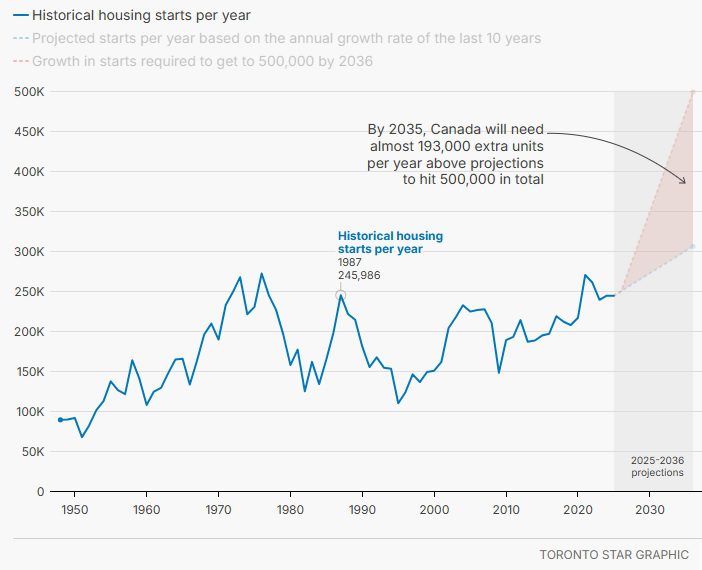
Like I said, it’s as though political leaders just blindly make promises without ever investigating whether or not their “bright ideas” are possible.
In order to see 500,000 homes built per year by 2035, our three levels of government would not only need to work together, but to have this thing called a “plan.” The reactionary nature of our government, however, will simply make this impossible.
Thankfully for the federal government, they’re slowly working to rid the idea of “building 500,000 new homes per year within ten years” from any and all communication coming out of their office.
The next article, from the Toronto Star, confirms this:
“Mark Carney’s Promise On Housing Was To Build, Build, Build. What Happened?”
Toronto Star
November 10th, 2025
From the article:
The federal government still says it will “double the pace of construction,” although it has ratcheted down expectations on the sheer number of units. During the campaign, the Liberals promised to build “almost 500,000 new homes a year” by the end of ten years. Now, any references to “500,000 new homes” are absent from the Budget; they have been replaced by a note stating that the CMHC estimates the country needs 430,000 to 480,000 units a year, while the Parliamentary Budget Office’s estimate is a more modest annual need of 290,000 homes. Unlike the Ontario government, the federal government has refused to release annual housing starts targets, so it is unclear what this softening in rhetoric means in practice.
Of course, they refuse to release annual housing starts targets.
When you’re losing a game, and you have the ability to hide the score from the viewers, that’s exactly what you do…
The article explains that the government has completely shifted its focus from “easing the housing crisis” by building houses to doing so by reducing demand as a result of reduced population growth.
This is exactly what we do not want.
For years, I lamented here on TRB that “demand-side” solutions were never going to work and that the government needed to focus on the supply-side of things. All three levels of government eventually hopped on the bandwagon, but it seems as though the federal government has jumped off.
From the article:
The message in the Budget could not be any clearer: the government is increasingly relying on reduced population growth, rather than building more, to address Canada’s housing shortage. This comes at a high cost, as newcomers to Canada do much to add to the social, economic, and cultural fabric of our country, and the changes in immigration rhetoric risk painting newcomers as the cause of housing shortages, when often they are its biggest victims.
Last, but not least, I would offer this article by Mike Moffat, whose work many of you are familiar with:
“We Expected Little In The Federal Budget On Housing. We Got Less Than Expected.”
Missing Middle Initiative
November 4th, 2025
“Ottawa promised homes for families; what it delivered was talking points on immigration.”
That’s the sub-title to the article, and it’s undeniably accurate.
This is a very lengthy article, and if you read one article from today’s blog post in full, I would reccomend you make it this one!
Mr. Moffat notices three major differences between what was promised and what was delivered via the budget:
1) Build Canada Homes: The Liberal platform had promised just under 3 billion a year (2.989B) for Build Canada Homes once the program fully ramped up by 2026-27. The Budget allocates an annual average of $1.59B between 2026-27 and 2029-30, just barely over half of what was promised. I asked officials about the discrepancy and was told that investors would roll out slower than anticipated by the platform, but investments would ramp up in later years. Ultimately, during the campaign, the Liberals had promised $11.8 billion in BCH investments through fiscal year 2028-29; instead, they are only investing $6.2 billion.
2) GST Rebate for First-Time Homebuyers: This commitment remains unchanged from the one in the election platform, but the costing has more than doubled. Finance Officials informed me that they are forecasting a larger number of first-time homebuyers will collect this benefit than the Liberal platform has anticipated; they are expecting over 40,000 first-time buyers to collect the rebate each year, with an average rebate value of approximately $24,000. I am highly skeptical that the actual figures will be anywhere near this level.
3) Development charge reduction: This was included in the budget but placed in the infrastructure section, not the housing section. The federal government has announced a new Build Communities Strong Fund, a combination of new money and existing infrastructure programs. The Budget allocates $17.2 billion over 10 years to “support provincial and territorial infrastructure projects and priorities”. Of this money $5 billion is allocated to health infrastructure, which explicitly does not require provinces and municipalities to reduce development charges. The remaining $12.2 billion over 10 years covers the forms of infrastructure covered by development charges (DCs) and requires DCs to be frozen. It is a watered-down commitment from what was in the platform, as the promise was for $1.5 billion, and required that development charges be halved, replaced with a requirement that they be “substantially” reduced.
4) Reintroduce MURB tax incentive: The budget does not acknowledge the existence of this platform commitment.
Sorry, folks!
I wish I could start the week on a more positive note.
But this topic has been in my queue for a while now, and the release of the federal budget – and all the articles that followed, sure made it easy to write!




















Serge
at 8:30 am
To look at wikipedia, Toronto proper grew from 2.48 to 2.79 mil between 2001 to 2021, or 2.61 to 2.79 from 2011 to 2021. Over this time, about 300K of only condo units were introduced over 20 years, or about 200K over last 10 years. Plus, single homes and rentals and social… may be another 100-150K. Of those, 20K is still available for rentals, or even 40K unoccupied. Does it need another 500K over next 10 years?
Marina
at 8:58 am
I think we all knew the “promise” was BS. You can’t just build houses on a hope and a prayer. But real solutions are difficult.
If the government was serious about housing affordability, they would be looking at everything.
Building is important, yes, but it’s not just quantity. What is being built? Where? Should we be building housing units or is it more efficient to build transportation so people can live further out?
Regulations are also important. Make it easier for people to provide rental units. Staff the LTB and give it teeth. Fund social housing properly.
Stop regulating for housing size and regulate purchasers instead. Cap single family home ownership at 3. Including corporations. Then exponentially raise taxes. Make it impossible for investors to buy up whole neighborhoods. Rental buildings only.
Tie immigration to infrastructure. Instead of trying to regulate student visas, make it so colleges and universities can only accept students for whom they can secure housing.
Not saying all of these would work. But there are so many things that can be tried. It’s just easier to promise to build.
Ace Goodheart
at 6:58 pm
A friend of mine (long since passed, unfortunately) used to say the following about government decisions:
“The only reason a government does anything, anything at all, is to get re-elected. Any benefit to the public as a result of anything the government does, while trying to get re-elected, is just a coincidence”.
He worked in government for 35 years, behind the scenes, and understood it better than anyone I have ever met.
That’s just how it works. If you want to get elected, you promise things that people who vote, want. This is why we have CPP and OAS (old people vote – they have nothing else to do. Whenever there is an election, go down to a polling station and you’ll see. Every old grandma and grandpa in your neighbourhood will be there. There is often no one under 60 in the room). This is also why we have medicare (other than getting patched up after a drunken night on the town, young folks usually don’t use hospitals or emergency rooms).
It is also why the Young Communists of Canada (generation squeeze) will never succeed in getting their “kick grandma out of her house tax” enacted.
The geriatric vote is just too strong.
So what will happen to the “housing crisis”?
The same thing that happened to “make america great again (Ronald Reagan’s phrase that Trump stole). It will just fizzle out, like all make believe, political theatre crisis fizzles out.
Young folks will never be able to purchase four bedroom houses in prime Toronto neighbourhoods by working part time in Starbucks and voting for Communists. Just go to a communist country and see for yourself. Young folks don’t own the houses (party members do and it takes a lifetime to get yourself high enough in the party to actually qualify for a house).
It’s just nonsense.
The way to the top is hard work.
Most people don’t notice opportunity when it comes knocking, because it is wearing overalls and looks like work.
There is no Santa Clause. Time to grow up and stop voting for nonsense, make believe causes.
cyber
at 2:39 pm
“Home ownership rate” statistic does NOT mean “percent of people who live in a home they own”, it actually means “percent of households in which homeowner ALSO lives”
Extremely high number essentially denotes a barely-existent real estate rental market. It’s largely individuals who came into inheritance after having a home of their own, renting out their inherited home; old ladies renting out rooms to students in big cities; and folks who frequently came into lots of cash during a shady time of communism>capitalism transition and poured that cash into buying up some cash flowing condos and houses, mostly in large urban areas. “Purpose built rental” buildings would be extremely rare / unheard of until very recently.
Effectively, a large chunk of people live in multi-generational homes, and “take over” as owners as older generations die off. This looks like: parents with 2 children sharing a 2 bedroom apartment with a set of grandparents in urban areas, or even multiple siblings with their respective families living with grandparents in more suburban/rural areas (the latter do at least have options to create more privacy by splitting off floors, or adding ADUs on the same property.)
In addition to insufficient finances to move out, and lack of rental options, part of this continuing is also cultural – grandparents babysit the kids and perhaps grandma cooks for everyone, while younger generation (well, mainly daughters and daughters-in-law) are expected to take care of aging grandparents etc. Old folks homes are much less common in places like this. But also women often find it much easier to go back to work after having a baby.
(I come from one of the 90% ex Communist/Socialist countries on your list.)
Ace Goodheart
at 8:24 am
This is true. I lived in South Korea so I can relate to this. You would have many generations of the same family living in what amounted to a condominium.
There were almost no single family homes.
Grandparents as a rule took care of the kiddos, while the parents joined the punishing Korean “salaryman” lifestyle and tried to work their way up the corporate ladder.
Serge
at 8:13 pm
Interesting point about Communism.
I have not been to China, but the wikipedia says: “As of 2023, China has one of the highest home ownership rates in the world, with 90% of urban households owning their homes.” Are not they all communists? All pensioners?
In Russia, then – “Home Ownership Rate in Russia increased to 92.60 percent in 2023 from 92 percent in 2022. Home Ownership Rate in Russia averaged 84.99 percent from 2000 until 2023, reaching an all time high of 92.60 percent in 2023 and a record low of 58.20 percent in 2000. source: Federal State Statistics Service”. Huh. But they are capitalists now, are not they?
Hmmm… the top countries with homeownership about 90% and above: Slovakia, Hungary, Croatia, Vietnam, Cuba, North Macedonia, China, Serbia, Russia (https://worldpopulationreview.com/country-rankings/home-ownership-by-country).
Bloody commies!
Ace Goodheart
at 7:35 am
Look at the houses though. They aren’t all four bedroom palaces in Riverdale.
Most of them are the equivalent of condos.
They have a high omr ownership rate because people are realistic about what they can afford.
Here, not so much.
Serge
at 7:21 am
That is true, they are mostly apartments in highrises. But it is not because of Communism, it is just different urban reality. There are as many SFH in Shanghai and Moscow (but not in Havana) as in Hongkong and Manhattan (or in Berlin and Paris). Toronto is still semi-rural, in their vision.
However, they own their property, they can buy, sell and rent it (and they do!) It is RE.
Well, it comes sometimes with limitations (e.g., only citizens or permanent residents could buy, like in Cuba – but it is same in many capitalist countries). Sometimes you only can have no more than two properties (like in Cuba and China) – but we see that depending on demographics, even in Canada, people call for limiting this number (see post above, up to 3, and multiple properties are already punished in B.C.) Sometimes you do not even own land properly (like in China, ownership is limited by 70 years… but I recently learnt that in Canada, that is similar, unlike in the US). Still – they own, can buy and sell, there is a RE market.
And it is 90%. Now, Cyber above challenged this number with the idea of multigeneraltional families. They are right, when it comes to the situation 50 years ago. They still have sweet recollections of “babushkas”! But back then, in Communist countries, there was no RE. Communist elite grabbed the best abodes while hoi-polloi lived in shared apartments (think Riverside and Liberty village), but they could not own it, sell it. Is not it universal (about elites)?
However, over 50 years, not only relation to RE, but demographics changes. There are no predominantly multigeneraltion Communist societies anymore. No “babushkas” down the hall. These countries are depopulating, naturally or not. Russia already crashed, Cuba lost 20% of population in just 5 years, China is crashing… all like most capitalist countries. There are less than 10% of 3-gen families in China (and that mostly rural), and less than 30% 2-gen in 2025 (https://onlinelibrary.wiley.com/doi/full/10.1002/hcs2.64).
Incidentally, there 30% of people under 35 living with family in Toronto, and growing, as the average first buying age hit 40 in Canada and the US. While in China, families go out of their way financially, buying the Junior his condo before 30, so he (it is motly “he”) could get married (directly what Mao said?).
Steve
at 7:30 pm
Here is an idea
Trying replicating successful completed middle density projects ( i.e 3 and 4 storey TH style builds) and incentivize those builder / developers to continue to build what works, especially in North York, Scarborough and Etobicoke boroughs.
There are these examples for all to see. Oh yes FORCE ( expropriate) those with land sitting empty, just land flippers anyway and BUILD. Finch West corridor between Yonge and Goldfinch Court for starters is prime territory. Oh yes, get the City of Toronto out of the way. Municipal Government especially development approval employees are too fat in numbers, why? because it creates employment for gov’t workers. Why make development approval easier when you can make it difficult and time-consuming. It’s all about the process not results. Give less attention to Nimby’s as well. The fed’s have little clue on how assist with the new home sales market other than tax changes and infrastructure funding partnerships to make building sites ready for construction.
Steve
at 3:01 pm
“Say what you want about the system of government in the United States, since the grass is always greener on the other side. But can you imagine if their refusal to pass a budget triggered an election? They’d be at the polls so frequently they’d build tents around them!”
This seems like more of an indictment of the fact that it’s perfectly normal in the US for both major parties to shut down the entire government for a month than to work towards a compromise, all the while being among the chosen few government employees who still get paid despite being the only ones who can end it.
Rather than it happening all the time if they had this aspect of our system I think it’s pretty obvious that the threat of triggering an election would result in it happening a lot less, for the same reasons it’s relatively rare that it actually triggers one here.