
This story broke last Thursday while I was still on vacation, but the topic of conversation will not go away any time soon!
I’d love to see this plan for the Port Lands take effect. Wouldn’t we all?
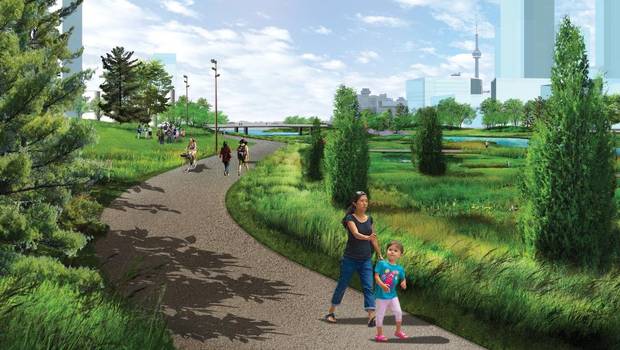
“A 30-Year Staging Plan For Port Lands”
By: Elizabeth Church
The Globe & Mail
Revitalizing Toronto’s Port Lands would take at least three decades and cost as much as $1.9-billion under a new plan aimed at kick-starting development on the massive waterfront site.
The proposal, part of a year-long study by Waterfront Toronto and city staff released on Wednesday, would reduce costs for developing the site by an estimated $130-million, primarily through changes to plans for flood protection and parkland at the mouth of the Don River. At the same time, it identifies additional costs including new bridges, roads, and sewers and bus and light rail lines that increase the total price tag for development and hinge on funding from the public and private sector.
Described as a “more realistic and affordable” option by Waterfront Toronto CEO John Campbell, the plan is broken into five phases that could be rolled out over the coming decades depending on market demand and financing. Once flood protection measures are in place, redevelopment could begin on one or both quays at the western end of the site, on the city’s inner harbour. Work also could take place in the area east of the Don Roadway. The final phases would include naturalizing the mouth of the Don River and developing the land between Cherry Street and the Don Roadway. The plans and cost do not include work on the section of the Port Lands south of the shipping channel or east of Carlaw Avenue.
The study is part of a compromise reached last fall after Councillor Doug Ford and his brother, the mayor, grew frustrated with the pace and cost of redevelopment as laid out by Waterfront Toronto.
Extolling the virtues of the waterfront site just minutes from the city’s core, Mr. Ford pushed to have the city take control of its development, but failed to gain the support of council.
But even under this accelerated scenario, Mr. Campbell cautioned it is likely five years before any construction could begin. “It is not going to happen immediately,” he said after a press briefing on the new plans, which also were presented at a public meeting on Wednesday night.
Responding to public criticism from meetings this spring, Waterfront Toronto brought back the designer of the original plans for the river mouth, the New York landscape architect Michael Van Valkenburgh.
“The planning of a city is not like the design of a building or a park in the sense that it evolves,” Mr. Van Valkenburgh said on Wednesday, explaining changes required to his 2007 designs to accommodate the existing users and the Toronto Port Authority.
The park that once would have jutted into the harbour has been replaced with a “harbour plaza” beside the existing harbour wall. Two new sites for “catalyst uses” were added, one on the south side of the new river mouth and the other near the existing Keating Channel.
These sites would be ideal for “civic venues” such as museums, he said.
New renderings of the site include ships tied to the dock wall during winter and a vessel moored beside the Lafarge cement facility, the plant visible above the foliage of the trees that line the new river mouth.
Asked about the need to change his design to cut costs, Mr. Van Valkenburgh said it is a constant request in today’s economic climate.
“It is just a time we are in,” he said. “Everybody still wants magic, but everybody wants it to cost less.”
The new plan also has several financing options, including land sales, area-specific and city-wide development charges, local improvement charges and new funding sources dedicated to transit, most of which require the approval of city council.
This latest report, along with recommendations from staff, will be presented to Mayor Rob Ford’s executive committee next month and to council in October. After that, provincial environmental approvals are expected to take another nine to 18 months.
A few things here stand out to me.
First, the fact that it’s going to take thirty years to put this development in place.
Second, the fact that they won’t start for five years.
Put those two points together, use your calculator, and conclude that it’s only a twenty-five year development.
That bothers me.
I know this is major development, and I know Rome wasn’t built in a day, but the pace of progress at City Hall is beyond frustratingly-slow; it’s almost non-existent.
Over the last few decades, no other development issue has gained notoriety more than the fact that we don’t have direct access to Pearson Airport. We’re probably the only major city in the world that doesn’t have a subway or tram to the airport, and it took years and years to finally get a plan in place.
Then over the last couple years, City Council have spun their wheels with major transit plans, none of which have come to fruition. We’ve seen plans proposed, approved, cancelled, re-proposed, re-approved, and everything in between. And yet here we sit, at a stalemate, knowing full-well that this will be an election issue in two years when Rob Ford, Karen Stintz, Adam Vaughan, and oh, maybe even John Tory, all run mayoral campaigns with public transit being a major part of each of their platforms. We know that nothing will be accomplished in the next two years, mainly due to political posturing, and it seems as if we’re supposed to eat up the rhetoric that, “It takes time to get things done RIGHT.”
Well I’m tired of waiting for things to be done, and this new Waterfront Toronto proposal, while impressive, comes with more “wait and see.” It’s like when the captain of the airplane you’re idling in says, “It’s going to be about five minutes for the ground crew to get this sorted out,” and you know damn-well that means forty-five minutes in captains-speak. Well in what is being called an “accelerated scenario” by Waterfront Toronto CEO John Campbell, even he admits they won’t have a shovel in the ground for five years. How is that “accelerated?” Would old plans have taken ten years? And if Campbell is saying, “five years,” should we assume that means seven or eight?
The word “progress” is one that should rarely be uttered when speaking about Toronto. We get nothing done.
Our City Council loves in-fighting, and when they DO outsource a project rather than fighting about it themselves, they rarely take the recommendations and run with them, as we’ve seen over and over with Metrolinx, Waterfront Toronto, and the like.
I’m guessing we’ll see another dozen articles this year about “plans” for the Port Lands and other areas of Toronto’s waterfront, but it’s almost like reading fiction.
Oh, and while I’m at it – when is the new St. Lawrence Market (north) going to be finished? Originally, the old market would be torn down by late-2010, and the new market would be built and in use by 2014. Well, we know the first date has been proved to be incorrect, so does anybody want to make a guess about the second?






















WEB
at 10:16 am
I think everyone would agree with your post this morning Dave. But as a harbourfront resident for many years I have seen firsthand the improvements in this neighbourhood. They started with significant boardwalk improvements in 2004-5 and since then they have added various parks (i.e. HtO) and completely redid all of the head of slips. They are now beginning work on the closure of the south lane of Queen’s Quay (with it being made into a bike lane and walking path.) They are also in the process of building Canada Square. They have also made significant progress on the eastern portion of the central waterfront (Corus, the college building and various parks and boardwalk.) Thus in about 10-15 years, the entire central waterfront (from Parliament to Bathurst) would have been completely transformed. Not only will it be completely transformed but it will have all been designed by the best landscape architects in the world. In addition to this the West Donlands would have made significant progress – maybe even completed (with the 2015 Pan Am Games being a major driver). Also, there have already been some improvements to the Port Lands (the sports fields) and there has been significant improvements to the Leslie Street Spit (rebranded Lake Ontario Park.) I think that is a pretty good accomplishment for 10-15 years.
As for the Port Lands, this future neighbourhood is quite large. It is the size of the beaches for instance. You are not going to create this new neighbourhood overnight. It is going to take some time, especially if you want to do it right. Plus there are major environmental issues to deal with. But as an observer of Waterfront Toronto’s progress on the central waterfront and the West Donlands, I would be optimistic about their future work on the Port Lands (both of end product and time to get there.) But one last issue with the Port Lands: it is right smack under the flight path of the Island Airport. If you are in the Port Lands and one of the planes flies over, it is quite loud as the planes fly very low. As the Island Airport continues to expand, you could see a plane fly over the neighbourhood every minute or two. So for myself, I wouldn’t want to live there
DB
at 11:27 am
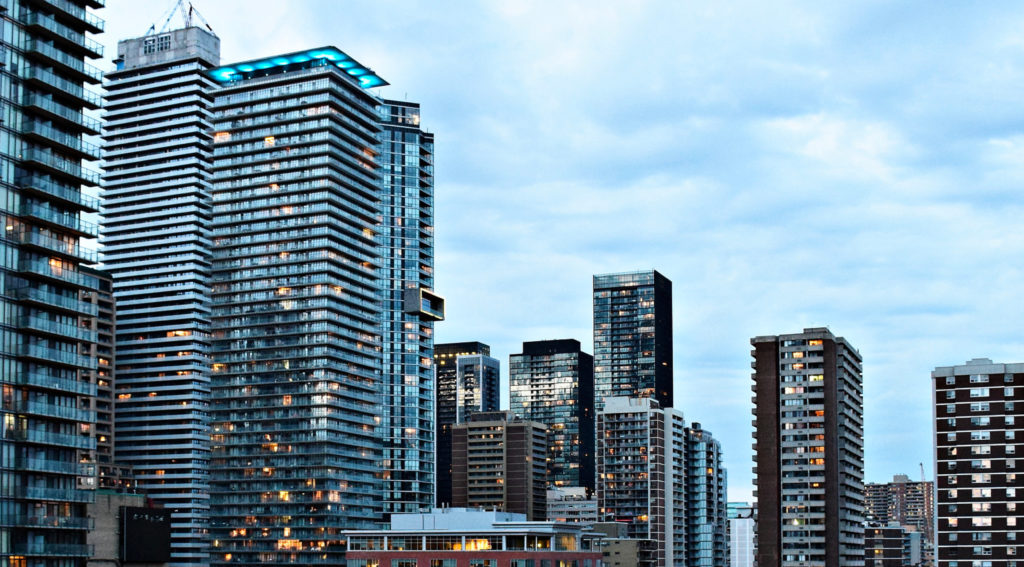
Consider that the size of the area is multiple times the size of CityPlace which has been under development since the year 2000 if you include the initial Front Street buildings. It will be at least another 5 years to complete all the remaining buildings. Given how much people (read: you) complain about that development I am surprised you think that a 30 year timeframe is something that is bad.
ScottRP
at 7:21 pm
The Toronto Way:
Wait, see, wait some more, talk, propose, discuss some more, wait, argue, wait, cancel, argue some more, forget, re-propose, re-discuss, then wait, then see.
30 years is an eternity. But in Toronto, we’re pleased as punch with such a timeline. I’ll be 67 in 30 years. Maybe lawn bowling facilities will included in the design?
Too bad Heel-Dragging and Buck-Passing weren’t events at the London Olympics. We would’ve reached our medal targets for sure.