
In short: the buyer.
And according to a RECO report, “there is no legislation or case law in Ontario to suggest that a seller, or his or her representative, is required to disclose the existence of stigma to buyers.”
A client of mine asked me about a property currently listed for sale where somebody was murdered a decade ago, and while my gut told me, “They have to disclose,” the laws (or lack thereof) suggest otherwise…

When you see a property listed for sale on MLS, what are the obvious steps you might take to find out more about the property?
You’d more than likely look at the neighbourhood, schools, and crime statistics perhaps.
And you might Google the neighbourhood that the property is in, just to see what people are saying about it.
Then again, why not just Google the address itself?
Go to Google, and type in “96 Franklin Avenue.”
The third link down is from a website called www.housecreep.com, and it shows the following:
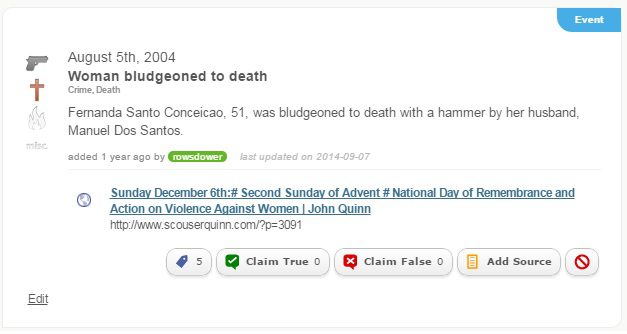
That’s right.
According to www.housecreep.com, somebody was murdered at this address.
HouseCreep is an online community that documents stigmatized houses.
Users can set up an account, and report a “happening” at a house, whether it’s a murder, suicide, shooting, etc.
The users have to provide “proof” (for whatever that is worth on the online world…) via some sort of newspaper headline or other document.
You might ask why somebody would want to start up a website like this, but consider all the crap that’s on the Internet, and you might ask why nobody started a website like this sooner.
So the questions we need to ask ourselves are twofold:
1) If somebody was “bludgeoned to death with a hammer,” does that impact the value of a home?
2) On whom is the onus to determine if the property is stigmatized?
Well the answer to the first question really depends on who you are, what you believe, and how you live your life.
Various religious beliefs might play into this, I’m sure.
And do you believe in ghosts?
Whether you believe there’s a stigma, you’d still be concerned with whether others believe there’s a stigma when you go to sell in ten years. You could say “I don’t care less about the fact that somebody died in this house ten years ago,” but if the buyer down the road cases, then it WILL impact the value.
But I think we could debate #1 all day and get nowhere, since we’re all different people.
The purpose of today’s blog is to focus on #2, and specifically the legal ramifications of selling a stigmatized property.
RECO released a “Registrar’s Bulletin” on this subject last year. HERE is the link.
Keep in mind that the bulletin is written by RECO, for Realtors. So there’s a lot of fluff in there about “the registrant should do this, the registrant should do that,” etc.
What you want to know is: what laws exist in regards to stigmatized properties?
First, let’s see how RECO defines “stigma.”
“In the context of real estate, a “stigma” is a non‐physical, intangible attribute of a property that may
elicit a psychological or emotional response on the part of a potential buyer. There may have been an event or circumstance that occurred in or near the property that does not affect the property’s
appearance or function, but might be considered by some as emotionally disquieting. Unlike a latent
or patent defect, which may exist at a property, there is nothing physically observable or measurable
associated with a stigma.”
I find it funny that the RECO bulletin goes on to provide examples of stigma, one of which is:
- there are reports that the property is haunted
Oooooookay……….sooooo……….RECO believes in haunted houses?
Now let’s get to the meat of this, as to what RECO advises when disclosing stigma:
“It is important for registrants to know that while sellers are required by law to disclose material latent
defects affecting a property that are known to them (an obligation which also exists for the seller’s
representative if the material latent defect is also known by the representative), there is no legislation
or case law in Ontario to suggest that a seller, or his or her representative, is required to disclose the
existence of stigmas to buyers. Registrants representing sellers should advise their clients to seek legal advice if they believe that stigmatizing issues may become a factor in selling the property.”
Great.
Thank you, RECO, for telling us that the law doesn’t require disclosure, but YOU do…
How about a legal opinion?
From one of Toronto’s most prominent real estate lawyers, David Feld, of Feld/Kalia:
There is no legal obligation to disclose (caveat emptor) BUT there are RECO requirements. You need to disclose “pertinent facts relating to the property and transaction”. If the property itself wasn’t used as a meth lab, it’s arguable you don’t need to disclose, BUT I would say that knowing the adjoining property (for example) was a meth lab is pertinent. I’d certainly consider it so and whilst it wouldn’t necessarily put me off the purchase, I for sure would try and use it as a negotiation tool in price.
If you’re not aware of stigma, there’s no obligation to disclose.
Bob Aaron in an article from April 2013 confirmed above also – sellers and realtors have no legal obligation to disclose information about any matters which might stigmatize a property BUT agents are required by RECO, to “discover and verify the pertinent facts relating to the property and the transaction.” RECO interprets its rules to mean that material facts regarding stigmatized properties need to be disclosed so that agents can treat all parties to the transaction “fairly, honestly and with integrity.”
I think a LOT of people reading this would be shocked to know that there is NO LEGAL REQUIREMENT for the seller to disclose a stigma.
So if a cult of twenty people “drank the Kool-Aid” in the family room of a Toronto home, and that home was listed for sale on the open market a week later, then the seller has no legal obligation to disclose what happened.
Enter: RECO. Aka, “The wanna-be real estate police.”
It’s good to know that when all of the legal minds in Ontario get together and write case-law, RECO is there to be the higher power….
The bottom line for RECO, is that if a “murder house” is sold, and the stigma isn’t disclosed, the listing agent likely will end up at RECO, and will likely be fined.
Why?
Because RECO expects Realtors to be cut of the same cloth of God himself.
From the Registrar’s Bulletin:
“All registrants have an obligation to act with fairness, honesty and integrity when dealing with others
in a real estate transaction. Similarly, registrants must use their best efforts to prevent error and
misrepresentation while still promoting and protecting the best interests of their clients. Therefore,
when the registrant representing the seller is asked about the existence of specific stigmas that might affect the property, that registrant may either answer the question and provide the information
without qualification, or in the alternative, refuse to answer the question and suggest the buyer
ascertain the answer for themselves.
The approach to be taken should be based on a detailed discussion with, and instructions from, the seller. Registrants are expected to use reasonable care and skill to ensure the accuracy and completeness of the information conveyed to the buyer and/or his or her representative, and should consider documenting such responses.”
So what RECO is saying, basically is:
“Play nice, and play fair. Be a good person. Be better than the person next to you.”
While there is no legal requirement for a seller to disclose a stigma, RECO believes that the professionalism of a Realtor should supersede the law.
I commend them for trying to better the industry, but it’s a bit confusing.
What if a seller says, “I’m not disclosing that there was a murder in this house, and I’m not hiring you unless you agree not to disclose it”? Then the Realtor has to choose between a paycheque, or an integrity and professionalism that’s defined by a real estate regulatory board, and not law.
And what if you’re not sure?
I sold a house in the Beaches a couple years ago that was built in the late 1800’s. My sellers told me that one day while raking leaves, about twenty years ago, some really old lady walked by and said, “My older sister was born in that house.”
She went on to explain that the house was actually a hospital in the 1890’s, before it was repurposed as a residential property.
People die in hospitals, right?
And back in the 1890’s, medicine was NOT what it is today.
So is it fair to assume that there was “more than likely” a death in the house, 120 years before my sellers put it on the market?
Did we disclose that? Of course not. It’s wild speculation.
But I give you this example so you can see just how grey an area “stigma” becomes.
With sites like www.housecreep.com, and newspaper articles freely found on the Internet, we can determine what’s happened in a home in the last ten years.
The Toronto Star’s Amy Dempsey wrote a great article last year about 934 Ossington Avenue, where a man was murdered, and the listing agent refused to list the property without proper disclosure. That would make RECO happy, even though there was no legal requirement to disclose. See the article HERE.
But the most intriguing part of that article is a quote from real estate appraiser, Barry Lebow, who says:
“A real estate agent shouldn’t have to play real estate detective.”
Lebow believes that that it’s unfair to put the onus on the Realtor, when there’s no legal requirement to disclose, and when the OREA Code of Ethics sets no limits on how far back the stigma-event occurred.
So I guess I should have disclosed that 120 years ago, somebody might have died in that Beaches house?
As I said at the onset, the onus really is on the buyer to do their due diligence on a home, and “caveat emptor” applies.
But Realtors have been fined countless times for either withholding information about a property that could affect its value, or not doing their due diligence to find that stigma, and my guess is that RECO will continue to take this course of action.
In the end, that lets the sellers off the hook.
If the Realtor is the one who is fined in the end, then why would any seller feel the need to disclose?





























Vlad
at 7:40 am
Whom.
David Fleming
at 11:26 am
I can’t believe I missed that….gddammit….
hoob
at 10:49 am
Add to the nebulosity the “stigma” that many insecure people have of houses or rooms where someone died, even of natural causes. To what level do you have to anticipate the peculiar stigmas held be a buyer?
Gwen
at 1:57 pm
Our 1796 house in Niagara Falls was haunted – projectiling items from closets, weird old music playing, knocking on walls and occasionally a woman and her son visible from the attic window from outside. The bright side is that we were able to be featured on a haunted TV show pilot and find out what it was (and make some $). The ghosts left shortly after their 15 minutes of fame.
David Fleming
at 11:27 am
@ Gwen
This made me laugh! Although part of me wonders if you were serious?
I’m waiting for Chroscklh to chime in with his experiences from homeland Russia…
Geoff
at 9:36 pm
I think a big part of the problem is defining ‘stigma’.
IE – would we consider a child dying in our home 1 year ago (natural causes) to be a stigma? What about 3 years ago? 5 years ago? 50 years ago? 150 years ago? Why is 365 days a stigma, but 366 maybe not? I could see why the law wouldn’t touch this with a ten foot pole.
Consider lofts converted from factories. Undoubtedly, there were some immigrant workers who died in these factories, it seems to me a strong likelihood. Does that corrupt the loft building, or affect in a material way?
Joe Q.
at 10:10 am
It ventures into the realm of psychology — “stigma” is a powerful psychological force that seems to be deeply rooted in human evolution (in terms of disease avoidance, enforcing group cohesion, etc.) There is a lot of research on this. But I also see why the law isn’t interested in putting any definitions around it.
Peter Mazzuchin
at 9:34 am
How could a natural death be a stigma? An unnatural death could be a stigma yet it’s highly subjective. When unsure, it’s better for everyone to disclose salient facts. After all, by adhering to RECO’s mandate, Registrants should do their due diligence by asking about potential stigmatisms prior to offer submission. When protecting buyers why not include a stigmatized clause? I do.
Jonathan Greaves
at 2:42 pm
In 2024… has there been any evolution on the topic? We just bought a house that is stigmatised by sharing a side with a halfway house. Seller made sure he did not learn about it (he was a flipper). Selling agent enabled his client to stay blind to any facts. They later sell the house with disclosure statements with no value. Our agent says that looking the locations of halfway houses are beyond the standard of care.
Interestingly, no lawyer is interested in working a case law that picks up where 2011 Dennis v. Gray case left. What is needed is a case law that pushes the extent of latent defects. Any lawyer interested in Ottawa?
Jon Greaves
at 1:54 pm
We are in court to try to do this… Failure to disclose and discover that the house next door was a halfway house. The opposing parties have filed for a summary judgment claiming that a halfway house is not a stigma. We will see how it goes. but long story short. It isn’t until it happens to you that you understand how there is a legal vacuum there in Ontario