
Much ado about housing.
Indeed.
Everywhere I look these days, housing is in the news. And that’s saying something, considering how messed up our world is and how many crazy things are at home, south of the boarder, and abroad.
For weeks, or potentially even months now, I’ve been compiling articles pertaining to Prime Minister Mark Carney’s “housing plan,” whether it’s affordable housing, overall housing targets, proposed legislation, the non-existent Federal budget (sorry, couldn’t resist…), or something else.
The topic almost seems boring to me. Almost.
It’s an important one, but I think many of the readers come to Toronto Realty Blog for an escape. Reading a story about how two real estate agents fought over a house, or how multiple offers were reviewed on an “offer night,” is a lot easier to read and enjoy than something as serious as the perilous future of the Canadian housing market and/or the Canadian economy.
But alas, I knew I’d eventually sharpen my pencil on the topic.
After the last federal election, I told myself that I needed to focus less on politics here on TRB and more on the inner workings of our real estate market. So the idea of digging into a federal housing “plan,” in which I place absolutely zero faith, seemed laborious, defeating, and uninspiring.
But then last week, I read this in a newspaper:
“Government figures show the cost of building the average home in Canada has increased 58 per cent since 2020 and could rise further.”
Hot-diggity!
Now that is a sexy headline!
We knew this, though, right? I mean, we assumed it, or something like it.
But to see this in print and then learn it was revealed via internal government documents is fascinating.
Here’s an article on the matter:
“Internal Government Documents Reveal Grim Housing Climate In Canada”
Toronto Star
September 12, 2025
The article talks a good deal about the high cost of real estate and the effect it’s having on Canadians, the type of properties the country needs as we move forward, and how the tight rental market is putting additional pressure on prices.
But that’s all fluff, in my opinion. It’s nothing we don’t know, nothing we’ve failed to discuss on TRB, and there’s no real “plan” to address it.
What really stood out to me was this:
“Government figures in the briefing binder show the cost of constructing a residential building in Canada has increased 58 per cent since 2020 and could rise even further, thanks to U.S. tariffs.”
We know that inflation has hammered the Canadian economy since the Trudeau government began printing money and offering handouts at every opportunity, and we know that “things cost more” than they did before. We know that the cost to build a home has increased, as has everything else in this country.
But until now, we didn’t have a figure pertaining specifically to the cost of residential housing construction in Canada, and one, more specifically, that we know was sourced by our own federal government.
The average home price in the GTA in 2020 was $929,699.
The average sale price in the GTA so far in 2025, January through August, is $1,080,118.
That’s an increase of 16.2%.
Should we expect the cost of construction to directly correlate with the cost of buying?
No.
But it sure gives us insight into many of the problems that currently exist in our housing market, as well as the challenges that we have moving forward.
So the next logical question becomes: “Why has the cost of housing increased 58% since 2020?”
By asking “Why,” I mean what. What has caused the increase? What components of home building have contributed to the increase?
The cost of labour has increased significantly. Can we do anything about that? Should we? Increased wage growth is the key to a successful economy; however, this comes with a caveat: the increase must come from intrinsic demand and not government influence. In our case, I think it’s a little bit of both. And an indirect factor in all this might be that fewer people are choosing trades associated with residential real estate construction than in previous generations, and I don’t believe that the federal government is looking to attract Canadian newcomers in these fields either.
The cost of materials has most certainly increased. I can’t imagine there’s a single piece of material used in new home construction that hasn’t increased dramatically in price over the last five years, and every associated industry and cost (ie. shipping, transportation, labour) to secure the materials has increased as well.
What about the finishes of the property? The bar has been raised, has it not? Buyers don’t want or expect the baseline electric stove anymore; they want a premium product with a brand name.
How about financing the build? I don’t know if this is included in the 58% increase (if it’s not, then my point is proven even further…), but when the Bank of Canada interest rate went from 0.25% in 2022 to 5.00% in 2024, I would imagine this played a major role in the increase in the cost of new home construction.
When all is said and done, I think we come to the unfortunate realization that this 58% increase in cost is not temporary. This is real. Not only that, but we have to expect that it’s going to get even worse from here.
There’s one more element to this which some of you might be loath to read about again.
As I have written many times on TRB, the amount of taxes included in the price of new homes in this country is daunting.
I would use the word “unsustainable,” but we live in a country where mayors, premiers, and prime ministers routinely borrow from tomorrow to pay for today, while thinking nothing of the interest on public sector debt, let alone the future burden.
December 9th, 2024, I wrote: “The Increasing Tax Burden On New Ontario Homes”
I’ve also posted this link in so many blogs this year that many of you are sick of it.
Over the last decade, we’ve watched the price of new homes in this city soar, and most people have blamed developers.
The uninformed and/or angrier members of society believe it’s “greedy, evil developers” who are making money hand over fist, morning, noon, and night. But as we have come to learn over the past year or so, developers actually operate on very thin margins. So thin, in fact, that construction in this city has come to a screeching halt because development is no longer profitable.
For those who don’t believe this is the case, I have a very simple question:
If developers are in business to make money, and building condominiums makes them money, then how come they aren’t building condominiums?
The reality is: it’s simply too expensive to build condos in 2025. It’s no longer profitable.
Part of the equation is that the price developers need to ask is no longer compatible with the price that buyers will pay.
But the other part of the equation is the increase in cost, and whether it’s taxation, materials, labour, tariffs, or something else, the result remains the same: we’re not seeing anything built.
Getting properties built in this city, province, and country is a problem, and it needs addressing.
Yet all the while, pundits, commentators, and onlookers are talking about what “needs” to be built.
Have a look at this article:
“The Condo Market Is Crashing. Here’s How We Keep Building As Prices Fall”
Toronto Star
September 11, 2025
From the article:
If we want affordability for families, we must create the same oversupply conditions for two-, three- or even four-bedroom homes.
This makes absolutely zero sense.
How can “we” create oversupply for 4-bedroom houses?
The suggestions in the article are great, don’t get me wrong. But after explaining everything that is wrong with how we’ve built new houses and condos over the years, and detailing what’s needed moving forward, the author offers absolutely no suggestion on who is going to build them.
How about “them?”
You know, those guys.
There are two options for who’s going to build:
1) Public sector
2) Private sector
And despite this simple equation, the author doesn’t suggest who, how, or when.
Just that fantasy of “they.”
“They should do this.”
“They should do that.”
I loathe thought pieces like this one because if you’re not going to write from the basis of reality, then why stop at 4-bedroom condos, multiplexes, and units with elevators? Why not suggest we need water fountains with Kool-Aid in them?
Paragraphs like this are where I recognize the author likely isn’t an economist:
Families want space to grow, light and air in their homes, and a neighbourhood scale that feels familiar. With single-stair layouts, units can be designed with windows on multiple sides, bringing in natural light and fresh air. With smarter elevator rules, more small buildings can include lifts, improving accessibility and convenience. Together, these changes would make it possible to build more spacious, affordable homes for families in buildings that fit comfortably into neighbourhoods people already value.
Just more and more of the same.
Talking about what people need, which is another way of saying what they want, and all the while, never addressing who is going to build, and how.
To the author’s credit, there is a mention of taxes:
Beyond high development taxes, the emerging barrier today is technical: the Ontario Building Code. This quiet rule book still blocks the small-lot, multi-bedroom apartments that would let families live in the neighbourhoods they already love. Fixing it doesn’t require another round of municipal battles. It requires the province to act.
I disagree.
The barriers are over-taxation and soaring construction costs, which make the concept of building a house, condo, or multiplex unaffordable in the first place.
Go back to the first article for a moment.
Here’s how that first excerpt continues:
Government figures in the briefing binder show the cost of constructing a residential building in Canada has increased 58 per cent since 2020 and could rise even further, thanks to U.S. tariffs.
The briefing note also acknowledges there has been “a growing mismatch between the housing types being built and those preferred and needed.”
Yan said the briefing notes reveal a focus on supply and market dynamics but omit much analysis on homebuyers and renters.
In major cities such as Vancouver, Yan said, the income differential between renters and homeowners is significant and plays a major role in determining overall housing affordability.
“They talk about housing prices. They talk (housing) starts and resale activity and rental vacancies. But I think what I don’t necessarily see is, who we’re trying to house,” he said.
The documents allude to the financialization of Canadian real estate, citing estimates from the Federal Housing Advocate that 20 to 30 per cent of purpose-built rental units are owned by institutional investors.
But Yan said the binder pays little attention to the role foreign capital has played in market prices, and could play in getting new homes built.
“I look forward to hearing about their solutions but yet their initial diagnosis of the problem seems to be about half the picture,” he said.
“Mismatch.”
That’s a great word to describe the difference between wants and needs, but my cynical side wants to continue the metaphor.
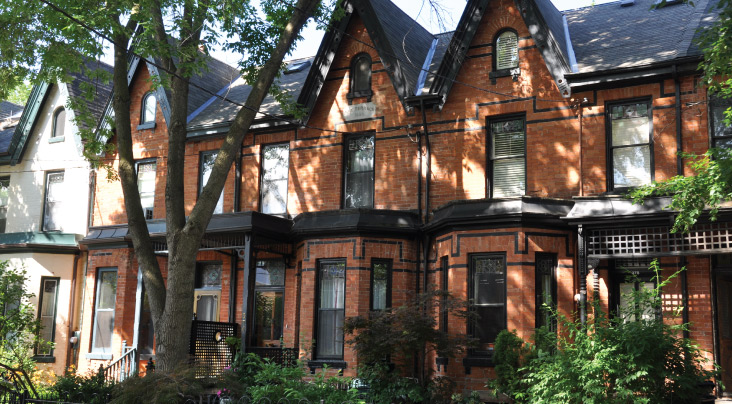
You see, there’s a “mismatch” between the two-bedroom rowhouse that Becky and Todd can afford and the red-brick Georgian mansion that they want.
Look, I get what people are saying.
For a decade, developers continued to shrink the size of condos as well as the proportion of smaller units to larger units. But it’s not like we didn’t notice, right? We watched this! We called it in advance!
I’m the last person who’s going to propose more government intervention in the free market, but nobody was ever in charge of putting forth a “vision” for the City of Toronto as it went through the largest growth spurt in its existence. Developers were allowed to do whatever they wanted, so long as the City of Toronto continued to bring in revenue through development charges, land transfer tax, and additional property taxes.
Now we have a problem with small condos?
Now we assess the “needs” of the market and conclude that there aren’t enough new(er) housing units suitable for families or individuals that need/want/require a larger space?
Of course, we do. We have the benefit of hindsight.
And as our government moves forward with a master plan to get housing built in this country, I wonder how they’re going to do that.
This “internal covernment document” seemed to catch Ottawa off guard, and I wonder how it’s going to affect the Build Canada Homes initiaitive once it’s underway, assuming it gets underway, of course.
There are a lot of competing priorities here, in case that hasn’t been made obvious. But I’d like to throw one more wrench into the equation.
Check this out:
“Budget Watchdog Sees ‘Considerable Concern’ Over Government’s Lack Of Fiscal Anchors”
CBC News
September 16th, 2025
From the article:
Speaking to the government operations and estimates committee on Tuesday, Jacques was asked by Conservative MP Kelly Block whether the government is currently on track to meet its “fiscal anchors.”
“I don’t know if the government currently has fiscal anchors, which of course causes the people we work with considerable concern,” said Jacques.
Former finance minister Chrystia Freeland established a suite of fiscal anchors in response to pressure from the Bank of Canada to avoid fuelling inflation with too much spending.
Jacques said the 2025 budget, when it is tabled, will give a sense of the Carney government’s financial guardrails.
He said that traditionally “all is revealed” in that several-hundred-page budget document, but the government is not yet at that stage.
“And at that point, we will have a clear sense of what precisely the fiscal anchors are,” he said.
We are getting a budget from the government. Eventually…
The last up-to-date look at the federal deficit dates back to December of 2024, when it was revealed to be $61.9 Billion.
So let me get this straight:
-Construction costs are up 58% since 2020.
-The federal government is going into the business of building homes.
-The Bank of Canada is calling for fiscal restraint, but the federal deficit is at an all-time high, and there are no “fiscal anchors” in the budget that is about to be presented.
Something doesn’t add up here, folks.
Any ideas on how this gets accomplished?
I’m all ears on this Monday morning…






















Appraiser
at 7:51 am
Interesting analysis regarding construction costs especially in light of recent data indicating that the price of land has decreased significantly over the past 4 years.
According to Ben Myers at Bullpen Consulting:
“The price per buildable square foot was $92 in the City of Toronto, down 14 per cent year over year and 37 per cent from the 2021 peak of $146. The suburbs averaged just $37, a 29 per cent drop year over year and a 38 per cent correction from the peak.”
“A volatile capital market, almost non-existent pre-construction condominium sales, restrictive lending conditions and weakened confidence in development feasibility are all contributing factors to the decline”
https://renx.ca/high-density-land-values-drop-dramatically-in-greater-toronto-area#:~:text=Residential%20Land%20Prices%20Toronto%20/%20GTA,more%20than%20high%2Drise%20land
Oscar Lutgardis
at 12:08 pm
Lmao Benny Myers of fortress??? This fortress??
https://www.cbc.ca/news/canada/toronto/fortress-real-developments-trial-1.7545051
🫵🤣
Keen Observer
at 12:58 pm
..somebody is still a fanboy of the Oracle of Owen Sound
Serge
at 8:18 am
That is great David you are doing this analysis for us.
But I am afraid you started from the wrong end. You took as given that the housing problem exists, and decided the solution is cost of houses, without analyzing what this problem is. In reality there are three problems: 1) affordability of property; 2) affordability of renting; 3) availability of social housing.
You might have started from the data, how many people are renting (let’s presume renters, not owners), and have some means to buy “something”, and desperatly want to buy. Let’s isolate this segment of population, and then decide how the problem could be solved. And if it could be solved. And if lowering taxes could solve it.
I have never seen those numbers. Nobody quotes them. I personally think it is minuscule. So I think it is a red herring.
JL
at 9:16 am
“Now we have a problem with small condos?”
To be fair, I think a lot of people have been complaining about this for a long time, including many here on this forum. The response was always something along the lines of “the free market is just satisfying investor demand and responding to market forces, so leave it be”. There were a bunch of ill conceived attempts at solving it too (remember the x% of units need to have y number of bedrooms City of Toronto directive, that just shrunk each bedroom to closet space?). All that to say, I doubt this is surprising anyone now; a lot of people for years were watching it heading towards the cliff and didn’t or couldn’t do much about it.
“Increased wage growth is the key to a successful economy; however, this comes with a caveat: the increase must come from intrinsic demand and not government influence.”
This is the key, IMO, and has been all along. Once we detached pricing from incomes, we removed a guardrail that kept the price equilibrium in check. The rising demand increased prices, which inflated input costs faster than the economy was growing. Now take away the various demand side inducements (and foreign factors) that helped fuel those price increases, and you’re left with a supply cost above what the local market is capable of supporting naturally.
Derek
at 11:32 am
David, your “link” to the Toronto Star article take us to your listing @ 8 Rutherglen. I see what you did there 🙂
Vancouver Keith
at 8:19 pm
A couple of thoughts. One, is the 58% figure nominal or real costs? Second, your statement that developers operate on razor thin margins is simply false. Ask anyone who finances condo construction, and if the pro forma has less than an 18% profit margin, it doesnt get financed. When you pre sell 70% of the units with an 18% plus net profit, that is why so few developments in Canada go broke, and its big news when they do. Vancouver has a lot of billionaires for a city of 675,000 with no manufacturing or processing type industry to speak of, and most of them are property developers.
Ace Goodheart
at 8:25 am
The Federal Build Canada homes initiative aims to build 4000 pre fab homes, on land the government already owns, for the low price of just 13 billion dollars. All of this will of course be borrowed money subject to interest payments.
That is $3,250,000 per house.
They already own the land. So that is just cost of construction and I guess paying for the bureaucracy?
David Fleming
at 9:24 am
@ Ace Goodheart
Part of the reason I’m not writing about Build Canada is because it sickens me.
People wanted this. People voted for this.
Margaret Thatcher said: “The problem with socialism is that you eventually run out of other people’s money.”
Canada isn’t going to run out of money though. They’re going to keep borrowing from our dystopian future…
Ace Goodheart
at 11:08 am
It’s an unreal amount of money for a house built on land you already own.
And the sad thing about it is, we know that government contracts always come in over budget. So the actual cost per house will likely be much higher.
David Fleming
at 11:34 am
I have this saying, which I would like to make less crude, but I’m not sure how…
“When the government gobbles up a dollar of tax revenue, it excretes sixty cents.”
Our current government is set up to be inefficient and costly.
Ten years from now, we’ll look back at “Build Canada” as an absolute disaster. Add it to the list with the other failed programs like the shared mortgage plan and the home energy loan nonsense.
And ten years from now, with home prices even more expensive, people will wonder, “How did we get here?”
Look outside your window…
Crofty
at 7:54 pm
Margaret Thatcher also said, “There’s no such thing as society. There are individual men and women and there are families.” Do you agree with her there?
David Fleming
at 10:33 am
@ Crofty
Very existential.
I don’t think I’ve ever been more confused as to what “society” is these days.
I wish I could move back to the 1980’s. 🙂
Ace Goodheart
at 11:41 am
Maggie said a lot of weird stuff. But her comments on socialism were spot on. They do eventually run out of other people’s money.
Ronald Reagan, who also said a lot of weird stuff, also said some things that make sense, including the following:
“When it moves, they tax it. When it stops moving, they regulate it. When it dies, they subsidize it”.
I think we are at the subsidize phase with housing.
Serge
at 8:24 am
En pendant to the Gov taking other people’s money. The Gov ordered the banks to freeze the mortgage payments and saved small RE “investors” from mortgage cliff. They saved small businesses at cost of big businesses. Poor banks! Now, the condo completion cliff is coming. Is not it clear that the Gov will again save RE investors, and the developers will have to write off the loss from their (reported) 18% margin? Poor developers!