

Choosing the “best” blog posts of the year is an awkward exercise, right?
Who am I to do the choosing, right?
It’s sort of like somebody taking thirty photos of you, and then saying, “Pick the best one.”
You’d be highly biased, highly influenced, and you might see things that aren’t there, while ignoring things that are.
I shared ninety-five blog posts with the TRB readers in 2025, not including the two year-end posts that you’ll read today and on Monday. Choosing the “best” posts is incredibly subjective and also risks adding an element of bravado.
After all, who are we to critique, comment on, or celebrate our own work?
At the end of each year, when I look back at everything that I’ve written, there are posts that will stand out to me, but often for different reasons.
Some received more comments from the readers than others.
Some ended up being controversial or divisive.
Some proved timely.
Some feel as though they’ll age extremely well and come off as forward-thinking at some point down the line.
Some were fun, entertaining, and memorable.
And some just make me think, “Oh yeah, I really liked that one!”
This year’s collection of “best blogs” could probably pick one from each of the above, but no matter how you slice it, let’s just say that these are my “favourite blogs” of 2025 for a variety of different reasons.
Now, an advanced warning:
This blog post, as well as Monday’s will be very, very long!
But how can you sum up an entire year in less than five thousand words, right? 🙂
Hope you enjoy!
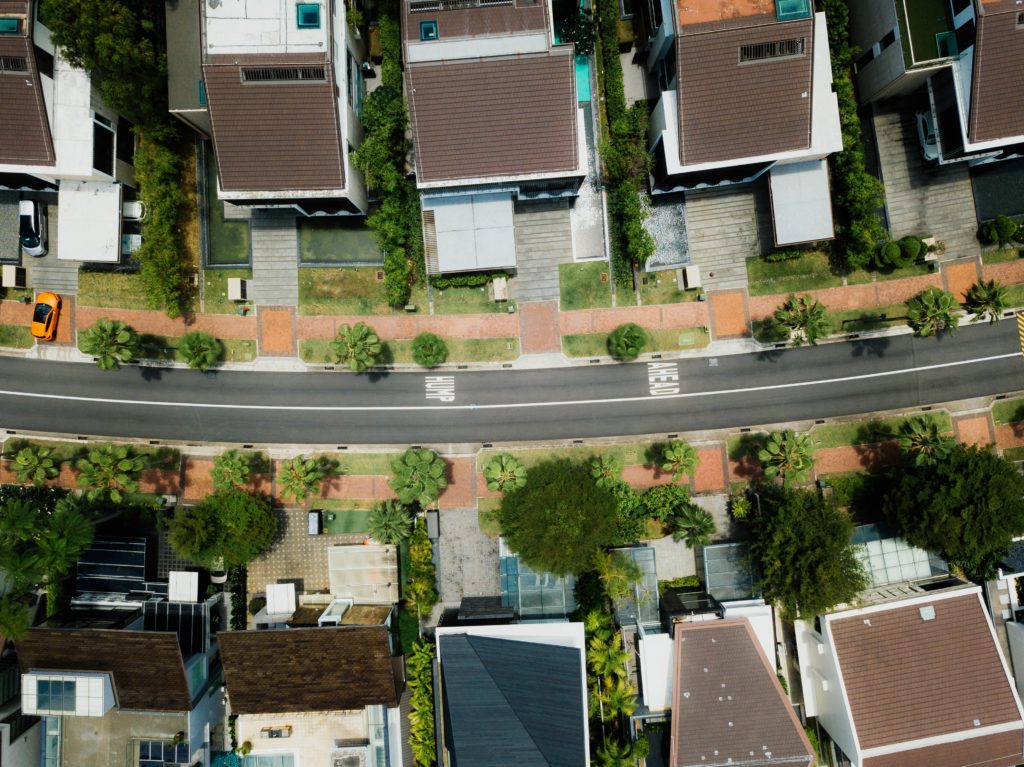
5) Why Infill Home Builders Always Make The Same Mistakes
Really?
This post? Worthy of a “top post of the year” label? Surely, you jest!
At first glance, this might not seem like one of the best posts of the year. It’s not controversial. It’s not aligned with “hot button issues” of the day. It’s surely not all that memorable a post either.
But what this post is, is accurate.
And because there are so many infill houses being offered across the city right now, this post is a blueprint for would-be home buyers on how to analyze, predict, and understand builder pricing.
Of course, this is also a blueprint for builders in terms of “what not to do.” It’s one of those blog posts that could have been titled, “How Not To Sell,” and targeted towards the very builders that are doing the development and selling.
But builders aren’t going to listen, and that’s exactly why we’re able to write this post in the first place.
Here’s a link to the post:
July 17th, 2025: Why Infill Home Builders Always Make The Same Mistakes
I couldn’t believe I had never written this before.
I’d thought things before.
I’d opined these things before.
But I’d never actually sat down to write a dedicated blog post to the madness that is “builder pricing and strategy” in the city of Toronto. And there’s no “strategy” in what they do, unless the strategy is to repeat the same mistakes, over and over.
Just think about it for a moment. Picture “that builder house” in your neighbourhood.
Now, let me spoil the contents of the blog post for those of you who don’t have time to read it…
Builders do not typically build for users within that specific neighbourhood.
Builders often include features that are valued by other buyers, in other markets, but not this market, ie. pools, basement apartments, or particular design elements.
Builders overvalue items of less importance and undervalue items of greater importance.
Builders typically overvalue the home, list high, and reduce the price over time.
Builders don’t understand that buyers assign a stigma to a house that isn’t selling, and don’t like being “that person” who buys a house on its 4th listing after 11 months.
Builders don’t understand the need for a “story” or some element of character or warmth.
Builders typically hire out-of-area agents and don’t realize this lowers the brand value in the eyes of the buyers.
Builders use very distinct, often ornate finishes that can clash with prevailing styles and trends within a specific neighbourhood.
Builder houses typically sell via the 2nd or 3rd listing agent.
Now, here’s the crazy thing, folks!
When I met “Builder Bob,” or whatever I named him in the blog post, I actually sat down in the conference room at Bosley Real Estate and presented these points to him, one by one, in a PowerPoint presentation.
Not only that, I showed him examples for every single point.
My team and I politely passed on the opportunity to list the property for sale, as I explained in the blog.
And guess what happened after that?
He repeated every single one of these mistakes when he listed.
The property is still for sale, by the way. But that was never in doubt.
The reason that I consider this post to be one of my “favourites” of the year is that I feel as though so many people can relate to this.
If you’ve been a buyer at some point in the last decade, you’ve come across these houses.
If you’ve been a seller, you’ve competed against these houses.
And even if you haven’t been a market participant over the last little while, you’ve most definitely seen examples of this in your neighbourhood, and you’ve always wondered why.
Why do builders do this?
Why do they always do this, and why don’t they learn from builders who have attempted to sell previously?
That’s the one question I simply can’t answer, except to say that it’s simply in their nature.
Kind of like the fable about the scorpion and the frog, as I wrote in the post.
Seriously, though – you should read it. Like, in eighty-six minutes when you’re done reading today’s opus…
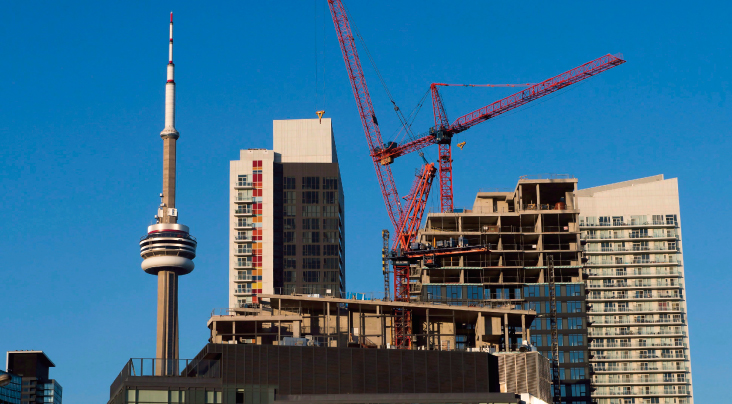
4) “Developers Suing Pre-Construction Buyers: Who Is To Blame?”
About one hour ago, I spoke to a reporter from BBC News about the state of the Toronto condominium market.
It seems as though discussions about our market have now reached overseas.
We spoke for forty-eight minutes. I planned the call for when I was driving…
A lot of subject matter was covered during that time, but one of the points I made that now rings true is the following:
Many people are to “blame” for what happened in our pre-construction condominium market; developers, lenders and banks, mortgage brokers, city planners, Toronto City Council, real estate agents, and real estate lawyers, just to name a few.
Years from now, books will be written about the pre-construction condominium collapse. Maybe we’ll even see a movie about a book, like we saw with “The Big Short.”
But for now, we’re still finding our way through the mess, and before any mess is cleaned up, there’s usually talk about who to blame.
Earlier this year, we learned that condominium developers were suing buyers who refused to close on their pre-construction condos, and I wrote about it on TRB.
Here’s a link to the post:
April 3rd, 2025: Developers Suing Pre-Construction Buyers: Who Is To Blame?
Earlier this year, two enterprising Toronto Star reporters dove headfirst into the savage world of developers suing buyers, and wrote an article detailing some 130 such lawsuits at that time. They even found some of these buyers to go on the record, and that was the part that I found absolutely wild!
In my blog post, I asked the following:
Who is to blame:
1) Evil, heartless, money-grubbing condominium developers with no soul, empathy, or ability to reason.
2) Naive, stupid, arrogant, entitled, uneducated, wishful, irresponsible buyers with no critical thinking skills.
Both options are obviously hyperbolic and exaggerated, but that further drives home the point.
This is how most people see this debate.
As with everything else in the world today, there is simply no middle ground.
While many people want to blame developers for their actions, which seem anywhere from “unfair” to “cruel,” the content of the article shines a spotlight on how naive most buyers were.
In my blog post, I went through all the quotes in the Toronto Star article from the buyers who were interviewed, and highlighted just how absurd their thinking was.
For example, one quote said:
“…knowing he could never qualify for the mortgage on the unit.”
As I detailed in the blog, I have no sympathy for a person who knew that he or she wouldn’t qualify for a mortgage on a condo once it was completed in 4-5 years, but who purchased it anyway, with the plan to “flip the paper.”
Another example:
“People don’t lose money in real estate, they’re not supposed to.”
This is what the book and/or movie will be about.
And while you can blame developers for creating this system, blame real estate agents for selling the units to buyers, blame city officials for turning a blind eye to the practice so they could rake in billions of tax revenue, or blame an entire cast of other characters, surely it’s the buyers who have to shoulder the majority of the blame, right?
Over the last fifteen years, I’ve written so many blogs on pre-construction condominiums and offered so many crazy stories, experiences, or quotes/comments, but this blog post from April might have shone the largest spotlight on just how unsophisticated most pre-construction buyers are.
In the blog post, I pulled sixteen quotes from the Toronto Star article and analyzed them individually.
With each additional quote, it should be very clear that most participants in the pre-construction condo “game” over the last twenty years have had absolutely no clue what they were doing.
Many of them made money, but what’s the difference between the person who bought in 2008 versus the person who bought in 2022? Other than timing and profit, can we really conclude that these folks are any different?
The scary part about this blog post and the contents therein is this: we’ve only seen the beginning of litigation in this market segment.
2026 is going to be a wild ride, and we’ll read more stories like this one…
3) “Where Have All The Sockless Realtors Gone?”
What do you think of when you hear the word “Realtor?”
Wait. Undo.
Undo. Undo. Undo.
Damn.
It’s too late, I already put it out there, and God only knows what you’re thinking…
Alright, so you’re probably not picturing a stock image of a real estate agent that you’d expect to find online, perhaps of a person shaking hands with two happy home-owners in front of their new house. I was in the TRREB Store the other day, and I saw these hats with the “R” logo for “Realtor,” as well as polo shirts with the Realtor logo, and I thought, “Oh, that’s how organized real estate wants us to look…”
Sure. Carrying a clipboard full of important “notes.” Perhaps a leather carry-all with business cards of our recommended lawyer, home inspector, and mortgage broker inside? Maybe the leather carry-all also doubles as a day planner?
How profesh!
How I picture a real estate agent and how you picture a real estate agent are probably very, very different, and how organized real estate pictures their version of this “professional” is likely symoblic at best and wilfully naive at worst, but I digress…
Earlier this year, I was chatting with a colleague who has been in the business around the same amount of time as I have; two decades, give or take. We were talking about the current market conditions, how real estate agents are behaving within it, as well as how the market used to function three years ago, and he asked me this question:
“Where have all the sockless Realtors gone?”
I didn’t know it at the time, but he had just coined a term that I think is one of the most memorable real estate buzz-words of 2025.
He was being condescending, in case it’s not obvious.
Yes, there is a style among men whereby they wear loafers with no socks, and yes, this is trendy, fashionable, and at times, very classy.
But his point was more about the type of real estate agent that was getting into the business between 2018 and 2022, and his off-the-cuff mention of “Sockless Realtors” absolutely nailed it.
A few days later, I did a podcast on Last Honest Realtor, called “The Market Flip ‘Nobody’ Saw Coming: Where Did All The Sockless Realtors Go?”
I had so much fun with this that I decided to include it on Toronto Realty Blog.
Here’s a link to the post:
April 24th, 2025: Where Have All The Sockless Realtors Gone?
As odd as it might seem for one of my “top posts of 2025” to simply be an embedded video of my podcast, trust me when I say that this was also my favorite podcast of the year, and for good reason.
Just picture what I’m describing, and you’ll see.
There’s a young man.
He’s wearing loafers with no socks.
His pants are what we would have called a “flood” in the 80’s, but he makes it cool. And they have a cuff.
He’s wearing a knitted short-sleeve shirt.
He has some sort of designer belt. Hermes. Gucci. Louis Vuitton. Whatever is the most expensive, or seems the most expensive.
There’s a v-neck that’s more than “plunging.” If it went down any further, it would hit his belly button.
He’s wearing a Rolex, or at least a watch that says “Rolex.” It’s either fake, which is pathetic, or it’s real, which is more pathetic, since there’s no way he can afford this.
He’s only in his mid-20’s but he’s had “work done.”
Not a single hair on his head is out of place.
He’s got one of those “Charlie Salinger beards,” which fans of Party of Five will understand, while the rest of you have no clue what I’m talking about, but that’s okay.
It’s possible he’s got veneers.
His Facebook and Instagram have hundreds of photos of him, and you’d have to search to find a picture of anybody or anything else.
There are multiple photos of him posing in front of a luxury car.
A typical Instagram story for him would be a photo of a bank draft for $100,000 with a caption that reads, “Another lucky client has bought a home,” only the photo isn’t really of the bank draft, but rather it’s of the Richard Mille watch he’s showing with the hand that’s holding the bak draft, and the Mercedes logo on the steering wheel of the car that the bank draft is sitting on.
You know what I’m talking about, right?
Look, I realize that the public has a low opinion of the average real estate agent, and for good reason. That’s totally far. In fact, I spend so much of my time here on Toronto Realty Blog telling stories about bad actors in the industry that I receive complaints on a regular basis! But there are professionals in this profession, and some of the most brilliant and hardest-working people I’ve ever met are folks that I call colleagues.
But then there’s the rest.
And nowhere is this worse personified than with respect to the slew of new entrants to the industry between 2018 and 2022, most of whom are no longer in the business, or at best, are running on fumes.
These incompetent, uneducated, ass-clowns who came into the business in their early-20’s, with no real-world training or knowledge, and ran around the city going to “launch parties” with developers, branding themselves “Certified Platinum VIP Brokers,” selling pre-construction condos to impressionable buyers who relied on their agent as a professional, but eventually found them to be anything but.
It reminds me of “The Big Short.” All these mortgage brokers providing “NINJA loans,” when only six months earlier, they were bartending at nightclubs.
Real estate was not immune to the moths attracted to flames. In fact, our light burned so bright that they came in droves, never seen before.
Sockless Realtors.
You’ve all seen at least one of them…
2) “Top Ten People You Shouldn’t Take Real Estate Advice From”
Should I be bothered by the fact that my title isn’t grammatically correct?
It should read, “Top Ten People From Whom You Shouldn’t Take Real Estate Advice.”
Geez. Did I even go to school?
In a completely unrelated story, when I pen the blog post, “Top Ten People From Whom You Shouldn’t Learn Grammar,” I’m going to put myself in the post.
Then again, I did put myself in the real estate advice post.
Here’s a link to the blog post:
February 27th, 2025: Top Ten: People You Shouldn’t Take Real Estate Advice From
You see?
The very first person that you should not take real estate advice from is “some random guy with a blog,” and while you might think that I did this simply to gain trust with the people reading, the truth of it is, every participant in the real estate market in 2025 should be wary of advice, opinion, and expertise, no matter where they find it.
You’ve probably heard me say this before: “The two things in Toronto that people talk about the most are the Toronto Maple Leafs and the real estate market.”
Well, maybe that’s changed a little bit, since the Leafs have fallen on hard times, and since conversations have veered toward negative topics in recent months and years (crime, traffic, garbage, encampments, taxes, leadership, etc), but you get the point.
Real estate is, has been, and always will be one of Toronto’s favourite topics of discussion, so much so, in fact, that another line you’ve probably heard from me before is:
“Real estate in Toronto is a sport.”
It’s competitive. There are winners and losers. It’s a “game.” And, evidenced by the fact that you’re simply here reading about real estate on TRB, we know that it’s entertainment for many folks as well.
Everybody has an opinion on real estate.
Absolutely, positively, everybody.
And that’s why, last February, I sat down to pen a somewhat sarcastic blog post about all the people who want to give you advice, but who perhaps you shouldn’t listen to.
It was supposed to be fun!
Funny, entertaining, and relatable!
A couple of the folks in the comments section didn’t quite get the memo, however, but that’s okay. I think it goes without saying that real estate agents, mortgage brokers, home inspectors, real estate lawyers, and anybody else associated with the real estate industry could fall into the list. I thought I made that clear when I included myself as the first option on the list itself, which I’ll detail for you here as follows:
10) Some random guy’s blog.
9) BlogTO
8) Any real estate agent saying anything on Tik Tok.
7) Your co-worker who lives outside the city and commutes.
6) Your best friend who lives “the simple life.”
5) Your boss.
4) Anybody who uses the term, “You know what you should do?”
3) Your in-laws.
2) Your financial planner.
1) Your parents.
Don’t let this list deter you from reading the post itself!
Some of these require an explanation, and some require real-life examples, which I have provided in kind!
Over the course of the year, this was one of the blog posts that was brought up the most by my clients or buyers and sellers that I was meeting for the very first time.
My goal was to make this relatable, and I think that anybody who has transacted in real estate has felt the “impact” of some or many of the people on the above list. Even those who haven’t transacted in real estate, but who have talked about it, have experienced the unwanted opinions that get attached to all things real estate in Toronto.
I got such great feedback on this post that I decided to include it in our annual INSIGHTS print magazine that’s sent to our client list every fall. I only include one blog post in the magazine every year, and I felt this one was playful and insightful enough to be included.
I wonder if this list will change as we move into 2026 and beyond?
A colleague of mine just said, “In a year, maybe less, you’ll want to update that list to include ChatGPT.”
Now that is a scary thought…
1) “The House Of Cards That Was Always Going To Fold”
I just looked at the title of this post, and thought, “What’s the best way to describe my mindset when I wrote that post?”
I live so much of my life through movie quotes, the more obscure, the better.
But the movie quote that best describes how I felt when I wrote this post is far from obscure. In fact, I think it’s one of the most famous quotes of all time:
“Just when I thought I was out, they pull me back in…”
Yes, I assumed that we were done talking about the pre-construction condominium industry, since I’ve been ranting and raving about it since I started Toronto Realty Blog in 2007.
But after the epic collapse in 2024-2025, it seemed as though suddenly I was drawn right back into the fray.
Here’s a link to the blog post:
September 15th, 2025: The House Of Cards That Was Always Going To Fold
The long time TRB readers know that, so many times over the years, I’ve written some form of blog post about pre-construction, saying, “This is the last time I want to talk about this.” It’s been a major thorn in my side since my very first interaction with the way pre-construction condominiums are sold, dating back almost twenty years. I’ve spent a considerable amount of my career warning people about the perils of this market segment, but as the masses continued to flock to these “investments,” I realized that many people are just going to see what they want to see.
Eventually, I stopped writing about it.
You can’t convince a fool not to search for fool’s gold.
But then, when it came time to publish our fifth annual INSIGHTS Magazine in September, I realized that the thousand people on our team mailing list might not be as familiar with the pre-construction condominium collapse as the TRB reader, and thus I penned a lengthy six-page article:
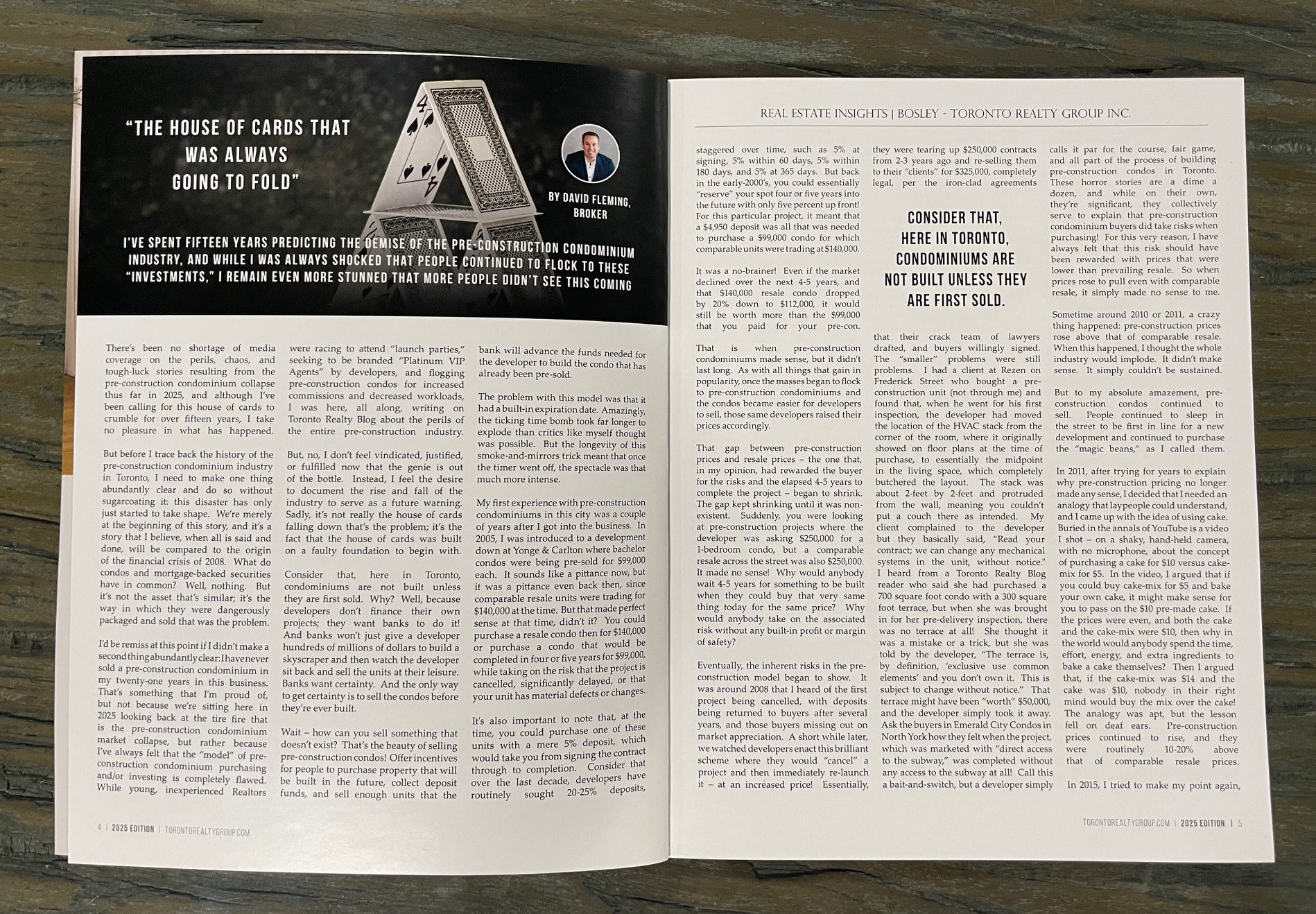
Of course, it seemed only fitting that I share the article on Toronto Realty Blog, which I did in September, right after the fall market began.
As has been pointed out to me by many people, there was a time when everybody who bought or invested in pre-construction condos made money. That is not lost on me, nor was it ever lost on me.
The point that I made, all along, was essentially threefold:
1) There was more money to be made in resale condos.
2) The risks associated with pre-construction condos were severely underestimated by a naive buyer pool.
3) Eventually, this was a house of cards that was going to collapse.
I’ve heard the “Platinum VVVIP Agents” talk about how buying a pre-construction condo is some sort of financial instrument, with structured payments, and how it’s a different and better investment vehicle than resale condos. But these Sockless Realtors were just quoting talking points.
My case has always been simple:
It makes absolutely no sense to pay a premium for a product that doesn’t exist, won’t be ready for 4-5 years, could be cancelled or delayed, is completely illiquid if the developer wants it to be, and has an unknown occupancy period that could last up to two years.
A premium. It was madness.
When resale condos were $250,000 and comparable pre-construction condos were $200,000, that made sense. The buyer was being rewarded for taking on the risks associated with the project, not to mention waiting 4-5 years to take possession.
But by the time we hit peak madness, and a resale condo worth $600,000 was next door to a parking lot where developers were selling comparable pre-construction condos for $900,000, it was only a matter of time before the two-of-hearts fell down and took the Queen, King, and Ace along with it…
In the blog post, which came from the magazine, I put together the most complete summary of the history of the pre-construction condominium market that I had ever penned before.
I started by discussing a pre-construction investment at Yonge & Carlton in 2005, and ended by discussing the state of the market in 2025, with lost deposits, mass defaults upon closing, developers suing buyers, and the lowest new-home sales figures since 1990.
In between, I told a slew of stories that provided colour commentary on what’s transpired over the course of two decades in this industry, as well as referring back to some of my attempts to educate the buyer pool over the years.
For example, this video from 2010, where I tried to shed light on the madness of pre-construction condominium pricing, by suggesting that you would never pay more for a cake mix than an actual cake itself:
The production quality of that video speaks to the era in which it was filmed!
But looking back at this, fifteen years later, we can see that this served as an early warning sign. This was around the time that pre-construction prices had pulled even with resale, and the writing was on the wall: pre-construction prices were going to surpass resale prices shortly.
It was madness.
I referenced another video in the blog post – this one from 2015, using pre-construction jeans as yet another analogy:
That was ten years ago.
Better production. Better analogy.
But what’s not included in a sarcastic video is a list of all the risks involved with every purchase of a pre-construction condominium, many of which the buyers aren’t aware of.
In the blog post, I covered:
-deposit structures
-hidden upgrade charges
-“launch parties” and marketing gimmicks
-project cancellations
-project delays
-material changes to the unit
-alterations to floor plans
-free rein to alter or remove building features/amenities
-assignment fees and prohibitions
-occupancy periods
-hidden closing costs
-permission to rent, advertise, or assign
-illiquidity of investment
-absurd pricing structure
-iron-clad purchase agreements
-developer scandals
Looking at this list, surely there’s some cause for concern, right?
And yet for ten, fifteen, or twenty years, buyers threw all caution to the wind and jumped in head-first.
Some got burned, many made money, but when the market fell off in 2022, it was only a matter of time before all hell broke loose.
That is where we sit today.
With buyers paying $1,700 per square foot for condos in 2021 and 2022, when comparable resale condos were selling for $1,100 per square foot, you don’t need to be a mathematician to understand how everybody taking possession of a new condo these days is well underwater.
The other side of this story is that pre-construction condo sales are virtually non-existent.
According to Urbanation, only 319 total units were sold in the GTHA in all of Q3, 2025.
Developers used to sell 319 units in a weekend.
Condo cancellations are also at an all-time high, with 18 total projects and 4,040 cancelled through the first nine months of 2025.
With nothing being sold, it means nothing is being built. And with nothing being built plus pre-sold projects being cancelled, aren’t we in store for a massive deficit in condos in 2030 and 2031?
Food for thought…
Well, folks, if you’ve made it this far, then you clearly don’t share my attention span, or lack thereof! 🙂
These are the five blog posts that I’m most passionate about, looking back at the year that was, and I hope you enjoyed the recaps as well as the posts themselves.
If there’s another post that stands out to you, I’d love to hear about it.
See you back here on Monday for our next feature: “Top Ten: Real Estate Stories Of 2025.”
Have a great weekend, everybody!























Pragmatic Jane
at 8:08 pm
Is it that time of the year already? Time flies.