

“We did this to ourselves.”
Here’s a combination of honesty and accuracy that I believe will age well as this city moves forward.
Earlier this week, I was standing on the terrace of a beautiful condo at 80 Front Street East, aka “Market Square,” that is a relic as far as the Toronto condo market is concerned.
Built in 1983, this building is nine storeys and contains 187 units, with some of the best amenities you’ll find in an older condo.
This building dates back to a time when people expected to have both an indoor pool and an outdoor pool, as well as a squash court and one for playing raquetball.
Today, the building is home to a “community” in every sense of the word. This is not a building that’s full of Gen-Z renters and AirBnb’s. In fact, I would be surprised to hear that even one of those exists.
The demographic is older, wiser, and more connected than all but a few buildings in the downtown core. The residents know each other. The concierge knows every resident by name – and their friends and family as well. There are daily coffee groups, social activities, and art classes.
The units are large, and many have three true bedrooms – something that’s impossible to find in new condominiums downtown.
The condo I visited this week was 1,858 square feet, fully renovated with tasteful finishes, and priced at a modest $1,650,000.
And as I stood on the south-facing, 350 square foot terrace, gazing out at the waterfront, I couldn’t help but utter those words:
“We did this to ourselves.”
I have no idea which buildings I was looking at, by the way.
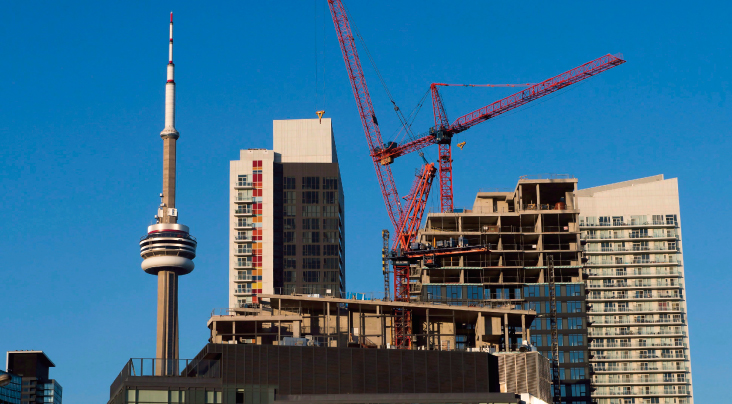
I’m in real estate. I sell condos. I work downtown. But I don’t mind being honest and saying that whichever two towers I was looking at to the south, I honestly couldn’t tell you what they were called, who built them, or what the address was.
I’m just not interested.
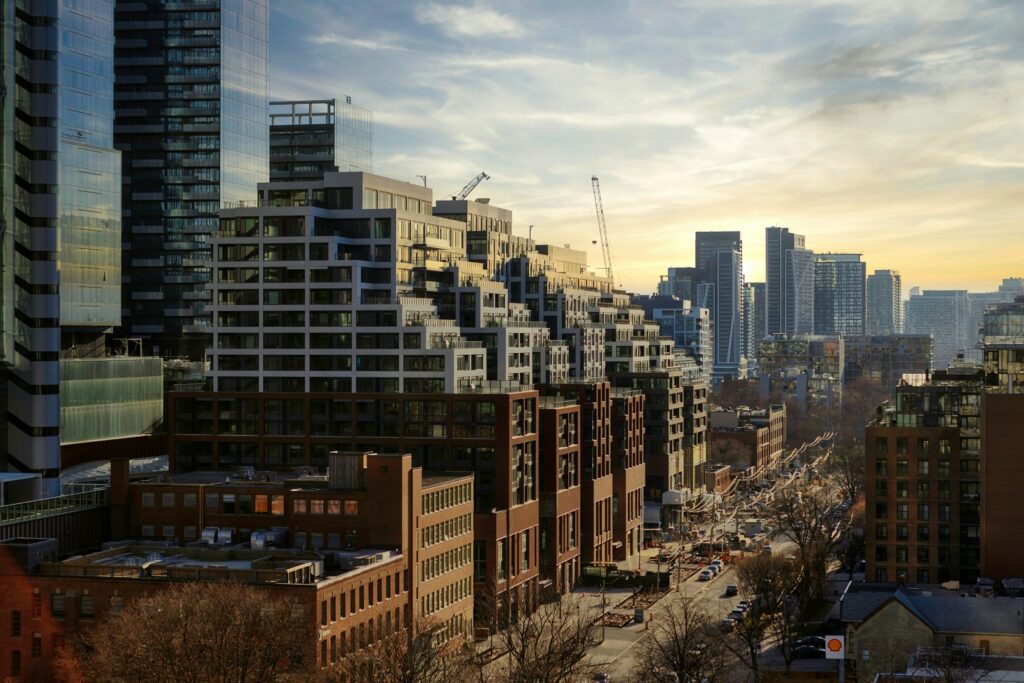
Those buildings are a symbol of everything that went wrong in our real estate market over the last decade.
Financed by international and domestic investors, sold by the proverbial pound (in this case, square footage), and offered as a pure commodity, these buildings will ultimately represent the least-popular style of residential living as our city moves forward.
Micro-condos.
Tuna cans.
Shoeboxes.
Dog-crates.
Tin cans in the sky.
Whatever you want to call them, they will be a timestamp in history, a time when our city had absolutely zero eyes to the future, and was so desperate for tax revenue that we allowed condo developers to sell pieces of the sky to whoever was willing.
Nobody wanted these units. Surely, not the investors who purchased them. But it was the only way to get condominiums built. Developers couldn’t sell 600 square foot, 1-bedroom units for $900,000 in pre-construction. Investors didn’t want that. End-users weren’t buying. And thus, we sat idly by as developers shrank the size of units so they could come up with an absolute price that was palatable to investors.
$450,000 sounds like a reasonable investment for a pre-construction condo, right?
Never mind that the condo itself is a mere 300 square feet. The investor never intended to occupy the condo, and simply wanted a safe place to park cash for the next 4-6 years.
As a result, we’ve been left with a slew of “condos nobody wants,” as is being reported in the media.
“Toronto Condos In Recession, Filled With Supply No One Wants: BMO”
It’s important to note that this doesn’t refer to all condo supply. We’ve listed and sold several downtown Toronto condos so far this year, but the type of offering is quite different from that which is being referred to as “supply no one wants.”
How about a 1-bed-plus-den, 2-bath, measuring 680 square feet, in a dynamite location?
Sure, that will sell, at the right price.
But how about a 0-bedroom, 1-bathroom, 300 square feet, on the umpteenth floor of a nondescript condo in an unpopular location?
Good luck!
With all this talk about “condos nobody wants,” I feel it’s time to actually show people what we’re talking about.
“Put a face to the name,” is it were.
Now, the regular readers know that I am not allowed to “disparage a competitor’s listing” under RECO rules, so the following examples will be provided without addresses, but I believe that the point will be made.
Here’s our first listing:
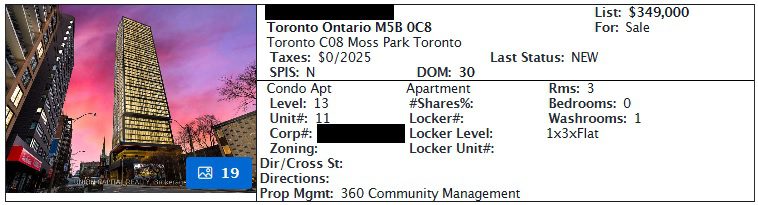
You know, my photographer once asked me, “Do you want me to do the sky replacement? Like, we can get a really cool pink and purple effect going.”
I told him to please hold off on that, since it’s a level of cheesiness that I find counterproductive, but it doesn’t mean that other folks aren’t still doing it!
This is a 310 square foot condo.
It’s listed for $349,000.
That’s $1,126 per square foot, which is a ridiculous price for today’s market, but the sad part is, this is very palatable compared to what these units were selling for at one point. We’ll come back to that.
Here’s the floor plan:
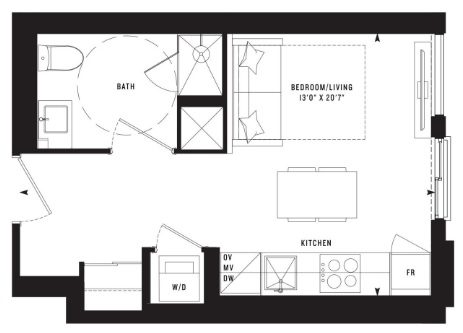
You can’t tell much from a floor plan, right?
It looks like there’s a bed, a television, a small dining table, and then a kitchen.
But how would this actually look in person?
Like this:
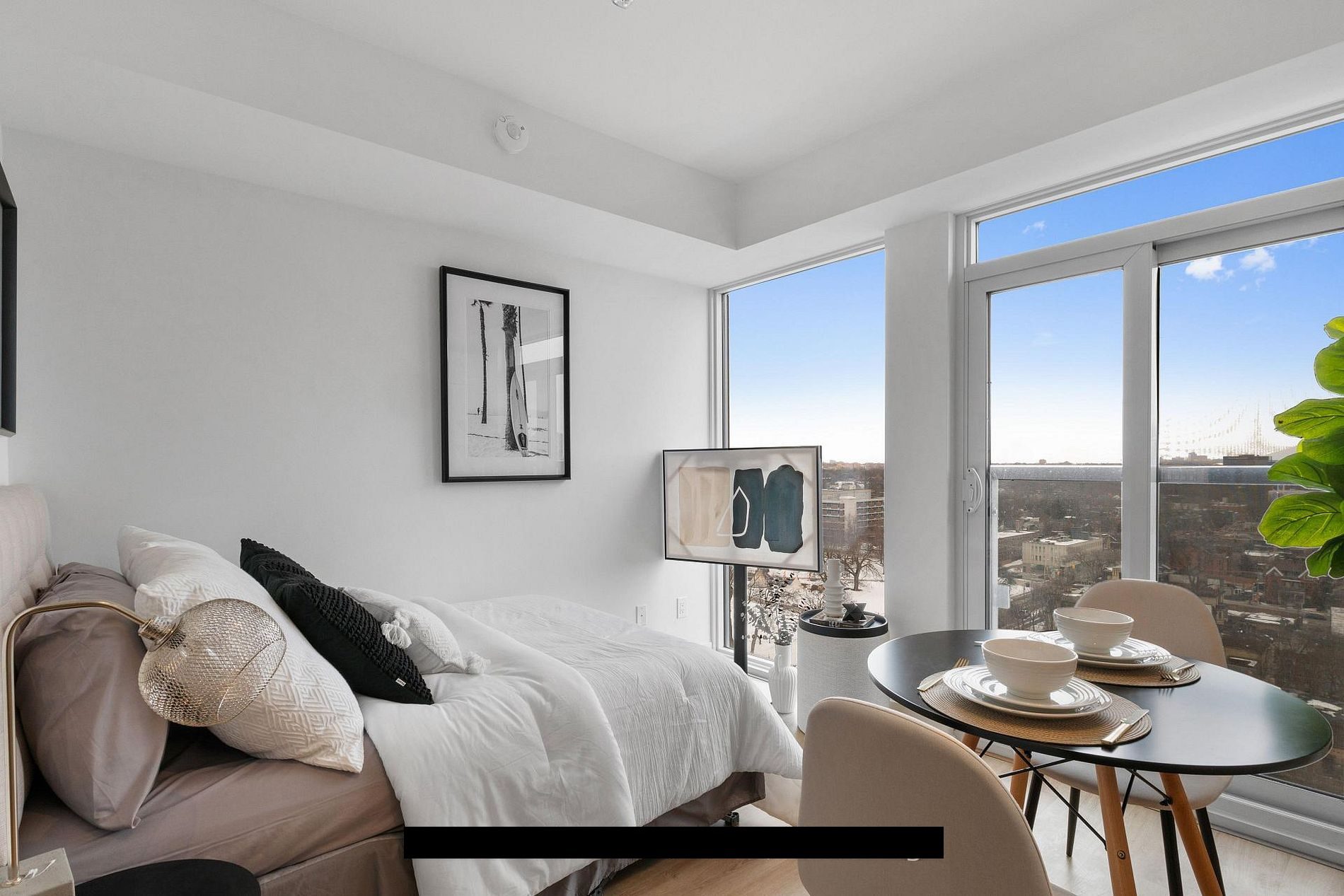
That’s a bed pushed up against the wall, with a prop-television on a stand (since there’s no wall to put it against), with a bistro set twenty inches from the bed.
Does this feel like home?
The problem is, once you turn the camera around and look at how close the table is to the kitchen, it becomes even less appealing:

Can a person actually fit between the table and the counter?
It feels like if you’re making scrambled eggs on that stove, your butt is going to be touching the dining table.
Oh, wait, you won’t be making scrambled eggs, since today’s 20-somethings just order three square meals per day, and then wonder why the city is unaffordable…
The same model is for sale on a higher floor:
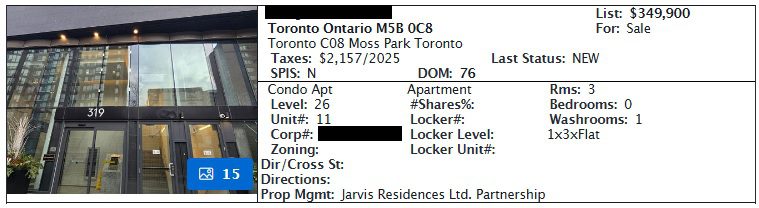
I’d hate to use this metaphor, but what does the supermodel look like first thing in the morning without her makeup, hair extensions, and designer clothing?
Probably like this:
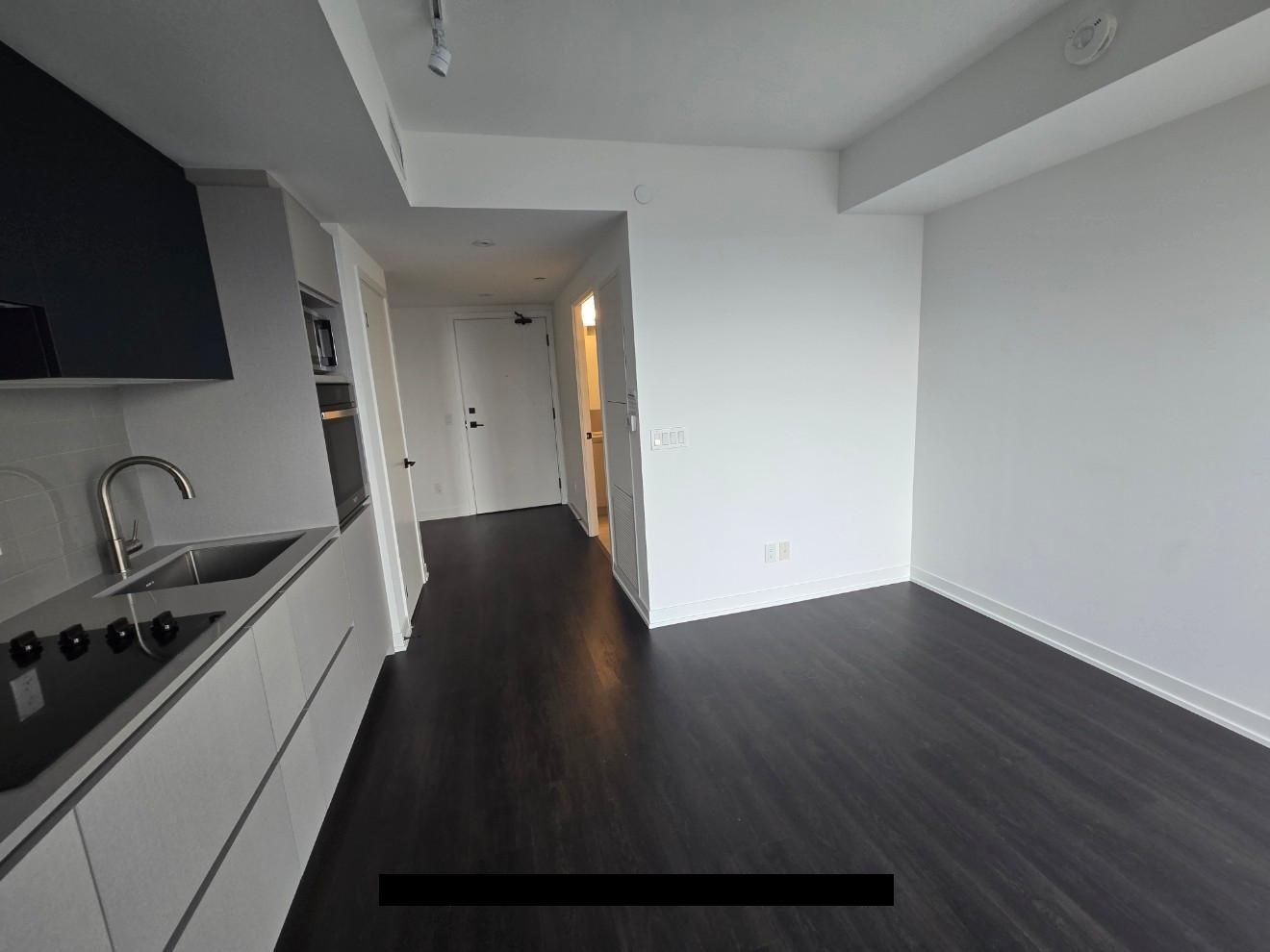
That is the condo in its entirety.
Without staging and high-quality photos (which need to be applauded by the agent who listed the first property), this is what the condo looks like.
That’s your bedroom, living room, dining room, and kitchen.
That’s it.
And it could be yours for the low price of $349,000, or less.
All jokes aside, that’s much more attractive than the price that was being asked in 2024:
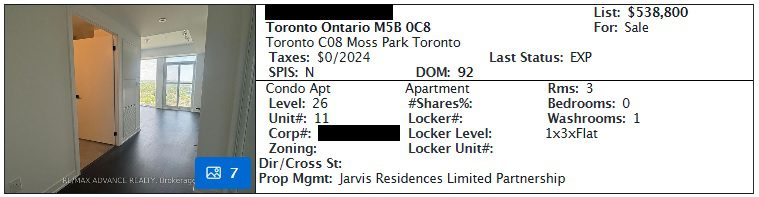
That’s $1,738 per square foot.
And while the property was never actually “worth” that much, it was listed here because the buyer was trying to recoup costs.
This condo was sold for $505,157.01 according to public records, but as we know, this is “net of HST,” meaning the contracted purchase price was likely far more. Maybe $540,000, maybe $550,000, maybe more, but we’ll never know.
This would have likely been sold in pre-construction somewhere between 2017 and 2020, and it’s possible that the transaction price was somewhere around $1,740 per square foot.
It’s one thing to pay that much money if we’re talking super-luxury in Yorkville, but it’s another thing if we’re talking about 310 square foot shoe boxes, dog crates, and tuna cans.
Then again, it’s all relative.
Because a 310 square foot condo might seem palatial in comparison to a 293 square foot condo, like this one here:
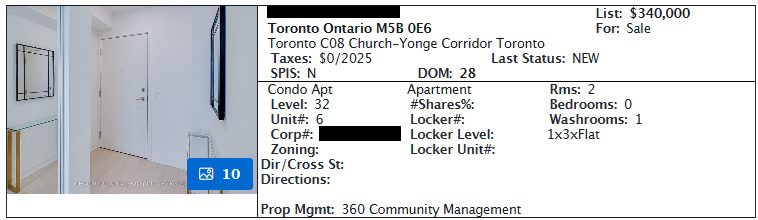
For a mere $340,000, this could be yours!
While this is a different building from the two shown above, the floor plan looks familiar:
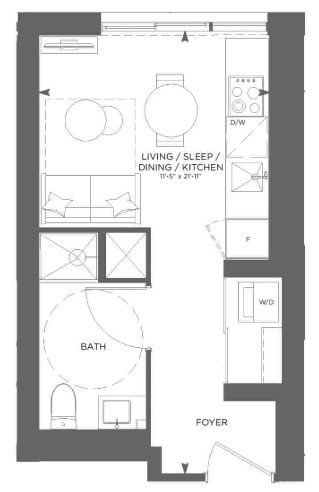
Same same, but different?
Here’s how this one was staged:
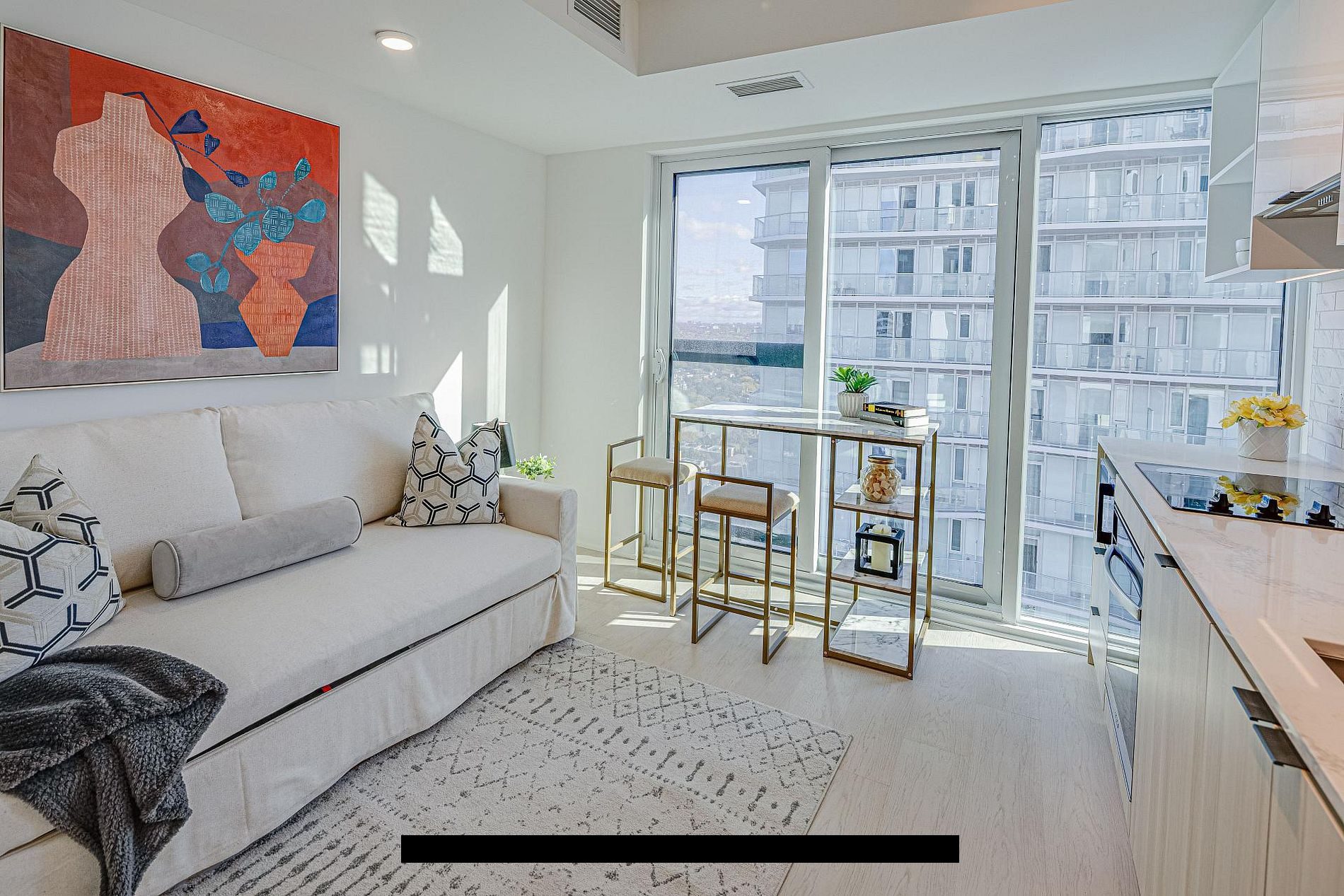
It’s almost an identical layout, just five percent smaller in every area.
Although, if we reason that the bathroom can’t be smaller, then perhaps the living/dining/kitchen/bedroom has to be 10% smaller to make up the difference.
In the photo above, we don’t even get to see what the unit looks like with a bed, but rather we’re given a sofa, and forced to assume that a bed could fit in this space.
293 square feet.
Can you imagine?
And while I know there are “other places in the world where people would kill for this sort of space,” those are, well, other places in the world. They’re not Canada. They’re not Toronto. Creating 293 square foot condos was not “progressive” in any way, so let’s not pretend like developers were somehow noble for doing so.
No, not noble.
Opportunistic.
When a 1-bedroom condo of 600 square feet was selling in pre-construction for $285,000, they were easy for developers to sell.
But as the cost to build a square foot in this city rose, and rose, and rose, it became unrealistic for developers to expect investors to grow with it.
If the cost to market, pre-sell, build, and profit ends up in the $1,500 per square foot range, then developers had no choice but to shrink the units in order to reduce the absolute prices of condos.
Somewhere, there’s a “sweet spot” for developers, and I assume it’s under $500,000. I think that as prices increase, investors have less of an appetite, so while you and I will understand the difference between a 900 square foot condo for $500,000 and a 300 square foot condo for $500,000, suffice it to say, many investors didn’t care.
This is why we have built a city of condos that nobody wants.
And the worst part is, we did this to ourselves.
We commoditized real estate.
And not just real estate, but real estate futures, which is what pre-construction condos essentially are.
Go back to that first example in today’s blog post with the 310 square foot condo.
That unit is located in a building that’s 46-storeys and has 595 total units.
Guess how big the largest unit in that tower is.
Go on.
784 square feet.
That’s a “two bedroom, plus den, plus study, two bathroom.”
Not quite as bad as a 293 square foot, zero-bedroom condo, but I would put this under the umbrella of “condos nobody wants” as well.
The good news is: there are still functional, liveable, desirable, affordable condos in this city that people do want.
They just weren’t built in the last five years…






















A Grant
at 9:07 am
“We commoditized real estate.”
This. A 1000x this. This is where the free market can fall flat on its face – when it’s trying to serve two distinct groups – buyers looking to purchase a residence vs. investors with readily available capital.
The former? Demand based on a need – a place to live. The latter? A “voluntary” source of demand that has had an outsized impact on the market. And in a real estate market no longer primarily concerned about housing, we shouldn’t be surprised that micro-condos are the inevitable end-result.
Serge
at 9:08 am
“Financed by international and domestic investors, sold by the proverbial pound (in this case, square footage), and offered as a pure commodity, these buildings will ultimately represent the least-popular style of residential living as our city moves forward.”
“Moves forward” … to WHAT? China started blowing up unwanted RE. Will Toronto?
JF007
at 11:04 am
David, well put and quiet thoughtful. Fundamental problem with condo building in Canada is how they are financed and built. On top of it the tight hold theta the Big 6 banks have on the lending in this country hasn’t helped matters as well IMO. I did hear from someone that the City of Toronto might be looking to snap up a bulk of these and converted them into rental housing but not sure if there will be takers for the same. Not families for sure.
cyber
at 12:15 pm
Yes, the “free market” will always try to squeeze the most bang for the proverbial buck. No surprise there, and really no fault to the developers for trying to do their job, which is return the most $$$ to shareholders on a risk-adjuated basis.
IMO the fault is actually with the government, whose “job” is to correct or prevent “market failure”. City of Toronto approved these ever-decreasing unit sizes, caved on allowing windowless dens with “closet sliding semi transparent doors” to count as a bedroom. Those development charges and land transfer taxes were a super sweet source of municipal funding that kept tax increases on existing property owners low, for mayors from right to left.
BoC kept buying the bulk of mortgage backed security issuances from the Canadian banks – with the public effectively holding the proverbial bag, literally “Big Short” style. In the early 2000s it was difficult to get a Big 6 mortgage on a sub 500 sf condo and required a special exemption, then somehow seemingly overnight investors could get low interest mortgages for 300 sf shoebox, no problem… OSFI doesn’t seem to have cared about this at all.
CRA only started thinking about tracking “paper flips” (assignment sales) once the party was already coming to an end, once domestic and foreign investors alike made off with tons of unreported and untaxed profits at 5x leverage (or even higher, since so many never even closed on their pre con contracts).
Even Carney personally as then head of BoC kept adding fuel to the fire by keeping interest rates below rate of inflation, basically paying people to invest into real estate with negative real cost of debt.
FINTRAC kept Canada going strong as “snow washing capital of the world”.
Need I go on…
Ironically I don’t blame the voters that much at all… sadly there is this weird entrenched “understanding” amongst political elites of all colours and logos, as well as various supposedly independent institutions, that Canadian domestic ologopolies – especially in banking – are a good thing, consumer costs and systemic issues be damned.
Derek
at 12:26 pm
Who makes up the demographic of end-user purchasers of condos, now? What young couple would want to get onto the property ladder via condo presently, when there is no longer a “guarantee,” or even a tenable sales pitch, that you’ll be able to move up within 3-4 years by netting out your down payment for that semi-detached in Leslieville.
Serge
at 1:46 pm
To buy them in bulk and turn into social housing – that is the second solution that is floated in China, after blowing them up.
TOPlanner
at 9:57 am
Yes!!
On the City’s role in this – can’t tell you how many proposed developments with tiny units City Planning fought at the OMB/LPAT/OLT. The City has done tons of work to encourage larger and better quality living spaces, like the Growing Up guidelines (minimum proportion of larger units), encouraging diverse and often larger housing units through Expanding Housing Options in Neighbourhoods (plexes, laneway and garden suites, etc.).
Meanwhile, the City does not control the market and there have been years of political and public pressure to approve any type of housing at any cost. The result is housing as a financial product rather than shelter.
In my opinion, the best way to resolve this is to treat housing intended for end-users differently. Options for Homes already does this in Toronto requiring those who receive downpayment assistance to occupy units, and Singapore runs their housing system on the Build to Order model where units have a minimum owner occupancy period. The question is – how do we do this is a way that’s fair, balanced, and doesn’t immediately prompt claims of government overreach?
Libertarian
at 11:08 am
David, maybe a future post with a breakdown of how many of these shoe-box units there are compared to regular units. You have mentioned often that you are regularly buying units as investments because you think there will be a shortage, but if the demand for condos goes down because of the stigma that they are all shoe boxes, doesn’t that ruin your investment philosophy?
David Fleming
at 8:18 pm
@ Libertarian
I haven’t bought any shoeboxes.
I want units that are 550 – 600 square feet.
I have never supported the notion of 293 square foot condos; not for investors, not for end users, not at market peak, and not at market bottom.
Libertarian
at 11:15 am
Hi David,
I know you are anti-shoe boxes.
To put my question another way….are you worried that as the stigma around shoe boxes continues to deteriorate, do you think that stigma will spread to all downtown condos? And if it does, then does investing in any downtown condo have higher risk than it did one year ago, three years ago, five years ago, etc.?
As shoe boxes go down in value, do they drag down all condos???
Serge
at 12:37 pm
PS
Speaking about David’s “We did this to ourselves”.
Yes! The landscape has changed forever.
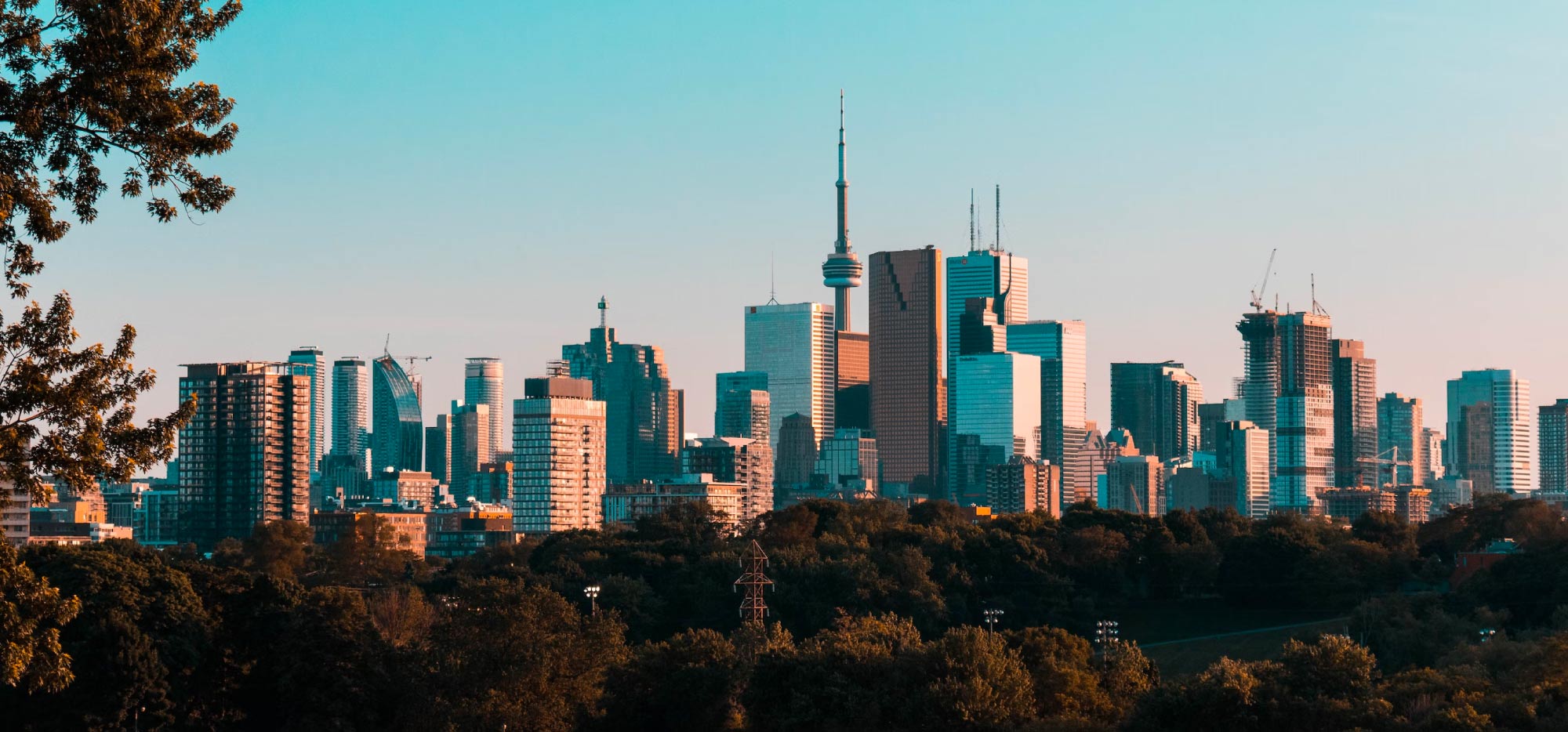
20 years ago, looking south from the Market building, one would only see sprawling parking lots, that replaced historical Old Toronto buildings in the 60s, and may be one-two brick coop low-rises.
Not so now. Whatever is the quality of these cookie-cutter condos and building architecture, Toronto’s downtown will never look again as a sleepy mid-West railroad small town. May be not Manhattan yet, but, at least, Brooklyn.
Huge change in 15 years, thanks to inverstors’ money.
Derek
at 1:09 pm
–“a time when our city had absolutely zero eyes to the future, and was so desperate for tax revenue that we allowed condo developers to sell pieces of the sky to whoever was willing.”
Who is this New David guy arguing the government should have regulated the size of condos that free willed investors could contract for, and developers could build? Old David was a let the market decide guy.
Anyone asked the investors who contracted for these condos why they don’t want them now? Aren’t they going to be good investments eventually? Who are these sellers that don’t want these long term investments? Aren’t they crazy to be selling these built condos now when new projects are frozen?
Serge
at 3:50 pm
Exactly. 10 years ago mostly anti-RE bears raised the idea of “investors” in their discourse. Especially “international investors” 🙂 The slogan was: “Young people all want to live in Toronto, it’s new Manhattan, we need more supply, the gov binds our arms!”
And here we are.
And note that David 1) seemingly does not suffer from lack of clinets; 2) does not live in Toronto anymore.
why bother?
Serge
at 3:51 pm
clinets= clients
David Fleming
at 8:32 pm
LOL I definitely live in Toronto! I’m right in the heart of midtown!
Serge
at 10:55 pm
@ David
What?! Did not you move the suburb/exburb?!
Yes, you lived at the Market area, but then you moved out?
My memory fails me, then …
Anywho, the gov definitely wanted people to move into the RE, but 300 sqft condos – that is capitalism not government. Banks+developers+investors.
But! They changed the face of Toronto forever… and this is a positive thing, IMHO.
David Fleming
at 1:25 pm
@ Serge
I lived in the St. Lawrence Market neighbourhood from 2005 – 2018.
I moved to a house in midtown in 2018.
It’s now the car-theft capital of the world. 🙂
Serge
at 2:52 pm
Midtown?! Ok. Anywho, car-thefts are better than shoot-outs 🙂
David Fleming
at 8:32 pm
@ Derek
This is a LONG conversation, with so many intersecting elements. Where do I even start?
I believe in small government. The Canadian government is so large and is so involved in our daily lives, that I have no idea how we got here. I have no idea how Canadians decided to give up their rights and freedoms to the extent that they have.
I believe in the free market, wholeheartedly. And I am a capitalist.
Then again, if you need a law to ensure people wear seatbelts, which are there for their benefit, then it tells you all you need to know about “free will” in society and allowing people to be free to make their own decisions.
Is there a happy medium?
But we also have to look at how governments work, and who’s in power.
Politicans are up for election every 4-5 years, which means they can’t really plan anything long-term.
How is a city supposed to put a plan in place twenty or thirty years out? Politicans are self-serving. They’re not going to do anything, say anything, or plan anything that gets in the way of their re-election.
And look at what’s happened in Toronto over the last few years. Toronto’s current city council is comprised of some of the least intelligent humans I’ve ever seen. They’re judgmental, virtue-signalling, idealogical zealots who are running social experiments at the expense of the city and its constituents. They have no “plan” for this city. These people are in charge of an $18.9 Billion budget and their council meetings resemble a bad Saturday Night Live skit.
Like I said, this is a long, long conversation…
Derek
at 10:11 pm
Yeah we would be insufferable to any within earshot discussing this stuff 3 beers deep lol. I just meant one specific point though—i.e., I don’t believe you ever ever ever thought any level of government should tell developers what type of condo to build or what type of condo investors could contract to buy…ever.
JL
at 11:15 am
To your credit Derek, I had a similar thought… this space was very much all about letting free markets be free. There were whole entries on the various well intentioned but very misguided attempts to “force” construction to focus on end-users (minimum # of units with x # of bedrooms, etc), but these were (in most cases justifiably) mocked and ridiculed. The current critique that what was being built should not be built, and that funnelling a housing strategy through condo investors may not be ideal, only seemed to have surfaced across the industry after the music stopped.
David Fleming
at 1:34 pm
@ Derek
You are correct. I never suggested that the government should tell developers what size units to build, what layouts, how many bedrooms, or what to charge.
But that is because, while I have zero faith in developers, I have less than zero faith in the City of Toronto government.
All three levels of government are to blame for the influx of international capital that bought and sold real estate here, most of it untaxed for decades, as a reader pointed out last week. All three levels of government are responsible for driving up the price of real estate through taxation. All three levels of government are responsible for failing to build adequate infrastructure that would allow our city to grow.
But it’s the city government that sold out the hardest, bending over for developers in order to get that sweet development charge revenue.
Condos shrank in size because prices rose too quickly, and prices rose too quickly because of:
a) Taxation
b) Cost to build
c) Speculation from foreign investors
Effective public policy could have curbed all three.
Now, how we started this practice of pre-selling condos before ever building them, is an entirely different discussion, and yet another reason why we built the city the way we did. However, I don’t think it’s a reason why we saw condos shrink in size.
Derek
at 1:51 pm
Okay wait what? “Speculation from foreign investors” is one of the causes of too-high condo prices and public policy ought to have curbed it? I am considering calling you an ambulance.
David Fleming
at 2:28 pm
@ Derek
Foreign investors financed a large part of the condo boom.
The government enacted a “foreign buyer ban” way after the music stopped. The “foreign buyer tax” is nothing but grandstanding.
Our governments are reactive. Never proactive.
What I’m saying is that excess demand causes prices to increase, and much of the demand for condos was from foreign investment. Remove the demand, keep prices stable.
This is with the benefit of hindsight, of course. But it’s not like we didn’t know what was happening back then. The years 2010 – 2017 were a boom for foreign investors.
Isn’t it the government’s job to create public policy that’s in the public’s best interest?
With hindsight, was allowing foreign capital to be stored in virtual safety deposit boxes, in the form of condos, good policy?
Derek
at 3:42 pm
There was a guy, Flavid Deming, who used to run a blog, who used to say foreign buyers were a scapegoat, a ban would be useless, and that not enough supply was the culprit 🙂
Okay, okay, can’t wait for next blog to end this conversation!
Serge
at 3:05 pm
@ David
“All three levels of government are to blame for the influx of international capital”
Was it government behind this famous poster in the lobby of Waterloo university, offering students mortgages with 30% of downpayment and no income check, not (TD?) bank?
“allowing foreign capital to be stored in virtual safety deposit boxes” – many capitalist countries still consider it a good deal, no? Many of them even offer citizenship for this.
Serge
at 11:03 pm
PPS
All in all, 300 sqft unloved condos and towers aside, the city “moves forward” into rentals. Like in rental apts, not condo.
I noticed that now, like in many other countries, but not in Toronto, realtors are getting involved into renting out apartments.
So, David, may be you would throw some light on what is happening there, from a realtor’s point of view. Much appreciated!