

I really don’t like traveling over the holidays.
I’m sorry, because I know that you do. And I know that you just did.
I hope your trip to (INSERT < Florida, Arizona, Costa Rica, Bahamas, Miscellaneous Family Locale In Europe > HERE) was really enjoyable, but I simply do not have it anymore.
I’m scarred.
I have trauma.
Many of us from my generation simply can’t get over that “feeling.”
The feeling is hard to describe, so perhaps there’a an appropriate GIF for this…
….lemme see…
…ah, here:

KEVIN!
When I think back to my childhood, this perfectly explains how I remember it.
This is going to sound really posh, so please don’t fault me, but in 1993, my father took our family to ski in Europe after Christmas.
So the first problem was: we left on Christmas. What kind of kid wants to leave the bounty of toys he just received, merely hours after receiving them?
But if I remember correctly, we took a plane, to another plane, to a van, to a train, to another van, and the whole process took over twenty-four hours.
The anxiety involved in this process was overwhelming. We were constantly made to feel like we were going to miss our next checkpoint in the Amazing Race, and while I have learned in subsequent years that my father loves to overdo things, exaggerate, and exacerbate, this knowledge was not present back then.
Three decades later, I still hate traveling. I always feel rushed, I’m constantly worried about a long line, a flight delay, or a missed connection, and the one time you bring home somebody else’s bag that looks like yours, but isn’t, and open it to find some really weird crap that you wouldn’t have been into even when you were younger, well, I’ve had it…
I love being in the city over the holidays.
It is really, truly, the only time I relax during the course of a year.
And that includes when I go on vacation.
Let’s pick it up where we left off on Thursday, folks!
5) Real estate prices across Canada
Raise your hand if you found yourself daydreaming during the 2020 pandemic.
I think every one of you should have a hand in the air.
While many of us have mentally blocked out March through September of 2020, many of us also remember where our heads were at, and what we spent our time on.
I distinctly remember coming into the old Bosley Real Estate office on Merton Street every morning, even though the building was “closed.” I needed an outlet. I couldn’t be cooped up in the house all day long. There was nothing to do! The world was shut down!
So I ask again: how many of us spent time daydreaming?
For some odd reason, I started to look at real estate in Prince Edward Island.
I don’t know why. I’ve never been there.
But maybe, in the midst of a worldwide pandemic, being expected to sit inside all day long and not interact with the outside world, my subconscious thought it would be better suited to do that on an island?
I remember a particular house that I saw online, listed for sale for a paltry $675,000.
It was a brand new house on a massive acreage, literally steps from the ocean. Not the lake, but the ocean!
I dreamt of turning some of that acreage into a baseball diamond; lord knows there was space for it! Maybe a soccer field as well?
The house was in mint condition, had a home gym, an arcade, and get this – there was a helipad next to the driveway!
All for the bargain basement price of $675,000.
I think many of us who live in the GTA take for granted just how cheap, relatively speaking, housing can be in other areas of the country.
Last year, I wrote the following blog post:
October 27th, 2025: “Canadian Real Estate Landscape: A Year-Over-Year Look”
In this blog post, I compared the CREA Home Price Index (HPI) from Septmeber of 2025 to September of 2024, and what I found was shocking!
The key takeaways:
1) Six provinces (Newfoundland & Labradour, Quebec, Saskatchewan, New Brunswick, Nova Scotia, & P.E.I) were up year-over-year.
2) Three provinces (Alberta, British Columbia, & Ontario) were down year-over-year.
3) Ontario was down the most at -6.7%.
4) Atlantic Canada and Quebec were soaring.
5) Of the 29 cities in Ontario that the HPI tracks, 23 of them were down year-over-year.
I encourage all of you to read the blog post, if you have time.
The results of this exercise were beyond what I would call “interesting.” Seeing as I knew nothing about the year-over-year prices coming into this exercise, the results were, without exaggeration, absolutely shocking to me.
Just look at Ontario for a moment:
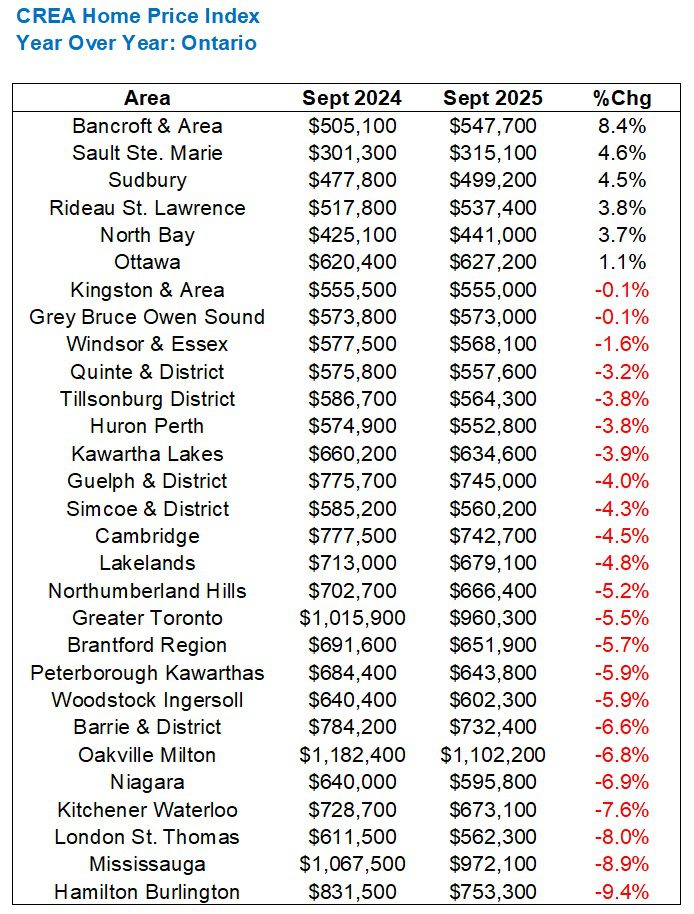
That’s a sea of red figures!
Like I said: 23/29 areas are down year-over-year, and some big-name areas like Oakville, Mississauga, and Burlington were hit very hard.
Contrast this with, for example, the following areas of Quebec:
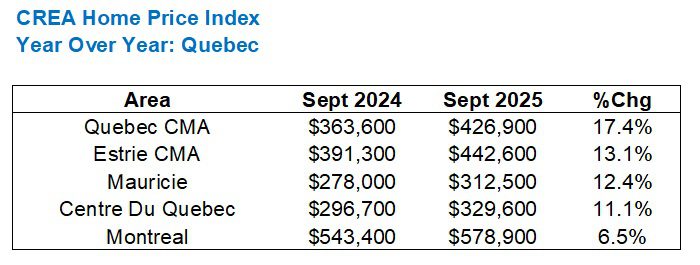
Of course, it’s all relative.
What was happening in these areas five years ago when prices in Ontario were soaring to new heights?
I think it’s fair to say that adjustments have been made for real estate prices in Ontario, however, relatively speaking, there are still some major cities across the country that have very attractive real estate prices!
For example, how much do you think this house costs?
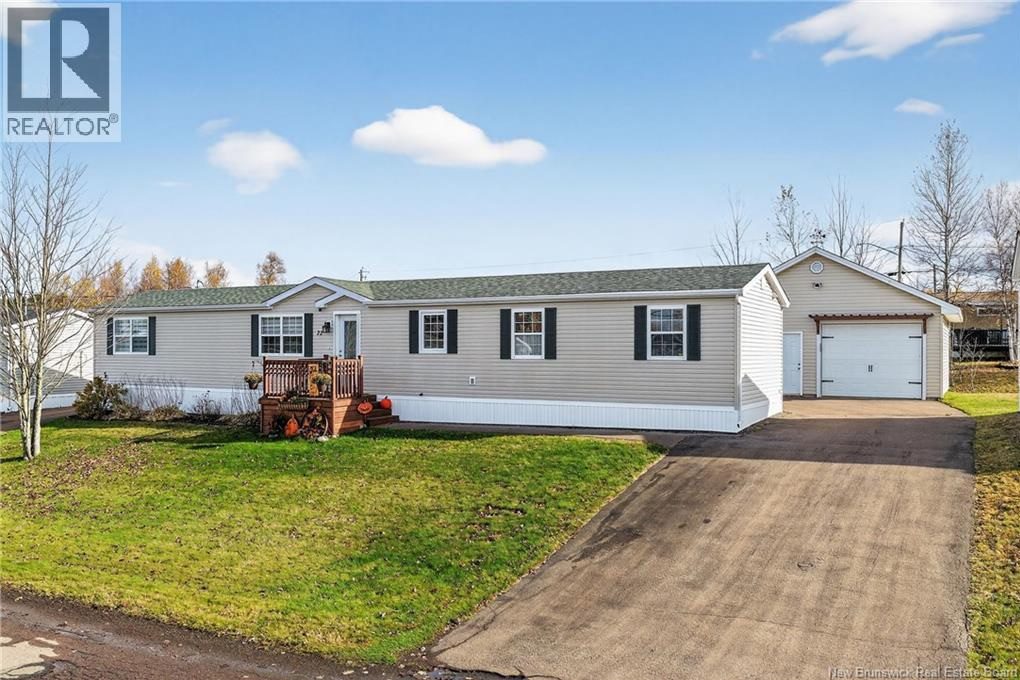
Viewed through your Toronto lens, you might call this a “trailer.” But it’s not.
Sure, it’s a “manufactured home,” but it’s 3-bedrooms, 2-bathrooms, and 1,200 square feet. There’s a private driveway, a detached, two-car garage, and the lot is quite large.
How much?
Arlight, you want to know where this is located first?
That’s fair.
It’s in Moncton.
Now, how much?
$229,900.
Tell me that you don’t want to live in this house, that you don’t want to live in Moncton, or that you don’t want to live in this house, in Moncton! That’s fine.
But where are you getting homes for $229,000 in the Greater Toronto Area? Where are you getting homes for $229,000 across the country?
There are areas in Ontario where you can find cheap(er) homes, no doubt about it. Moncton isn’t the only place, but I’m using this as an example to highlight the fact that not everybody needs to live in Toronto or Vancouver.
Just how much cheaper is real estate in other cities?
Using the November HPI (which was published well after I wrote the blog post referenced above), I wanted to compare the HPI for the Greater Toronto Area to that of other selected cities across the country:
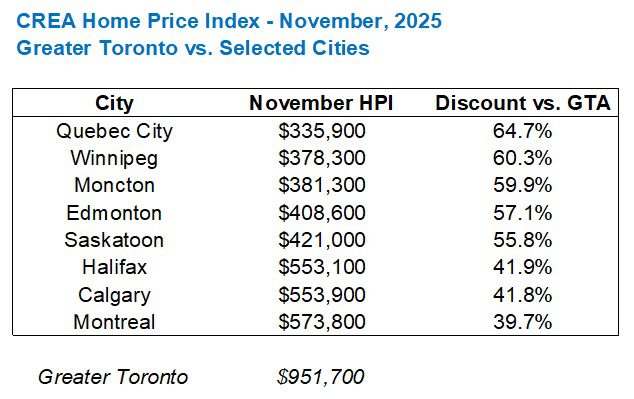
I know, I know, you don’t want to live in Quebec City. You can’t even speak French!
But what about everybody else?
Surely there are folks who will consider moving to Edmonton, where the home price index is 57.1% lower than here in Toronto, right?
As we move into 2026 and beyond, I can’t get this thought out of my mind: that we need to keep a focused eye on the home prices across the rest of the country, if for no better reason than to put our own home prices here in Toronto into perspective.
And perhaps this is an Ontario-wide conversation.
Looking at the Home Price Index in the province of Ontario, versus that of the other provinces, the point continues to be made:
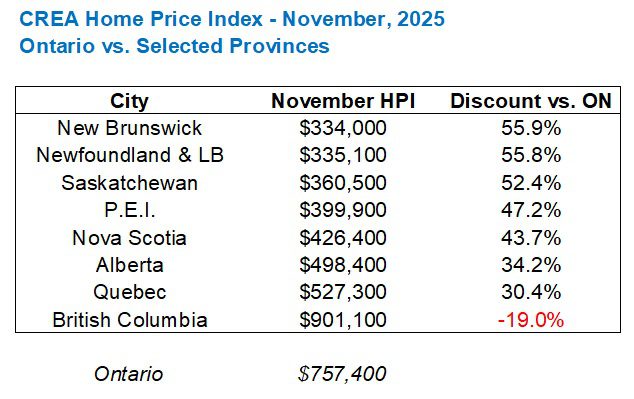
Well, at least it’s cheaper to live in Ontario than in British Columbia!
In case it’s not obvious at this point, I’d be remiss if I didn’t specifically point this out:
Despite the year-over-year HPI increasing across the board in provinces not named “Ontario” and “B.C.,” and prices in 23 of 29 cities in Ontario decreasing, it’s still 2-3 times as expensive in Toronto, on average, as the rest of the country (excluding B.C.).
This is the key takeaway from Point #5.
Because if we were running this exercise in January of 2025, any 40% figure above would be 50%, and any 50% figure above would be 60%, and so on.
Also important is that this leads me into my next brainworm for 2026….
6) Net migration in the province of Ontario
This is far more economics-related than it is real estate-related, but surely you see the tie-in.
Then again, I should probably ask, “Why are we discussing this in the first place?”
Let me follow up this question with another question, or a poll.
Would you rather:
a) Real estate prices in Ontario increase.
b) Real estate prices in Ontario decrease.
And no, you’re not allowed to answer with option (c), which is “Real estate prices remain flat.”
The point is this: the answer to that question overwhelmingly depends on whether or not you own a home.
Sure, there are exceptions to the rule. Your friend Agnes owns her home but would very much like to see home prices fall to benefit the next generation. But that’s because Agnes bought her house in 1977 for $41,000, and it’s now worth $3,000,000. So she doesn’t care if it falls in value to $2,700,000…
And I suppose there are those who own a $1,500,000 house and want to buy a $3,000,000 house, who figure that prices decreasing would benefit their net gain.
But on the whole, people who don’t own real estate and want to own real estate would like to see prices lower, and people who do own real estate would rather see prices higher, if there is no option to see prices remain flat.
So why are we discussing this?
Because if Ontario becomes (too?) unaffordable, and people move out of the province, or never move here in the first place (ie. skilled immigrants), then the entire province suffers in the long-term.
If the Ontario economy suffers, then the irony is – real estate prices would decline as a result.
Not quite a “Catch-22” but a bit of a “Three Bears” situation where you’re trying to find the poridge with a temperature that’s just right.
Since the pandemic, the net migration in Ontario has been negative.
The most recent data that I can find includes only Q1 of 2025:
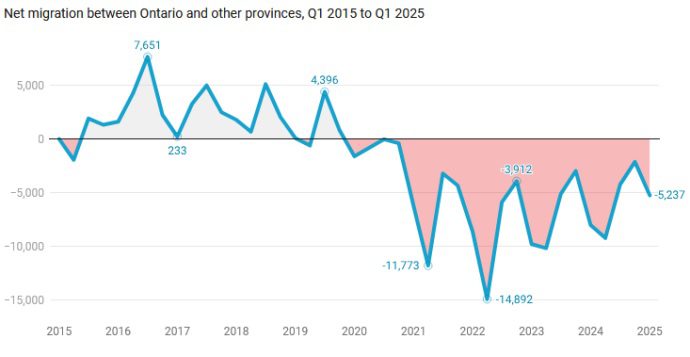
(source HERE)
I would welcome any data that’s more current, if you’ve got it!
Now, you might say, “Who cares about 5,237 people?” But that’s not the point!
The point is about the trend that we’re seeing, the reasons for that trend, and what it means moving forward.
What is the mass exodus a function of, you might ask?
Home prices. The cost of goods. Unemployment.
Just to name a few.
And as I was reporting all through 2026, unemployment in Ontario remains higher than the nation’s average.
Using unemployment data from October, the national average was 6.9%, but Ontario’s unemployment rate was 7.6%.
Further broken down by province:
10.1% – Newfoundland
8.5% – Prince Edward Island
7.9% – New Brunswick
7.8% – Alberta
7.6% – Ontario
6.7% – Nova Scotia
6.6% – British Columbia
5.8% – Manitoba
5.5% – Saskatchewan
5.3% – Quebec
4.9% – Yukon
4.3% – Northwest Territories
In case you’re wondering, today is not the day to talk about why the federal government is responsible for the high unemployment rate in Alberta, as they continue to kill Canada’s golden goose. Not today, sorry. I know you want to, but we’ll save that for another time…
In any event, due respect to Newfoundland and Prince Edward Island, but I don’t think we can, or would want to, compare unemployment rates between those quaint hamlets and a province that houses almost 40% of the nation, and which is supposed to be the country’s economic engine.
So that’s the job market, and we clearly covered housing costs in the previous section. As for the cost of goods, if you can tell me how much a Snickers bar costs in Ontario versus that of Quebec and Yukon, I’m all ears.
But now, I’d like to share a story that I referenced in late-2025 with respect to the “exodus” of people from Ontario. Specifically, young people, per the report by the Fraser Institute.
I don’t know about you, but I tend to place the Fraser Institute higher on the “credibility level” than most other sources of economic data and analysis…
“Exodus Of Young People Suggests Ontario Is An Increasingly Less-Desirable Place To Live”
Fraser Institute
August 2nd, 2025
Because I know most of you won’t read it, I’m going to post it in full! 🙂
From the report:
Over the four years from 2020/21 to 2023/24, Ontario saw 104,426 people (on net) leave the province and migrate to somewhere else in Canada. This concerning trend of out-migration, particularly among working age individuals, suggests the province is an increasingly less-desirable place to live and work—and policymakers should take notice.
Using data from Statistics Canada, we can see that over the four year period from 2020/21 to 2023/24 (the latest year of available data), 277,299 people migrated to Ontario from other provinces or territories while 381,725 left Ontario to move to a different province or territory. Put differently, Ontario saw a net loss of 104,426 people to the rest of Canada.
We can further break down this data by age. Looking at working age individuals (15-64 years old), Ontario had a net loss of 80,323 people from 2020/21 to 2023/24. If we zero in further, roughly 39 per cent (40,608 individuals) of the total net loss during those four years were young individuals aged 20-34 years old.
These are concerning trends. Not only have more individuals been leaving Ontario than are coming from other provinces in recent years, but a significant share of those who are leaving are young adults—those who may be finishing school, starting a career or a family, and who have the potential to contribute greatly to the overall standard of living in Ontario over the course of their lifetime.
So, why might Ontario be increasingly viewed as a less-desirable place to live?
First and foremost, Ontario’s economy is broken and provincial living standards have been falling behind the rest of Canada for decades. In 2000, per-person GDP—a broad measure of individual living standards—was $63,146 (inflation-adjusted), nearly 5 per cent higher than the rest of Canada. Yet growth in Ontario’s per-person GDP (inflation-adjusted) has slowed since then and provincial living standards in 2023 were 3.2 per cent lower than the rest of Canada. In other words, over the last two decades Ontarians went from enjoying a higher standard of living than the rest of the country, to now suffering lower living standards.
Ontarians are further saddled with some of highest tax rates in North America. For example, an Ontarian earning C$150,000 per year faces the third highest combined (federal/provincial) marginal personal income tax rate of anywhere in Canada and the United States.
And the Ford government’s continual debt accumulation—including massive projected deficits of $14.6 billion this year and $7.8 billion next year—suggests taxes in Ontario could rise further in the years to come.
High tax rates take away more of your hard-earned money and discourage skilled workers (including doctors, engineers and entrepreneurs) from living and working in the province—meaning future tax hikes will only further weaken Ontario’s already-struggling economy.
Finally, Ontarians (particularly younger individuals) may be leaving the province in search of more affordable housing. Ontario is ground zero for Canada’s housing affordability crisis and there are few signs this will change anytime soon. Home prices and rents are through the roof due to a lack of housing supply, and recent efforts by the Ford government to try and spur more homebuilding will do little to help (despite their considerable cost).
Migration numbers suggest that Ontario is increasingly becoming a less desirable place to live and work compared to the rest of Canada. If the Ford government is to stop the exodus, it must balance the budget, lower taxes, and meaningfully address housing affordability.
In fairness, the same could be said about Canada as a whole with respect to the budget, budget deficit, spending, housing affordability, taxes, and just about everything else.
But do you remember that marketing campaign from 2022 that sought to call skilled workers in Ontario to move to Alberta?
Just in case you forgot, here’s a refresher in the form of an advertisement in a TTC subway station:
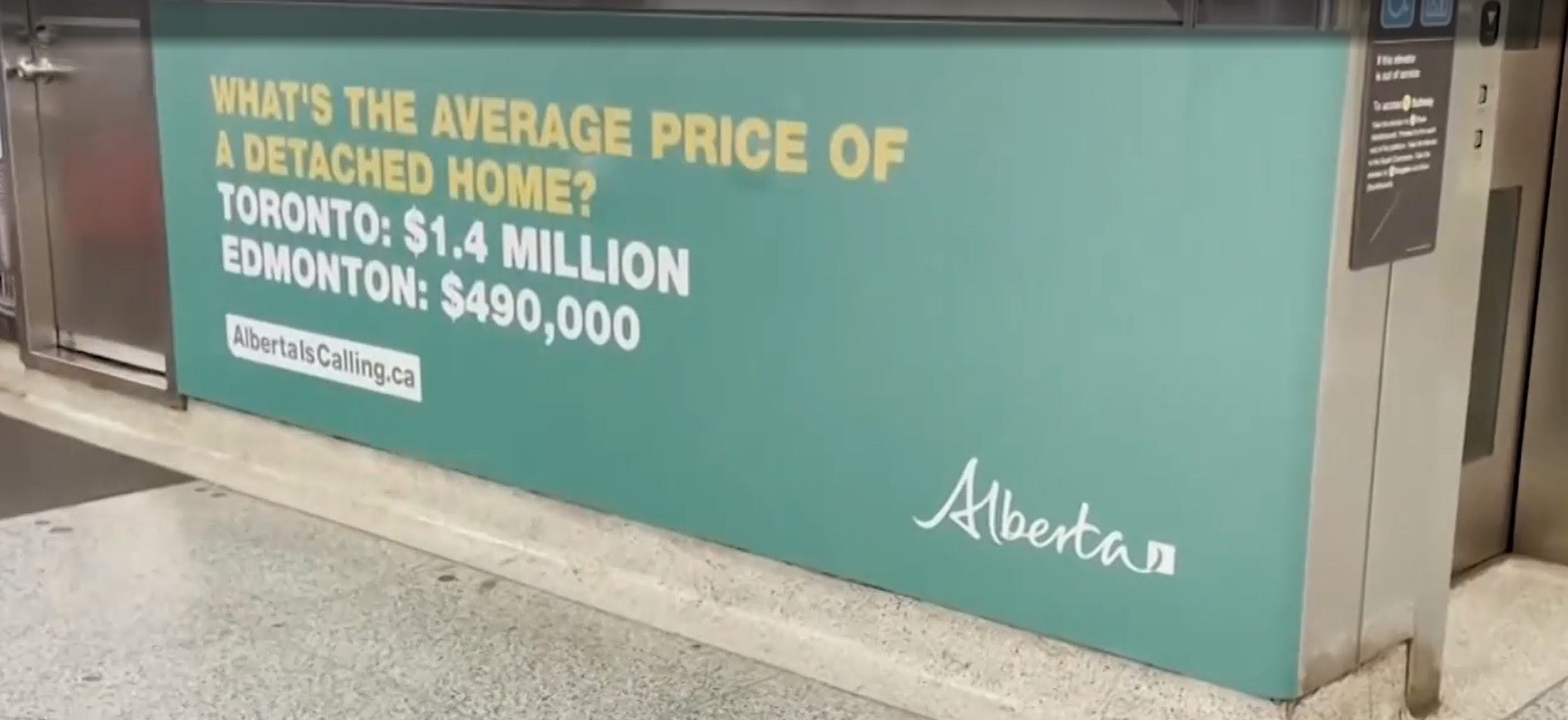
While the initial campaign targeted skilled workers living in Toronto and Vancouver, a subsequent campaign in 2023 went across the country!
“Alberta Calling Again: New Campaign Targets Skilled Workers From Atlantic Canada, Ontario”
CBC News
March 13th, 2023
Make no mistake, the dates above may say “2022” and “2023,” but this story has not concluded.
Not even close.
As we move through 2026, we’re going to want to keep an eye on net migration figures in Ontario, and while the province will undoubtedly benefit (at least numerically) from an influx of immigrants, how many of them stay here is another story.
Well, it took me eight days and three blog posts to get through six points, but I think this is a classic case of “quality over quantity.”
We cover a lot of ground here on Toronto Realty Blog, and there’s always much to discuss, ponder, and opine upon.
I have no doubt that a few topics that aren’t on our current radar will make an appearance throughout the year, as our dynamic, fast-paced, ever-changing real estate market will undoubtedly produce something new for us to dwell upon.
But for now, I hope you enjoyed this look at the top six items on my “real estate mind” as we head into 2026.
What’s on your mind for this year?
For that, I’m all ears…


























Serge
at 8:39 am
One thing I find missing is the stats of number of sales in e.g. Moncton and Mississauga.
I am glad that realistic depopulation of Ontario (and, specifically, Toronto) is noted.
Island Home Owner
at 8:57 am
Waves from one of the best communities in Canada with the most affordable real estate (Summerside, PEI). Post separation, just found myself in a nice 3-bed, 2 bath with a waterview from my back deck for just over $200/finished sq. ft. Lots of sellers wanted crazy prices and haven’t sold months later, but still lots of lovely homes here can be bought in the $300-400K price range.
A Grant
at 10:18 am
And this is why I place the Fraser Institute lower on the “credibility level”.
First, using GDP to define standard of living. The recent push by some to cite Mississippi’s higher GDP to demonstrate that the average Mississippian is better off than say, the average German, should be Exhibit A as to why GDP is generally recognized as, at best, an extremely flawed proxy for standard of living.
Secondly, the report cites higher tax rates as being one of the primary drivers why young people are moving out of Ontario “to a different province or territory.”
Only to note the following as evidence: “[An individual] Ontarian earning C$150,000 per year faces the third highest combined (federal/provincial) marginal personal income tax rate of anywhere in Canada and the United States.”
Assuming that we define a young adult as being between the ages of 25 to 34, the actual average income for this demographic is approximately $50,000 to $60,000. Ontario’s income tax rate for this bracket is one of the lowest in the country.
The link included the report sneakily alludes to this noting that: “an individual making C$50,000 per year faces a higher income tax rate in Ontario than in every U.S. state.” Conveniently omitting Canada entirely.
Libertarian
at 1:08 pm
Happy New Year David! (I know it’s been two weeks, but who cares!)
I totally agree about travelling. It’s getting worse and worse. Airports are a zoo. Too many weirdos, too many rules, too much shrinkage on planes (smaller seats, more seats, stuffed like sardines, etc.).
That’s why I automatically disregard travel days now and do not include them as part of my vacation. So a week off is now only 5 days off.
Captain Jerk
at 11:13 pm
You can’t look at cross-province migration in isolation. Ontario may be losing people to the other provinces but we are importing millions of third worlders to replace them. The population of Ontario has certainly not trended down since 2020.
It is the influx of third worlders that is also driving Canadians out of Ontario.