

Submitting a Bully Offer
Something interesting happened last week that made for water-cooler conversation in the real estate industry.
No, I’m not talking about TREB. That’s more than just water-cooler talk. That’s an Armageddon on the horizon.
I’m talking about one of those day-to-day occurrences that’s worth talking about, until suddenly, it isn’t.
I’d hate to say it, but those shady practices, or unfair dealings, or borderline illegal or unethical experiences only sting for a day or two, and then market participants in this industry simply move on.
So let me know what you think about this one…
A listing agent double-ended her east-side listing for a really hot, possibly “best of the fall market” property in this particular area.
You might have an issue with multiple representation, and/or “double-ending,” but that’s not my problem here.
The problem was: this was a bully offer.
Can you bully your own listing?
Suddenly, I’m reminded of one of my favourite movies of all time:

So let’s go through the logic and reasoning here; how in the world does one bully his or her own listing?
You’re the listing agent, and you bring a property onto the market at $1,199,000, setting an offer date for Thursday, September 20th.
You have your own clients for the property, and you show it to them.
This is where I start to feel uneasy.
For the record, if this is me – I immediately hand this off to a colleague. I would never represent both buyer and seller in competition. If there was no multiple offer situation, I would still represent both sides. That’s something that many of you won’t like, but it’s also a topic for another day. But in competition, how in the world are you supposed to be at arm’s length?
Many agents feel the same way, and it’s not just because of how tough it is to remain unbiased.
It’s because of how it looks to your industry colleagues.
Imagine 123 Smith Street goes up for sale, offers are on Friday, and there are nine bidders.
You check the listing after the price has been posted, and there you see the double-ender:
LISTING BROKERAGE: David Fleming, Bosley Real Estate
COOPERATING BROKERAGE: David Fleming, Bosley Real Estate
Nine bidders?
And this guy magically happened to have the winning bid?
“What an asshole,” says the entire industry, all at once, under their breath.
I don’t like it, and I wouldn’t want my name on it.
But there are agents out there that have massive egos, and strive for this! It’s a badge of honour!
To me, it just makes me weary of dealing with them. Your reputation is so incredibly important in this industry. For you folks reading this, I can’t possibly explain how important reputation is, and how agents run into each other over, and over, and over, and how previous interactions shape future dealings.
So if double-ending in a multiple-offer situation is bad enough, then what do we make of scenario where an agent bullies his or her own listing?
It’s shady.
And it’s not well-received by other agents who are looking on.
But it’s also not illegal in any way, so long as it’s handled properly.
When does this come back to bite the listing agent?
When the agent decides or she isn’t going to tell anybody about the bully!
Here’s a recent ruling from RECO in exactly this situation. Have a read:
Legal corner: Mishandling of offer process results in major fine
For listing representatives, fair handling of the offer presentation process is essential. Providing interested buyers a fair chance to put in an offer, or improve their offer in a multiple offer situation, is key to providing the best service to the seller client.
Mishandling the offer process can have serious consequences, and a recent fine of $10,000 provides a good example.
Here is the sequence of events that resulted in disciplinary action:
-
- A registrant (referred to as Representative A) listed the property, with a note indicating a delayed offer presentation—meaning that the representative would hold all offers and present them to the seller at a specific date and time. [A delayed offer presentation requires written direction from the seller.]
- The listing indicated that all offers had to be registered by February 24 at 5 p.m. [To register an offer means that the buyer or their representative has confirmed with the listing brokerage that they have an offer to submit.]
- The note said that the seller reserved the right to consider a pre-emptive offer (also known as a bully offer) at any time.
- Representative A showed the property to his own buyer client and prepared an offer for the seller’s consideration.
- A buyer’s representative (referred to as Representative B) contacted Representative A and set up a viewing appointment for February 19. In total, there were five viewing appointments scheduled for February 19. Representative A did not advise Representative B that an offer had already been received from his own buyer client.
- Representative B made a follow-up call to Representative A for more information about the property, and left a voicemail. Representative A did not return the call.
- Representative B later received a message that the property had been sold, and that the appointment for February 19 had been cancelled.
RECO’s discipline panel found that Representative A violated the Code of Ethics by:
-
- Failing to notify all buyers who expressed an interest in the property that an offer was registered on the property, and that the offer was from his own buyer client;
- Failing to respond to Representative B’s voicemail within a reasonable time;
- Failing to notify Representative B that a written offer had been registered or received for the property at the time they were making an appointment to view the property the following morning; and
- Failing to obtain written instructions from his client to review offers earlier than the date on the listing.
What you need to know
One element of that is promoting the property in such a way as to generate interest from multiple buyers, who can then submit offers for the seller’s consideration.
If the seller is considering a delayed offer presentation, it is a reasonable expectation that the representative would explain that the approach could prompt some buyers to submit pre-emptive offers (also known as bully offers). The written direction must explicitly outline how to handle pre-emptive offers.
In addition, if the seller changes their mind and decides to review offers before the previously-agreed time, a new written direction is required to do so. The listing is then updated to reflect the change, and any interested buyers should receive notice so they are aware of the revised approach (via their representative, if they have one). This is in the seller’s interest as it reduces the risk that the buyer is not aware of the change and fails to meet the revised timeline for offers.
With the timing of such events happening very quickly, it’s also essential to respond to inquiries from interested parties in a timely manner.Outcome
Representative A agreed to pay a fine of $10,000. The decision is published on RECO’s website and the disciplinary decision appears whenever a member of the public uses RECO’s search tool to check on his registration status.
The panel concluded that the following sections of the Code of Ethics were breached:
Fairness, honesty, etc.
3. A registrant shall treat every person the registrant deals with in the course of a trade in real estate fairly, honestly and with integrity.
Best interests
4. A registrant shall promote and protect the best interests of the registrant’s clients.
Error, misrepresentation, fraud, etc.
38. A registrant shall use the registrant’s best efforts to prevent error, misrepresentation, fraud or any unethical practice in respect of a trade in real estate.
More information
For more information about written direction for delayed offer presentation, see our Registrar’s Bulletin.
Now this agent is either stupid, or greedy, or both.
I think it’s more of the former; I think you’d have to be absolutely clueless to do something like this.
And the point that rarely gets made here is that the “Multiple Listing Service,” or MLS, is supposed to be used for cooperating with other agents. Before MLS, and before cooperating brokerages, agents simply tried to sell their own listings to their own clients, because it’s the only way they got paid.
Along came MLS, and cooperation, and an agent was able to advertise his or her listing on the MLS system to gain more exposure.
If you want to sign an exclusive listing, refuse to cooperate with other brokerages, that’s fine! There’s a checkbox on the top of the damn listing to do so!
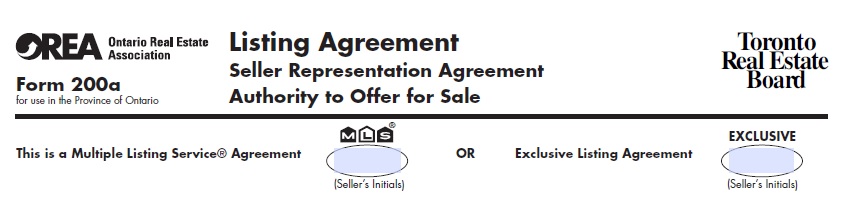
But what you don’t do is sign and MLS listing, put the listing on MLS, and then sell to your own client, exclusively, without cooperating with other agents.
That completely defeats the purpose of MLS.
However, I’ll tell you what’s really going on here.
What really happens in these situations where agents “bully” their own listings.
An agent gets a “cold call” from a potential buyer, who has no agent, and wants to see the house. That buyer then says, “I want to buy this house, and I’ll do it through you. I want to buy it now.”
That agent is faced with a decision;
1) Tell the buyer, “Sorry, I can’t very well submit a bully offer on my own listing! That would be so shady, and every agent out there would grow to distrust me.” Then the agent would see if the buyer would agree to submit an offer on the scheduled “offer night,” or walk away, costing that agent a potential sale.
2) Sign an offer, register this offer with his/her own listing brokerage, phone and email every agent who has “expressed interest” in the property to notify them of a bully offer, and then hope like hell that offer isn’t beat, and, be willing to take the hit to his or her reputation.
I wonder which is the path less travelled…
Happy Monday! 🙂






























Sunlight
at 9:25 am
Similar thing happened at 151 Heath St E in Moore Park last spring. I’ve seen it in other places as well.
johnny chase
at 11:55 am
Isn’t this a classic Freeman Realty move?
Jennifer
at 2:01 pm
A lot of things about the way we are permitted to sell property in Ontario is ridiculous. This is one of them. Holding back offers in the manner it is done now is another. It needs a total revamp.
The reputation of the agent should not be the driving force here. If I am a buyer or a seller, I really am not concerned about that. The agent must act in the best interests of his clients (obtaining the best purchase price for them, dealing with conditions, etc.). That’s the driving force and what matters. By double ending in this scenario, this agent cannot be acting in the best interest of both his clients. Even though technically double ending is permitted, it really shouldn’t be because you are inherently in a conflict of interest position.
So really we need a third option 3) sorry, I cannot represent you in this situation because that is a conflict of interest, a breach of my responsibilities to my client, ethics, etc etc but I am happy to refer to you to these three other people, or you may hire any other agent out there.
But what we really really need is option 4) you can submit the offer yourself through a lawyer who you hire to prepare an APS and who will charge a fee. But 4 is a whole other can of worms.
Tom Tyman
at 2:05 pm
Great post! Isn’t there anything that the buyers can do to prevent this from happening?
rational mind
at 2:48 pm
$10,000 fines are not going to change anything.
Tim Harford’s book The Logic of Life explains this better as: humans respond to incentives. They weigh the pros and cons along with the probabilities of the outcomes in choosing to be a ‘rational criminal’.
If I’m going to make 2.5% commission on double-ending this deal without following rules, but the million dollar home will net me/brokerage $25,000…and I get fined only $10,000…even if I get caught I’m ahead!
This logic applies everywhere. Parking tickets are a great example. Bus/train tickets work too…the likelihood of getting caught is just one part here, the other being the severity of the punishment. You can increase the frequency of the checks…and/or increase the penalties…
Certain individuals have figured this system out, and simply…do. not. care. Why would they? What is the incentive here?
Housing Bear
at 4:57 pm
The seller in this scenario should have been very skeptical with their agent’s advice. The biggest conflict of interest I see here is that the selling agent has more of a personal incentive to make sure they get both ends of the deal than to get their selling client the highest price possible. If you are getting double the commission, you are ahead as long as the final selling price is more than half of what you would have gotten by allowing another agent to be in on the deal.
Example
1 million sale with a 5% commission being split between the buying and selling agent, each get $25 000. If the same house sells for 900k, same commission rate, but one agent gets both sides of it, he or she pockets $45 000. Even after the 10k RECO fine you are still 10k ahead. (as the agent).
Heck you could even position to the seller that you are going to take a 4% commission instead and give them a “deal”. (36k on 900k) sale. Still up a grand if you get caught by RECO.
The fine should be greater than the commission made on a single sale.
craijiji
at 11:49 am
The whole point of a bully offer is to make it seem hard to beat on offer night. You would assume that the offer in this case was good enough that it met the risk threshold of the sellers. Unless of course they were totally clueless about the value of their house, which I find is increasingly rare in Toronto.
In the end, I would be willing to bet that they came out ahead here. I know agents that have done both sides of the deal, and none of them have taken more than 3.0% on it.
Housing Bear
at 1:05 pm
This agent may have gotten their selling client the best sale price possible, (not the best for the buyer) but still leaves open the possibility of abuse. At the same time could be a strategy for a buyer to get the best possible price from their perspective (can agent properly rep both sides?) For the buyer, if you stumble upon a shady agent with an active listing and go direct, that agent now has a personal incentive to push away competition using other agents. I assume most will not do this (David clearly has much higher ethics) but shady actors are always drawn into booming markets.
It is good to know that a lot will drop down to 3% when double ending, that would limit the main issue with the potential conflict of interest I outlined above. 3% vs 2.5% is still 20% more in commission for an double ending agent however (with same sale price). Max haircut here would be about 16% before the agent is losing money. Same payout on a 1m sale split @2.5% vs a 833.33k solo sale @3%. Both equal 25k. Of course, in this scenario the 10k reco fine would have caused a 5k loss for the agent even if he got his client the full 1m sales price. 20k commission vs 25k doing it right. Depending on how often you can get away with it might just be a cost of doing business though.
Heather
at 9:35 am
We had this same scenario happen to us this summer and it left such a bitter taste in our mouth. I would say it fell in to scenario 2 – I’m fairly certain the clients weren’t a cold call, but rather the agent’s existing clients.
We saw a property with an offer date and then all of a sudden get a call at 6pm from our realtor that there’s a bully offer being represented by the listing agent and that the seller was going to look at the offer that evening. To keep them honest, we scrambled and put our own offer in and were the only other offer. The listing agent then came back and told us her own offer was higher and asked if we wanted to increase. We got the sense that she was going to use our offer to try to get her own clients to come up a bit, but there was no way we were ever going to win because her clients would always be $5K higher than us, so we walked away.
There’s more to the story on this one, but needless to say we knew the other agent was unethical.
Derek
at 1:16 pm
Can anyone explain the origin/rationale/basis for the blind bid process when there is a an offer date? Why not have an open bid process? What sacred interest is protected by the process of the listing agent calling all of the buying agents and saying, “there are some really close offers here; you need to improve”; then, rinse and repeat? Is the interest of the seller unassailable versus the interest of the buyer? Don’t both sides have agents who could be advocating for a balance of the competing interests?
Kyle
at 4:47 pm
It’s simply the economics of a Seller’s market. There is one Seller who has what multiple Buyers want. So he/she gets to call the shots, including keeping the bids blind.
Any buyer who doesn’t like it has the option of walking away, but in a Seller’s market he would really only be hurting himself by doing that.
Derek
at 11:37 pm
What is the regulatory or other actual barrier to receiving offers and then going back to the buyers transparently and asking if anyone is willing to improve on the current best offer of $1.45M, no conditions, 30 day close, for example?
Kyle
at 1:49 pm
There aren’t any regulatory or other barriers (nor do i think there should be). The only thing that really stops Sellers from doing this N times, is that at some point the Buyers could walk away and they could be left without their highest bidders.
Condodweller
at 2:48 pm
The only barrier is greed. If you went back to all the buyers and told them what the highest offer was and offered them a chance to improve you may get new offers somewhere above the existing offer. If you don’t know what the highest offer is the seller can, and will, go back to the actual highest bidder and ask them to improve their offer, which the very well might.