

Five months ago, my long-time clients decided that it was time to let go of what was once their family home, but what had been serving as an investment property for the last several years.
The property was currently home to the fourth set of tenants since my clients had moved across the country, and everybody in Toronto knows (or should know…) that selling a tenanted property in Toronto is really, really hard.
My preliminary conversation with the clients outlined all that would have to be done in order, not only to sell the property, but to do so for a premium price. That initial phone call was over an hour.
As I explained, first, my clients needed to find a way to incentivize the tenants to vacate, since Ontario laws prohibit landlords from evicting for any reason except personal use. Sure, the landlord can sell the property, and the buyer can evict the existing tenant, but selling a tenanted property in the shape it was in would have cost my clients hundreds of thousands of dollars. That’s literal, not figurative, by the way. I’ll prove it with some math shortly.
Form N11 was eventually signed by both the landlords and the tenants, and a vacancy date was agreed upon.
Up next: I had to assess the condition of the property and make recommendations to my clients on what they needed to do in order to sell in the spring market.
I went to the property with my designer and my contractor, and we put a plan in place. That was the easy part.
The hard part was convincing my sellers to spend a whack of money to renovate before selling.
I told my clients, “I want you to do a $70,000 renovation,” then I paused for effect. “The good news is,” I continued, “It’s only going to cost you $45,000.”
They weren’t moved at all.
I’m not kidding when I said that I could do a $70,000 renovation for $45,000, by the way. What I mean is that your “average” Toronto contractor would charge $70,000 for this job, but I might be working with the only honest contractor in the city! We do 30-40 projects per year together, all pre-listing renovations, and he’s the only person I’ve ever met who delivers what was promised, on time, on budget, and without issue.
My clients balked at the idea initially. But I told them, “If you’re going to be selling your largest asset, you owe it to yourselves to at least come to Toronto and take a look at the house.”
They agreed.
And when they saw the condition of the house, after nine years of tenants living there, they realized that the house simply wasn’t presentable in its current form.
My clients asked what anybody would ask in this situation: “What’s our return on investment?”
I told them that if they sold the house in its current state, they’d be looking at around $1,350,000.
If they spent $45,000 to renovate, I figured they could get up to $1,600,000 for the updated house with a fresh look.
That sounds far-fetched, right? Just another exaggeration from a real estate broker.
How could you turn $45,000 into $250,000? It sounds like a Ponzi scheme!
Well, another proverb goes, “This ain’t my first rodeo,” so let me explain what we did, how we did it, and how it all paid off in the end.
–
Painting
There is simply no better return on investment than painting. No way, no how. Never, ever.
A coat of paint doesn’t just “freshen” up the space, or add that new paint smell for buyers to fawn over, but rather it completely transforms the space.
You can call us boring for painting everything off-white, but as The Game once said, “This is how we do.”
Here’s the living room:
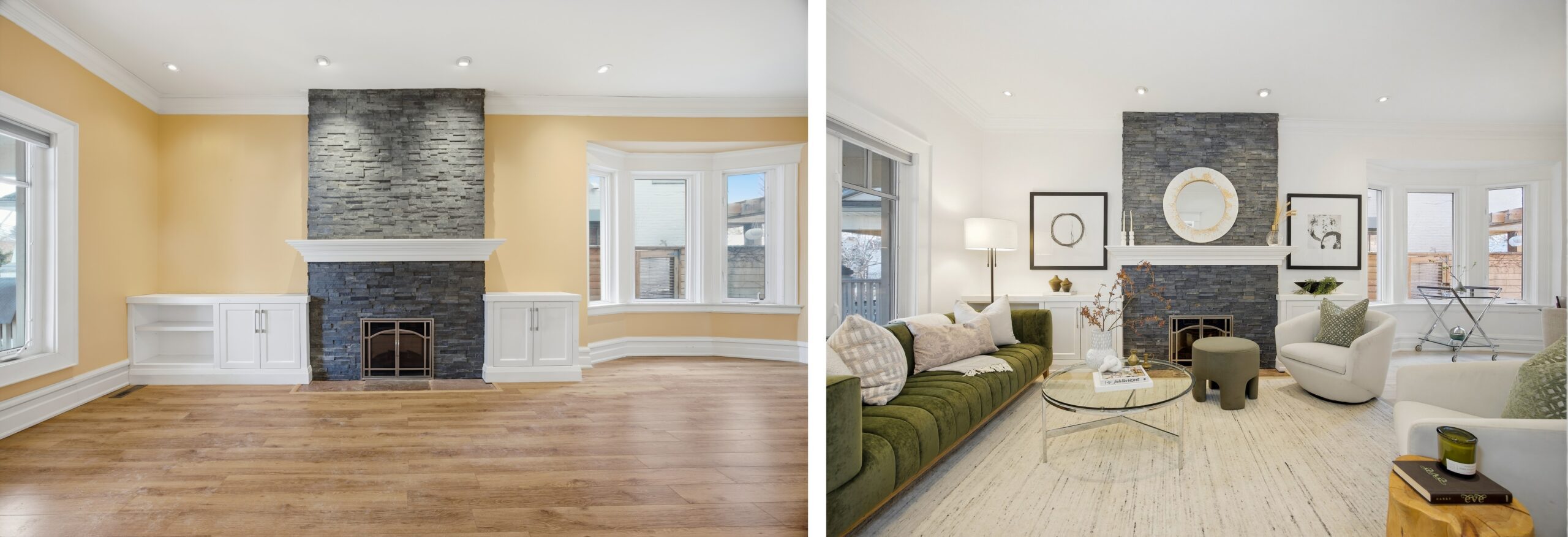
Oh, I should also mention that these photos will be “before and after, after,” which is to say that they’re after the renovations and after we had the property staged.
Our goal isn’t to make a property colourless, but rather to be strategic about where we put colour, as evidenced by the green sofa and accent pillows.
Here’s the primary bedroom:
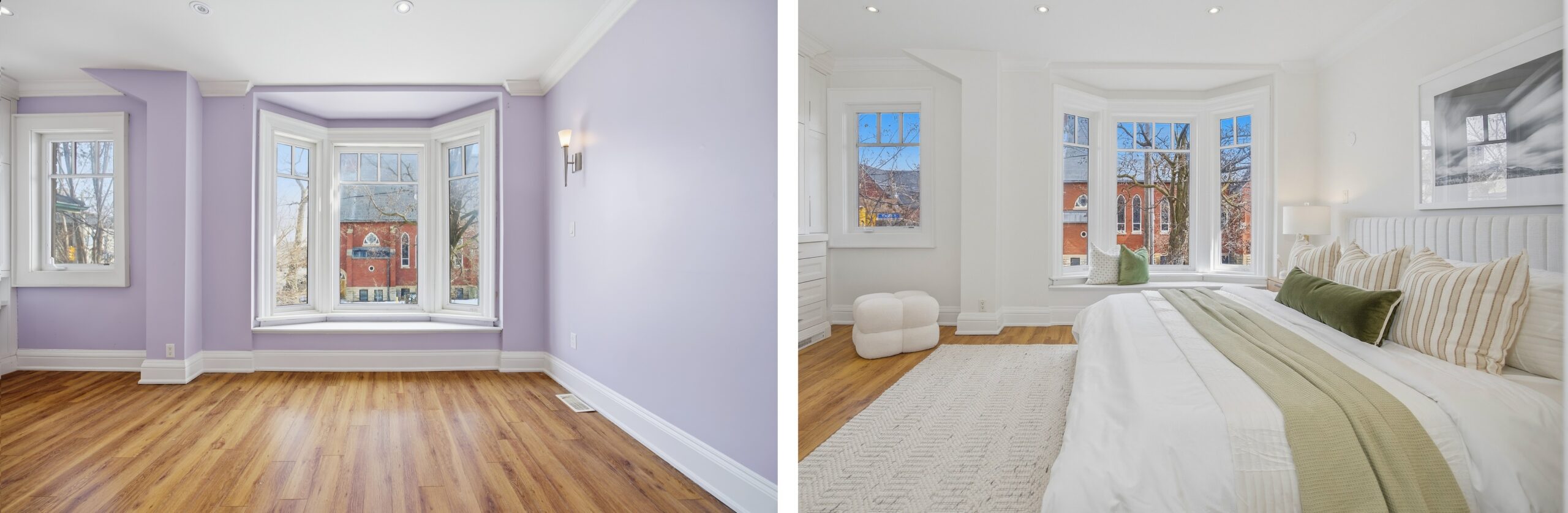
Purple would have been tough to work with, and there’s no question that a neutral, off-white looks better.
–
Flooring
While I’m tempted to say that lighting provides the second-best return on investment, flooring is a close second. Not only that, we didn’t do much in the way of lighting in this house, so let’s take a look at the changes we made to the flooring.
To be blunt, this house had a type of floor tile that I hadn’t seen in quite a while. It was the type of tile that was really popular at one point, but has since fallen out of favour.
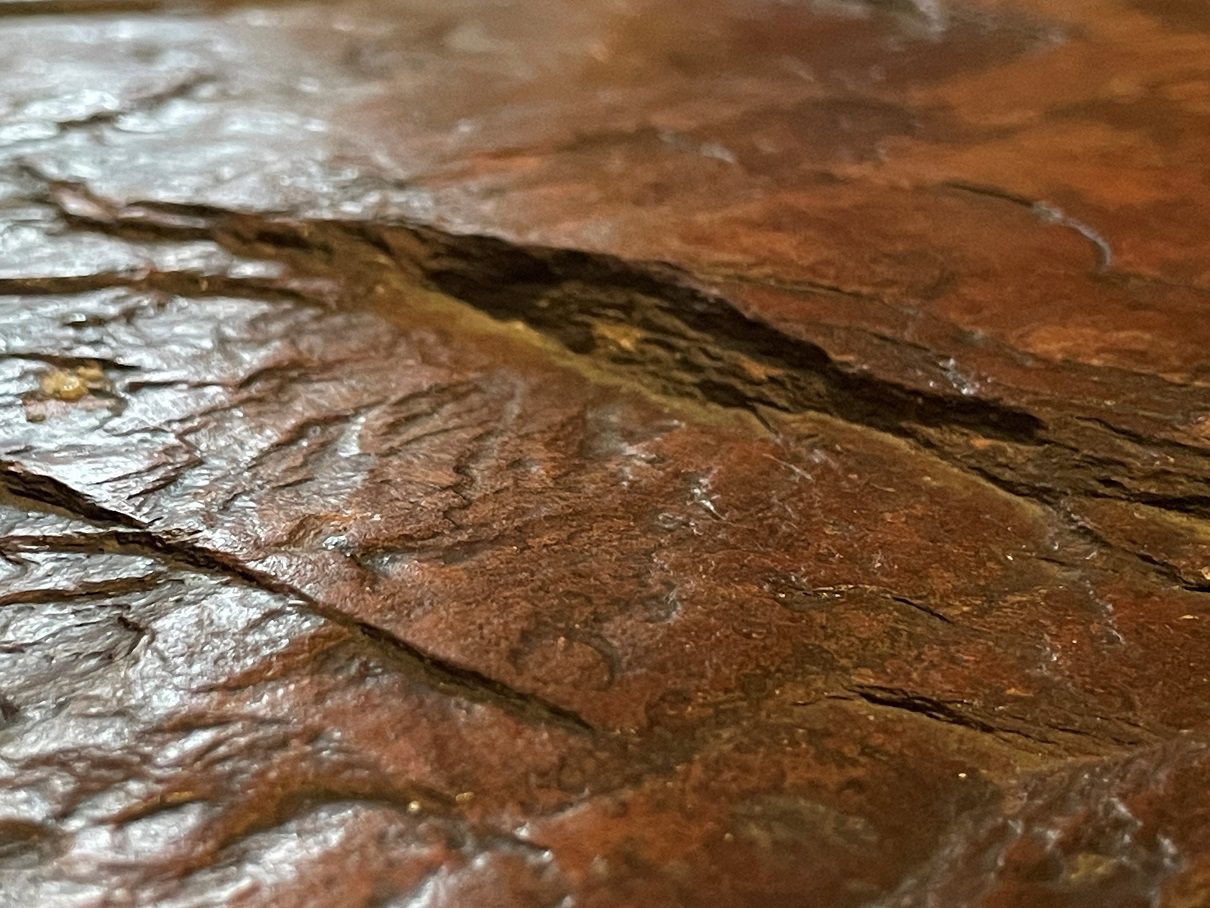
And that’s fair, right? Styles and trends come and go! But the tile was reddish in colour, and it was really, really textured! More tumbled than I had ever seen:
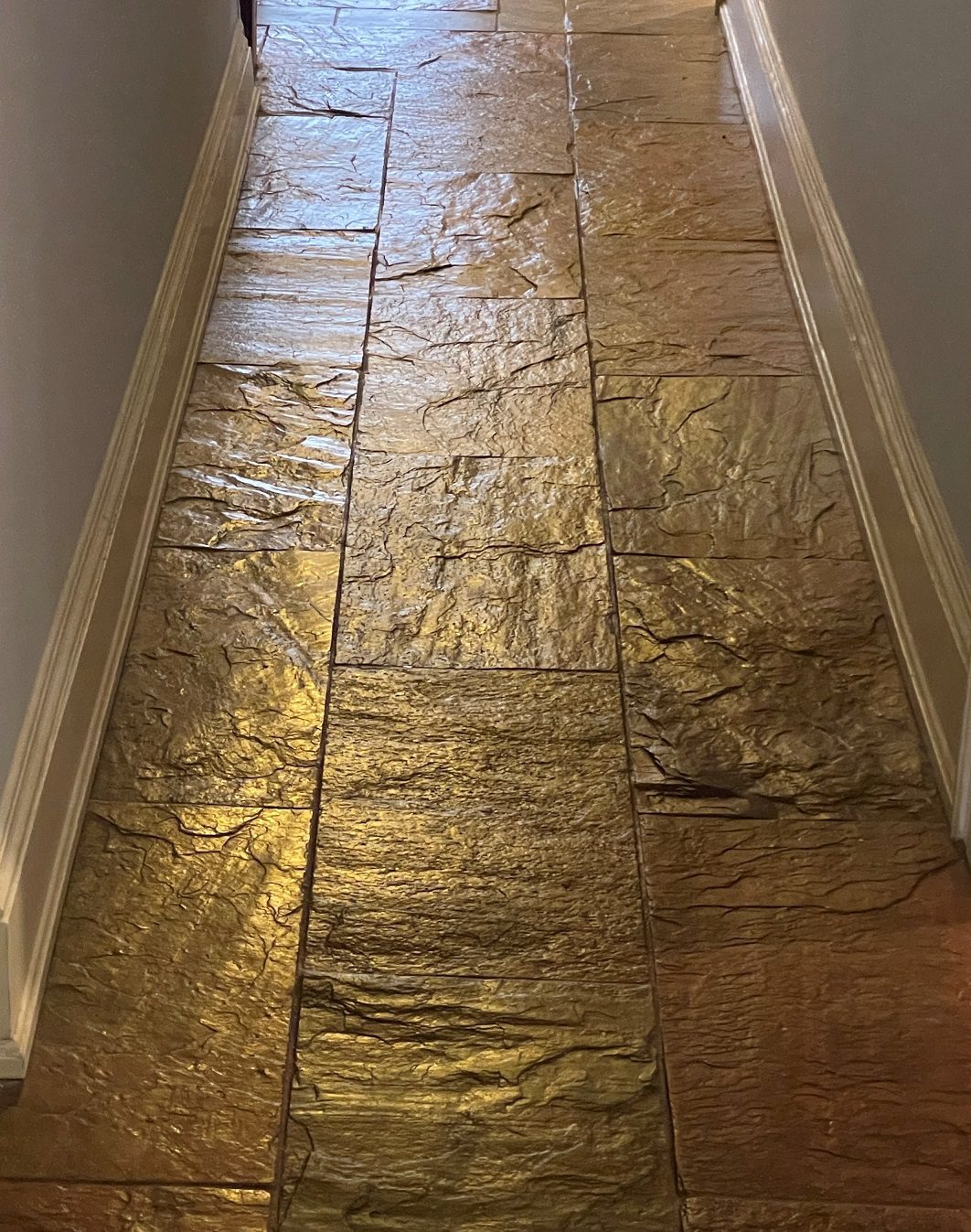
Some of those levels in the tile were pretty deep.
Again, this was a very popular rustic look with cottages and western motifs, but this wasn’t going to play with the buyer pool in 2026:
So here’s what we did:
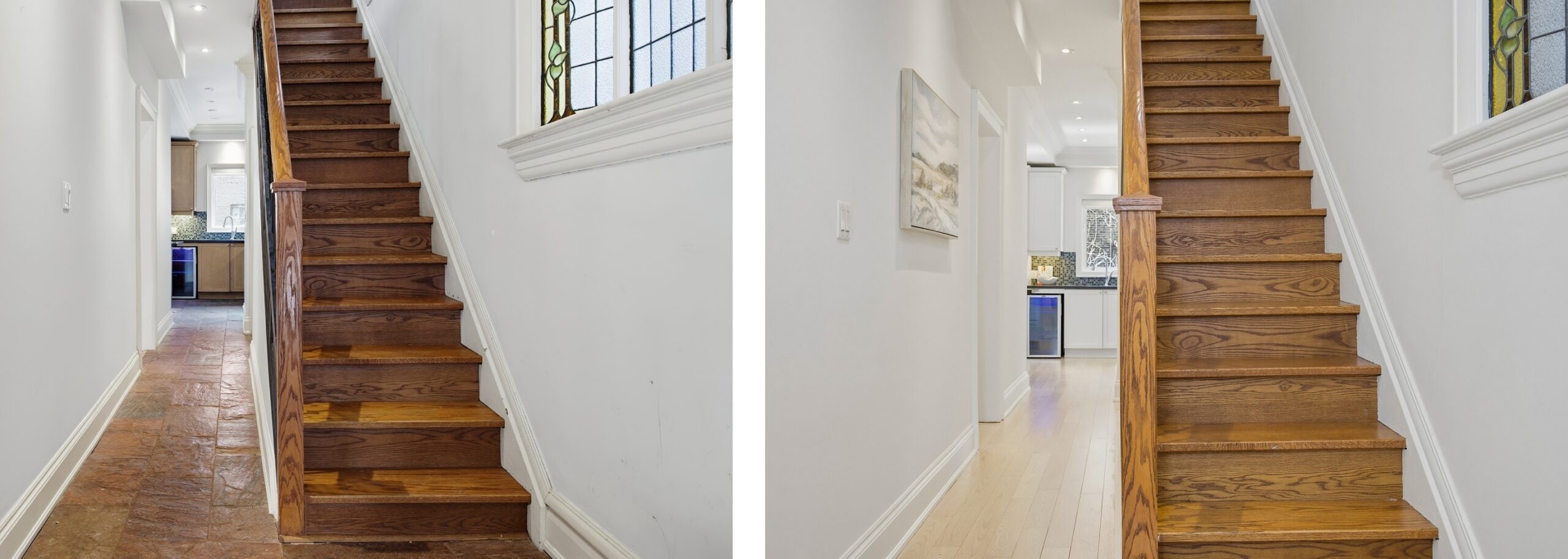
The lighting in the above (right) photo makes it look a bit yellowed, but I’ll show you the true colour in the next set of photos.
Bottom line: the tile was gone!
But here’s the next problem:
Buyers today want consistency in flooring throughout.
It wasn’t enough to replace the tile (which for some reason ran from the foyer, through the hall, and into the kitchen) with one type of hardwood and then leave a different type of hardwood in the living rooms and dining rooms.
So we replaced that as well:
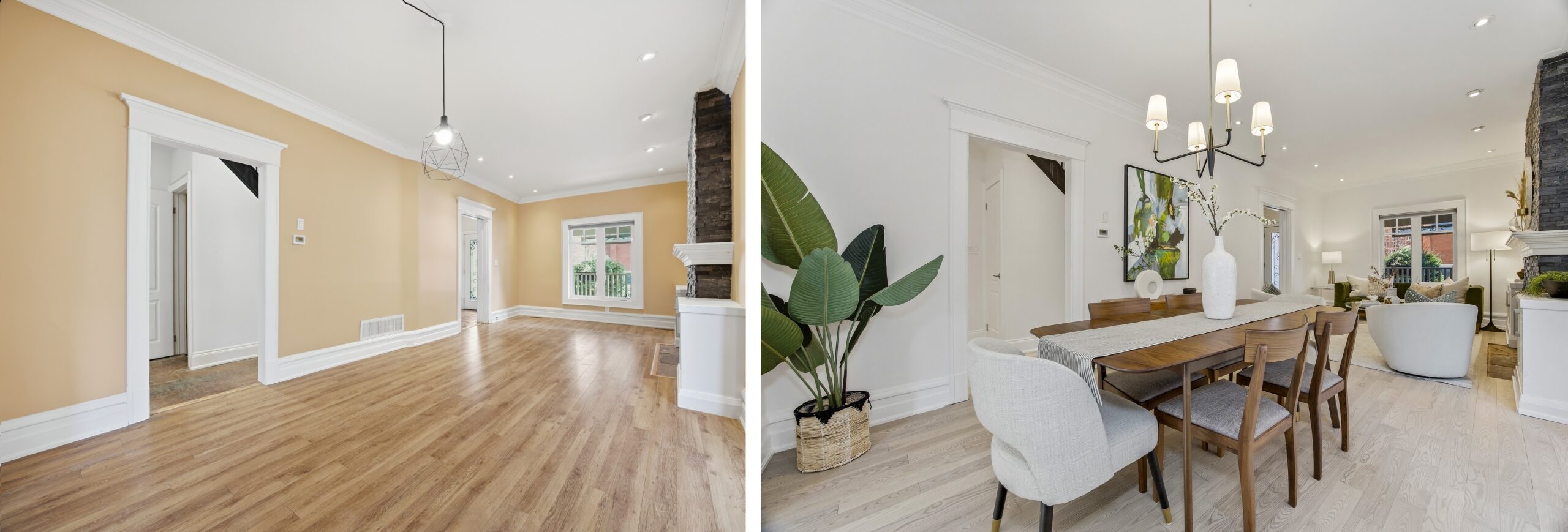
The photo on the right shows the true colour of the new hardwood; a bit more of grey oak than the previous photo showed.
Now, nobody likes carpet right?
Even if we called it “broadloom,” people still don’t like it.
Well, what if you had carpet runners going up the narrow staircase from the second level to the third, and that same carpet ran into the hall and both bedrooms? How do you replace that?
We couldn’t afford to remove the carpet on the stairs with hardwood, but the carpet in the bedrooms was dirty and stained, so we got a cost-effective and more modern broadloom:
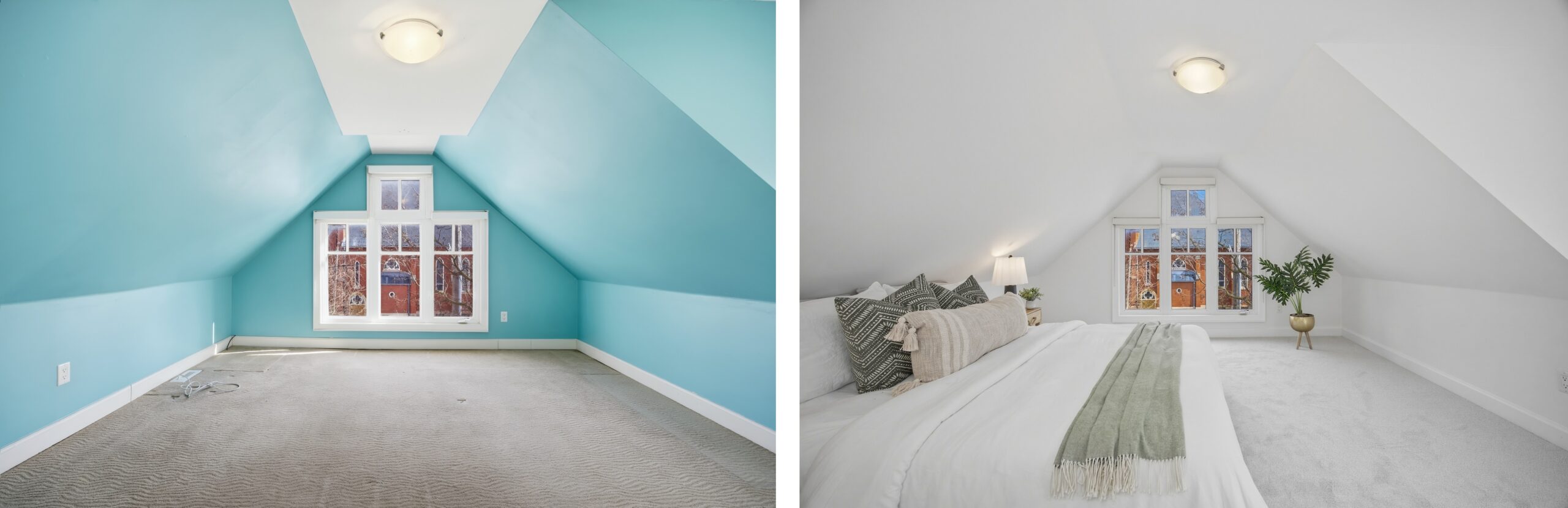
You can’t really tell how stained the original carpet was, but you’ll just have to trust me.
Not only that, we painted out the turquoise, and combined with staging, it made a huge difference.
–
Kitchen Cabinets
“Don’t replace them; reface them!”
I actually just thought of that, but I might use that in future marketing.
It’s true, however. Many sellers think you need to replace kitchen cabinets, but we can spray them, change the hardware, and you’d never know the difference.
Get rid of that early-2000’s yellow wood look, and go bright & light:
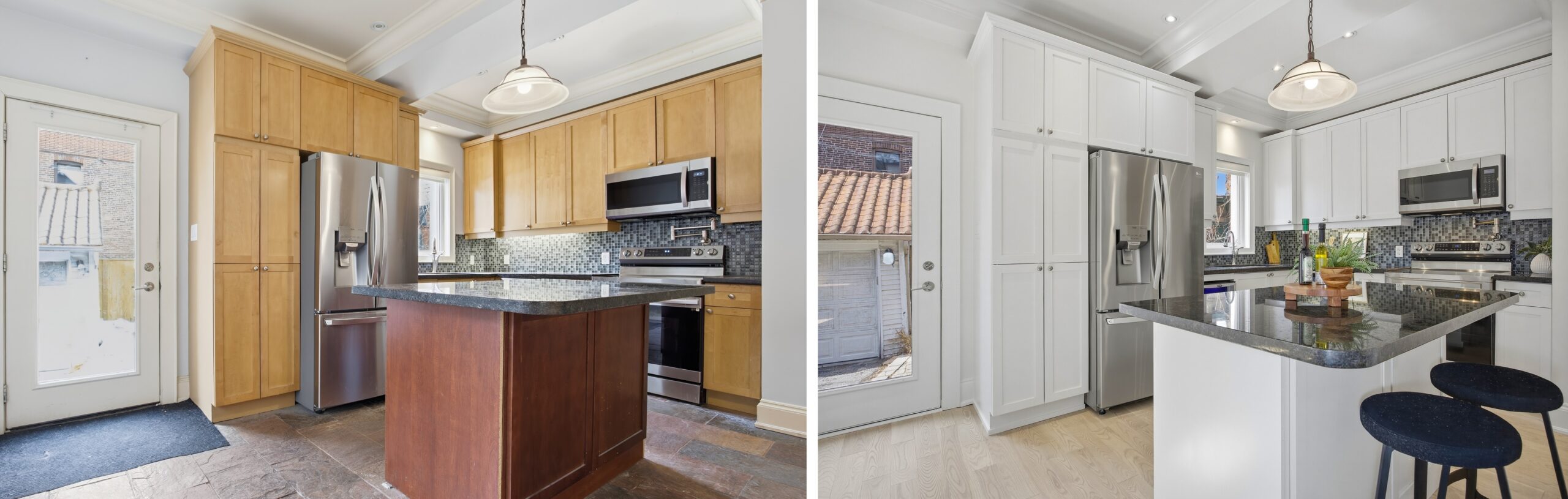
Yessir!
And you’re noticing the flooring too, aren’t you?
This is the literal real estate definition of “night and day.”
–
Kitchen Island
It’s one thing to paint kitchen cabinets, but it’s another thing to do so while leaving the island as it is.
This is a huge mistake that some people make!
We didn’t make that mistake, of course.
We repaired, levelled, and painted the kitchen island:
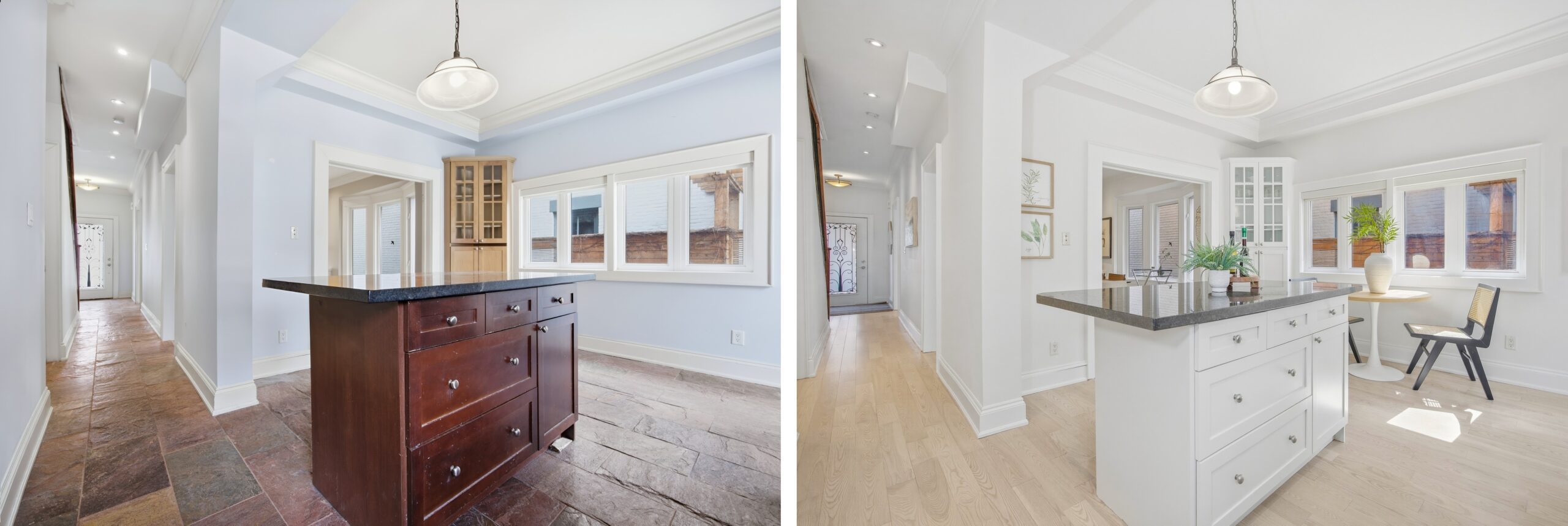
Again, when you pair this with new flooring and fresh paint, it looks amazing.
–
Bathroom Vanities
Is there a place in your house that gets more unintended water than the bathroom vanity?
Maybe the bathroom floor, if you have kids who splash in the bathtub. But for most people, the bathroom vanity is the largest victim of H20 happenstance.
The vanities in this house were in really rough shape!
But believe it or not, these are really simple to replace, as they come in standard widths, just like your kitchen appliances.
Here’s the guest bathroom vanity:
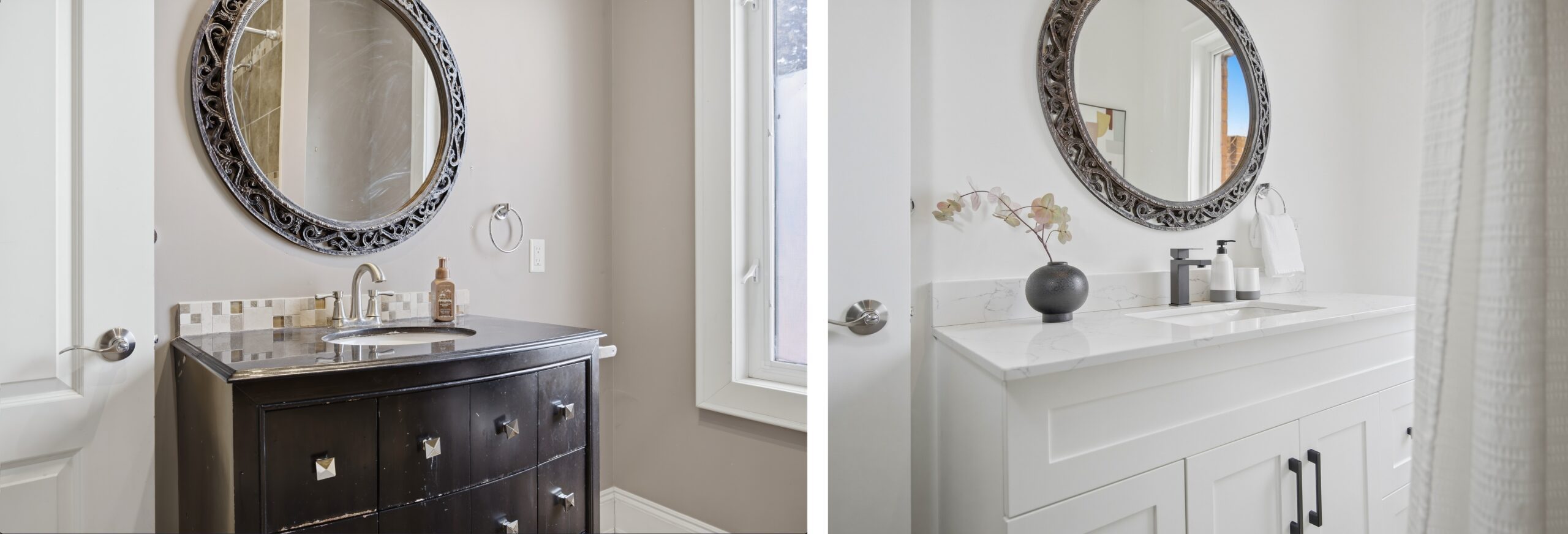
You can see how damaged the original vanity was, on the left, but that photo doesn’t do the true condition justice.
Again, we painted out the existing colour, and completely remade this bathroom.
Here’s the ensuite master bedroom vanity:
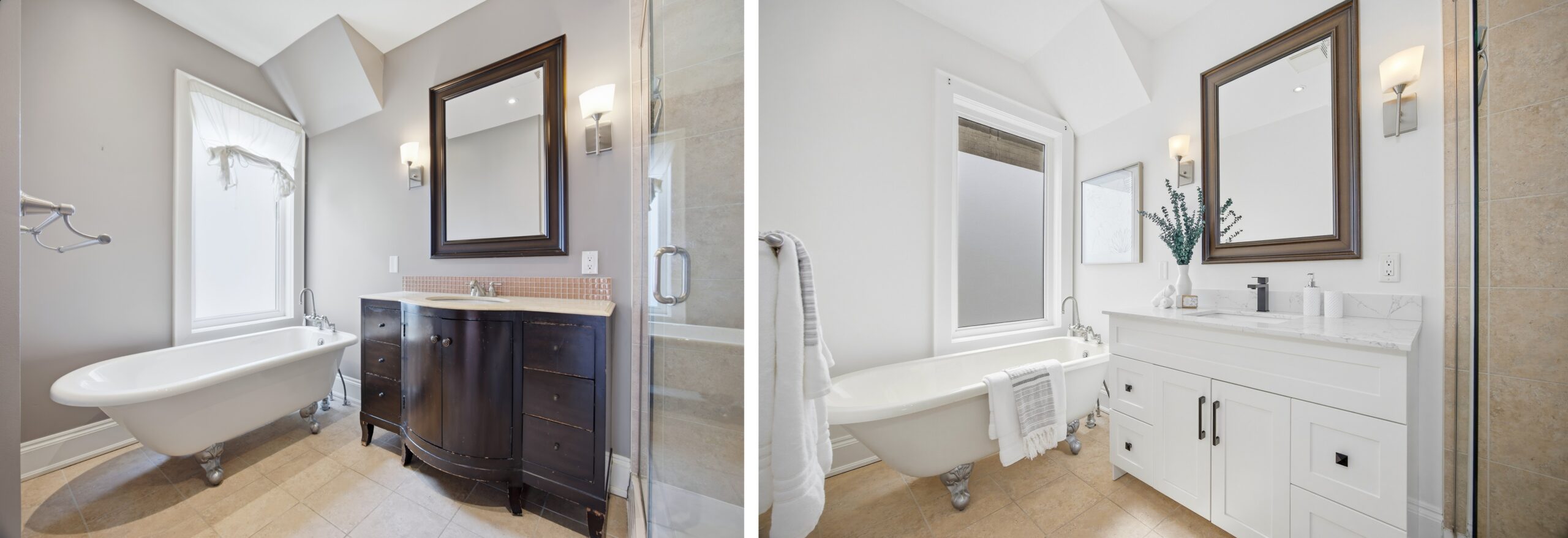
Massive difference!
But notice we were able to keep the floor tile, which probably isn’t the most popular, and still give the whole room a fresh look?
A vanity might cost $800 – $1,000, plus installation. It’s hard to make a bigger impact than that!
–
The “Old Toronto Home Eyesore”
I could have called this many things, such as “Exterior” or simply “Rear Stairs.”
But I wanted you to understand what scares Toronto buyers more than anything these days.
1800’s Victorian-era homes are beautiful, but they can often be really worn down.
What would you think if you saw this:
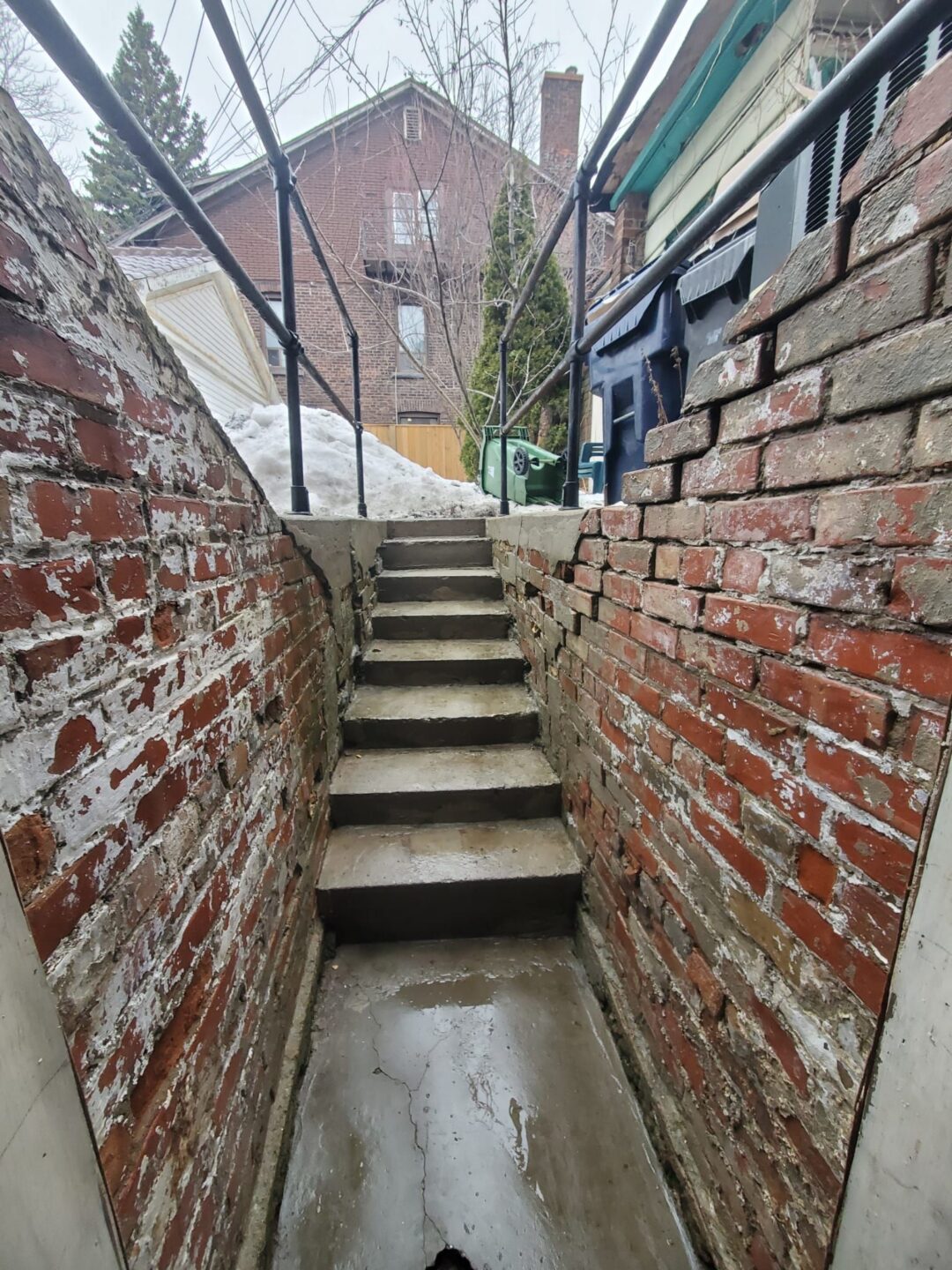
That’s nasty, right?
Google anything to do with “fixing old brick” and you’ll see massive dollar figures being thrown around.
An inexperienced buyer, combined with an inexperienced buyer agent, might run scared from this.
That’s why we did this:
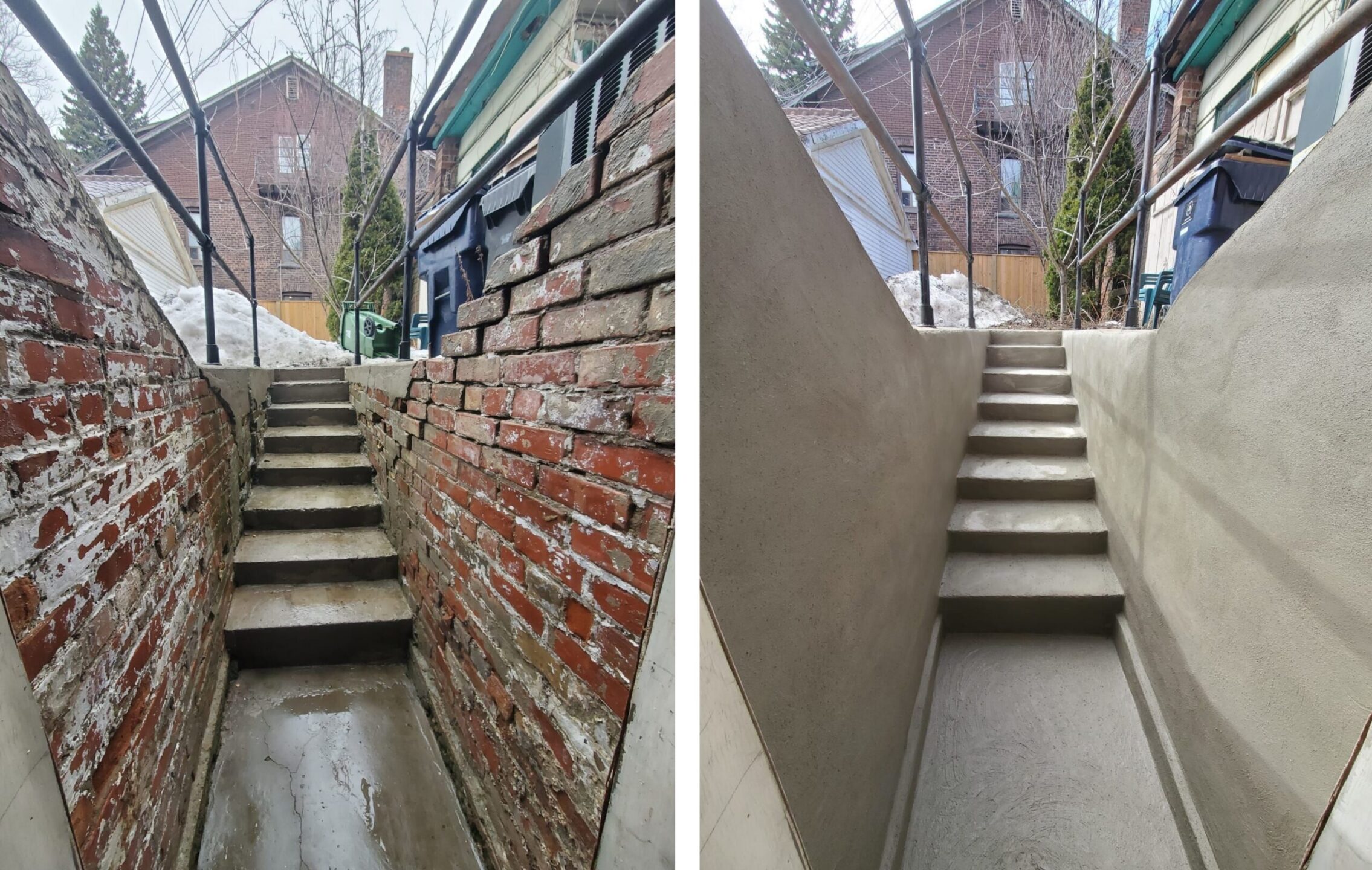
I don’t want to overuse the term “night and day,” but how else would you describe this?
Most people think this costs $40,000, but trust me when I say: it does not.
–
We did various other things throughout the house, but these are the biggest items, with the best before-and-after photos!
Not only that, when I say “painting,” I’m not doing the job justice.
Walls, trim, baseboards, window sills, crown moulding, ceilings – all of it, including repairs. Mudding, sanding, the whole nine yards.
That is what’s meant by “painting.”
And that is the effort that went into every single aspect of this renovation.
In the end, my clients sold the house for $1,705,000, which was far more than they expected. It was also more than I told them they might expect to sell the house for if they did the renovations, so colour me a little surprised as well.
So if you’re going to be selling your house or condo at any point in the near future after reading this, and you think you don’t need to do any work to the house, think again.
Unless you don’t want top dollar, right?
But show me a seller who doesn’t…




























Jamie Sellers
at 2:42 pm
Great article David. I’m not a CPA, but understand that “refresh” expenses are deductible as selling costs in non-arms-length taxable situations that your vendor faced.
I always enjoy your articles on sale and purchase strategy – choosing a listing price, choosing dates/seasons, initial offers, conditions and such.
Thanks again for your diligence continuing your valuable input.
Jenn
at 10:10 am
More of these posts please!!
Robert Allison
at 12:36 pm
David, I’m hoping you can answer this but I understand if it’s not something you want to share. When you do these renovations for clients, do you charge a project management fee, or anything in addition to the standard listing fee/commission?
David Fleming
at 2:55 pm
@ Robert
I do not charge an additional fee.
These pre-listing renovations are one of our competitive advantages in today’s market, and they are included in our fee for service.
Anwar
at 8:00 pm
When you said you had something special for today, I honestly thought it was the story of your mom downsizing. Great photos of the renovation and all, but like come on, take us inside the family dynamics of what went on behind the scenes with this big move!
Ace Goodheart
at 12:27 pm
There’s a lot of dampness in that brick. Did you waterproof it from behind before putting the stucco over top of it? I have seen that attempted several times before with those old below grade double brick walls, and the result is that usually within six months’ to a year, the stucco will detach from the brick face and begin to crumble off, due to water leakage from behind. The only reliable method of fixing that situation is excavation from behind the wall and then waterproofing. I also find that a weeping system can be installed at the same time, as usually there is a drain present somewhere in the floor of the stairwell that it can be attached to.