

Here’s a conversation that I had recently.
Actually, this is the end of a conversation…
When I have a property listed for sale with an “offer night,” I always schedule a call with the sellers the evening before, so that we can go over the day that lays ahead, the process, and expectations.
This is absolutely essential, and yet I find that many listing agents don’t do it. But imagine being a seller who has never sold their home with an offer date before? How would they have any clue what goes on that day?
In any event, I was at the tail-end of one such call a couple of weeks ago, and I asked my clients the following:
“Just to make sure, and I know we covered this already, but to triple-check here, tell me again that you’re positive you don’t rent your hot water tank?”
I can’t tell you how many times I’ve had this same conversation…
“Nope, we don’t,” my clients said, as they probably expected the call to end right there.
“Awesome, thanks, guys,” I said, before adding, “So, we’re sure? Like, sure-sure?”
They said, “Yes, David, we would know if we rented our hot water tank. We pay the bill every month.”
Again, you might think this would be the end of it, but I was on a mission.
“Gotcha, okay, guys, thanks,” I told them. “But….could you just take a quick peek at a recent Enbridge bill to make absolutely sure?”
At this point, I think my clients might have been slightly perturbed with me.
“David, we do NOT rent our hot water tank,” they told me. “But we’ll check, if that’s what you really want.”
We bid farewell, and sure enough, they emailed me twenty minutes later:
“Hi David, see attached, here’s our gas bill. It turns out that we do rent our hot water tank for $28.99 per month plus HST. Who knew?”
Yes, indeed, who?
I’ll come back to this story in a few sections, but first let me ask: what’s bothering you right now?
The weather is better, right? Summer is just around the corner, and people are happier!
There’s no reason to be peeved!
Except, well, when you operate in my line of work, it’s not a matter of finding a “reason” to be peeved but rather finding no shortage of reasons.
Here are a few that I’ve had multiple times in 2026, all having to do with the “details” of an MLS listing, an Agreement of Purchase & Sale, and the intersection of expectations and naivety…
–
“Inclusions & Exclusions”
What is a chattel?
What is a fixture?
Well, there are a lot of ways that we could go about defining this, whether it’s a dictionary definition, a real estate definition, or simply a “common sense” check, if you will.
In real estate, we label a fixture as “anything that is nailed, screwed, or glued.” It makes sense because it rhymes, you see!
We also label a chattel as “anything free-standing that can be moved.”
The problem with these sayings is that there are always exceptions to the rule.
A fridge is a chattel. A stove is a chattel. A chair or a couch is a chattel. But what about a garden gnome? Chattel, right? But what if it’s gigantic and weighs 5,000 pounds?
Out the window with our “anything free-standing that can be moved” description.
A light fixture is a fixture (not just because it’s called a “fixture” but because it’s wired into the house), a curtain rod is a fixture, and a toilet paper holder is a fixture. But what about a bookshelf? What if there’s a single bracket affixing it to the wall so your child can’t pull the IKEA Billy Bookcase on top of himself?
Out the window with our “anything that’s nailed, screwed, or glued” description.
In reality, a Billy Bookcase is free-standing, and that single bracket, weighing 20 grams, that attaches the shelf to the wall won’t make it a “fixture.” Legally-speaking, maybe. But in reality, nobody is leaving that behind.
What’s considered a chattel and what’s considered a fixture is creating major headaches in every Agreement of Purchase & Sale I see these days, no matter how obvious you feel particular items are.
A mirror that’s hanging on a picture hook on the wall is a chattel. But a mirror that’s glued to the wall is a fixture.
Hard stop there.
But two weeks ago, I went for a final buyer visit with clients who paid top dollar for a house, and the bathroom mirrors were stripped from the walls. Not only were they missing, but they left damage to the walls.
I spoke to the listing agent, and she said, “Oh, well, the sellers really liked those mirrors, and they can’t get them anywhere else! They never intended for them to be included in the sale.”
Oh, they never intended, eh? Well, then, they should have excluded the fixture in the following section of the APS:
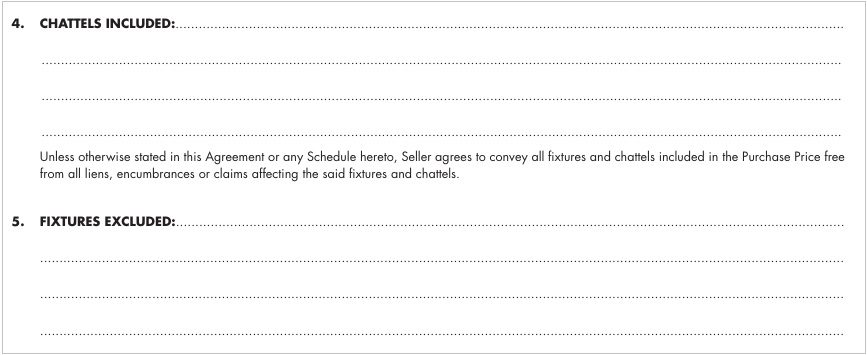
This isn’t rocket science, folks.
When in doubt, include the chattel or fixture in the APS. Even if it’s redundant.
Two weeks ago, clients of mine offered on a house in Kleinburg.
There were about five wall-mounted televisions, and I saw a potential problem.
I wrote in the CHATTELS INCLUDED section:
All television wall-mounts (televisions excluded)
The listing agent called me and said, “Just so you know, the televisions were never meant to be included in the sale.”
She was absolutely correct, and good on her for clarifying.
I explained, “I just want to make sure the television mounts are included in the sale, because technically, they’re fixtures. I shouldn’t need to include them in the APS, but I’ve had issues lately, and I want to clearly spell it out.”
She understood, agreed, and the process was clarified and simplified.
Why don’t agents do this more often?
There’s so much confusion out there about what constitutes a chattel and what constitutes a fixture, and we’re having serious issues pre-closing and beyond.
Now, why did I want those television wall-mounts included?
–
Define “Normal Wear & Tear”
Do you expect the seller to mud, sand, and paint nail holes?
Maybe. Maybe not.
Some buyers will go out of their way to ensure the sellers do so by including a clause in the APS.
Personally, I think that’s silly, since the buyer has no control over how well the seller fills the holes, and because the buyer is just setting him or herself up for disappointment.
But what about massive holes? Like, what goes beyond a simple hole and constitutes an entire part of the wall missing?
This is what happens every time a seller removes a television wall-mount, and I’m so tired of it.
Last year, I had buyers close on a house where the seller had essentially cut out a 6-inch x 36-inch hole in the wall to remove his wall mount.
When a buyer takes possession of a resale home, they know they’re inheriting “normal wear and tear,” and the house needs to be delivered in the same condition in which it was sold. And if the seller makes a small mark on the wall when moving out a couch, well, so be it. I tell my clients, “Be realistic.”
But when sellers are literally ripping walls apart, I have a serious issue.
Now, here’s the rub: there’s nothing the buyer can do about this.
I’ve told you this time and time again. The buyers can threaten not to close, all they want, but something like holes in the wall won’t stop them from being in breach of contract if they refuse to close.
So the way I get out ahead of this is by including wall-mounted items where and when I can, sometimes, even if the buyer doesn’t want them. Because in my experience, the buyer will put more care into removing a wall-mounted fixture in a new house that he or she is moving into than a seller who is rushing to move out of his or her old house…
–
“Buyer Agent To Confirm All Measurements”
This has long been a thorn in my side, but it’s more so in 2026.
For many years, real estate agents have been attempting to absolve themselves of liability by simply detailing, “Buyer to verify” in certain parts of the MLS listing.
This is utter laziness.
Buyer to verify all measurements.
Buyer to verify taxes.
Buyer to verify all information.
The problem that I have with this is twofold:
1) It’s lazy.
2) It’s unenforceable and thus irrelevant.
As I wrote in a blog post in 2024, there were a slew of new regulations introduced by the Toronto Regional Real Estate Board pertaining to use of the MLS system.
One such regulation was the following:
“Members are responsible for the accuracy of information submitted to the MLS System, including photographs and all documentation. No language in the MLS listing shall be used to override or diminish this responsibility.”
And yet, we still see it all the time.
Here’s an example:

Verify all…….costs?
Like taxes, maintenance fees, rental agreements, et al?
This is almost funny. Almost.
The listing agent is simply throwing his or her hands up and saying, “I don’t know, and I don’t care,” and then hoping that a lame disclaimer like this will absolve them of their liability.
I’m tired of it.
Do better.
–
Much Ado About Rental Items
I saved the most important (and longest!) for last, folks. But you won’t want to skip this part. Trust me.
We’ve talked about this many times before here on TRB, but perhaps the following story will add more colour, perhaps than we’ve ever seen before…
I submitted an offer on a freehold property for buyer clients back in February, and yadda, yadda, yadda, it was accepted.
But it wasn’t the property, the price, or the offer process that was the story. It was what happened after.
Two weeks after we unconditionally purchased this house, and the Agreement of Purchase & Sale was firm and binding, the listing agent emailed me the following:
Hi David,
The HVAC system is a rental.
It’s $49.99+HST per month for the furnace and $39.99+HST per month for the air conditioner.
I’ll prepare an amendment and send your way for signing.
Thanks, have a great day!
(name)
Oh, you will, will you?
Nuh-uh.
I don’t think so.
You see, a rental item is something that must not only be disclosed to buyers, but also be included in the Agreement of Purchase & Sale. Otherwise, it is the responsibility of the seller to discharge the contract and/or free the property of the rental item.
Here’s how it appears on page two of the standard APS:
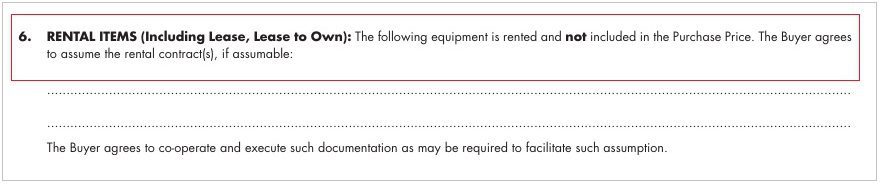
Failure to include a rental item in section six does not mean that the buyer ends up paying for the contract.
The listing agent on the other end of my purchase either didn’t know this or simply didn’t care.
But an Amendment is a document that must be signed by both buyer and seller; otherwise, what you are amending doesn’t take effect.
There was no way my buyer was going to agree to take on $100 per month in contracts that was not disclosed in the MLS Listing and was not included in the APS.
Speaking of the MLS listing, here’s how it looked:

“none”
It doesn’t get any clearer than that, does it?
I wrote the listing agent back the following:
Hi (Name),
These rental items were not disclosed to the buyer.
They did not appear on the MLS listing. In fact, the MLS listing read “none” under Rental Items. Please see attached PDF of the listing.
These rental items were not included in the Agreement of Purchase & Sale.
The Agreement of Purchase & Sale is firm, and your sellers signed the Confirmation of Acceptance to execute the sale.
My clients will not be agreeing to take on these rental contracts.
Please ensure that your sellers buy out the contracts and provide proof of same before closing.
I have CC’d my buyers’ lawyer above.
David.
I would consider that email to be professional, wouldn’t you?
The agent called me that night and lit into me.
She threw every excuse at me.
“This happens all the time,” she said.
“It’s not that much money,” she offered.
“You’re being difficult,” she accused.
But in the end, it didn’t matter. Most rental contracts are registered on title to the property, many as liens, so her sellers would have to buy out the contracts, or the sale wouldn’t close.
Three days later, she called me back and tried being nice.
“My sellers are telling me I have to buy it out myself,” she said. “They told me it’s my mistake and they’re not paying for it.”
She asked me to “help her out,” noting that the buyout was several thousand dollars.
I told her that, respectfully, my clients purchased a property with no rental items, and they were going to close on a property with no rental items.
She eventually changed her tune.
“If you think I’m fucking paying for this, you’re on drugs,” she told me, verbatim.
I replied, “I haven’t done drugs since February of 2007, but I’m getting a bit high off your sense of entitlement right now.”
She hung up the phone.
The sale closed in March, and my clients did not assume any rental contracts. The furnace and air conditioner were free and clear.
I have no idea who paid the buyout in the end, but it doesn’t matter whether it was the seller or the listing agent.
In today’s market, agents have to go the extra mile in ascertaining whether there are rental items in the house.
Here’s how a listing should read:

That’s a disclosure with the rental items and the cost!
All the better!
Here’s another example:

This one goes even further and notes the buyout amount.
That’s great work on behalf of the listing agent, who is trying to show that the buyout isn’t that bad.
We should really make this a requirement to list properties on the TRREB system, but as we’ve seen in previous examples today, making something “mandatory” doesn’t mean people will do it…
–
Let’s return to the story I told at the onset.
I explained that my own clients were unaware that they rented their hot water tank, and upon finding the rental amount buried in a line item in their Enbridge bill, they said, “Who knew?”
If you find out tomorrow that you actually rent your hot water tank, but you never knew it, don’t feel bad.
You’re not alone.
This is happening all over the city right now, and I know this because it’s playing out in live real estate transactions this year.
The reason I was so persistent with my clients, almost to the point of causing them annoyance, is that so many homeowners have rental items they’re unaware of.
If you get a bill from “Vista Credit Services” every month, you’re probably aware that you rent your hot water tank.
If you have a direct withdrawal from “Reliance Home Comfort,” then what else could it be?
However, make sure you check your Enbridge bill. You think this is simply for household gas, but a lot of people have a hot water tank on that bill that they didn’t know they were renting.
And thus, so many sellers take their properties to market, unprepared.
Then again, just as many agents neglect to ask…
…and then ask again…






























Francesca
at 8:19 am
When we bought our current condo there were various items of furniture included in the contract including a bedroom large mirror on a wall. When we did our final inspection all items that were supposed to be left behind were there except for this mirror! By removing it they left huge holes in the wallpaper wall that could only be concealed by hanging another mirror of the exact size. The bedroom also had no other mirror besides this one which was one of the reasons we included it in the sale. Luckily our realtor quickly resolved the problem by calling their realtor and had them return it and hang it back.
JF007
at 9:38 am
David you didn’t end the story about the missing mirrors please do share how it went. Looking for some gossip with my morning Tims 😀
Derek
at 10:09 am
I think I’ve posted this before, but I bought a property and 2 issues came up. The first was the large plastic shed, bolted to a base at the back of the yard. The second was a set of cabinets in the laundry room, which were just placed against the wall, but not actually mounted to the wall (you couldn’t tell they were not mounted unless you tried to move them). Before closing the selling agent reached out to ask if we wanted to also buy those items for some additional sum of money. I think we just said, we thought we bought them, but go ahead and take them if you want them. They did not take them.
Jennifer
at 12:16 pm
Curious whether that agent paid for the rental buy-out. If she asked and they said none, that is not on her. The sellers obviously signed the APS too, the part where it said rentals none, so they are not of cleaned hands. On the other hand, is seller able to remove the rental before closing as they do buy-it out and then if so, would buyer not have to replace it? What happens then?
Derek
at 1:06 pm
I imagine the buyer would expect to receive the home with the furnace and a/c units installed in the same condition as when they signed the APS.