

Well folks, it’s that time of year again.
Just as Christmas Eve is synonymous with “plays of the year” on TSN, Sportsnet and the like, and just as New Year’s Eve gives us those “2018 In Review” shows on CNN and CBC, I always like to wind down the year with the same themes.
On Friday, I gave you my last “MLS Musings” post of 2018. While photos and MLS captions don’t exactly have expiry dates, I do like the tradition of putting everything in the queue onto the blog at year-end, and starting fresh in the New Year.
Then comes my “goodbye week,” where I like to recap both the year in blogging and real estate, with back-to-back “Top-Five” posts.
In years’ past, I had penned top-ten lists, or combined stories and blogs together. But I think we’ve grown into a solid, workable format here, even though I have to whittle down 120+ blog posts into merely five.
In choosing my top five blog posts, I’m not merely looking for the posts with the most comments, although that’s something to look out for.
There are other aspects of a blog post that I look for in addition to the ability to capture the attention of readers. I’m always curious to see if the topic is still relevant a week, a month, or a year later, in addition to the impact the article had at the moment it was posted. Unique or previously-unexplored topics always make for memorable blogs. Something that Googlers could find down the road and still learn from makes a good post, and often it’s something that I just sat back and said, “Damn, I’m glad I wrote that.”
I can’t quite put my finger on it, but I usually come up with a short-list of 10-12, and the top four always stand out.
It’s all subjective, but that’s why I’d love to hear from you, the readers, as well.
So without further adieu, here are my top five blog posts of 2018.
–
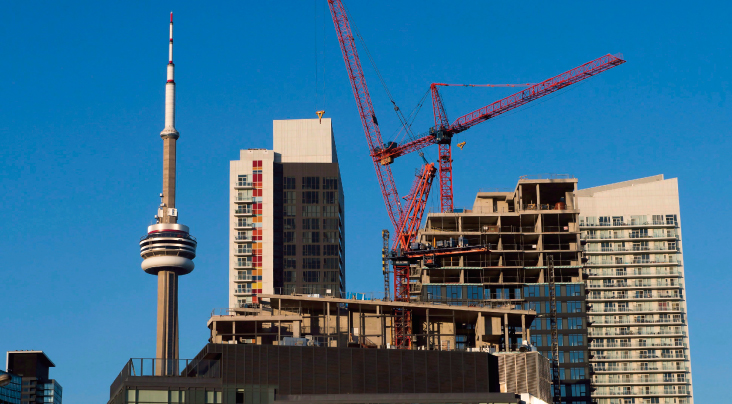
5) What Does It Cost To Build A Condo In 2018?
We’re starting with a pretty unsexy topic here, but when you get past the title, is it really that unsexy?
It’s not controversial, and many of the top TRB posts are exactly that.
But what I found the most stimulating about writing this blog post was the fact that, from what I can tell, it had never been done before.
Ask around, just try. Ask if anybody knows what it costs the developer to construct a single square foot of downtown Toronto real estate, and you’ll get a multitude of estimates, at best, which are entirely based on nothing.
I mean, ask somebody who works in the development field, and sure, they’ll be able to hone in on it. But most people out there today with an interest in real estate are simply guessing, and guesswork, combined with frustration, often leads to exceptionally biased and incorrect conclusions.
That is what led me to conduct the research for this post, since there’s a common misconception out there among the would-be buyer pool that “developers are getting richer and richer” as the market goes up, when in fact, margins are shrinking.
In March of this year, I was part of a round-table discussion for a Toronto Life article that would come out in June, called “SKY HIGH: A Real Estate Roundtable on The State of the Condo Market.”
One of the panelists was a gentleman named Shamez Virani, who is the president of CentreCourt Developments.
Now the regular readers know that I do not like condo developers, nor would I be inclined to get along with one. But during the course of three hours with Mr. Virani, I honestly didn’t take issue with a single thing he said, and that’s not like me. He was courteous, respectful, extremely informed and insightful, and just as passionate about the city of Toronto as I am.
Mr. Virani opined that a major hurdle to condo construction in Toronto is the speed at which City Hall moves – a topic we covered several times, although I’m not sure if any of this made it into print. He also mentioned the shrinking real estate margins, as the acquisition cost of land has increased dramatically, as have operating costs.
Shrinking margins, eh? I’ll believe it. No question about it.
Toronto used to be a city of parking lots, and finding a prime, build-ready site in the downtown core was easy. Today, we’re doing land-assemblies for residential, commercial, and industrial alike, and buying 25-storey office towers to tear down and replace with 70-storey condos.
But this conversation at the Toronto Life roundtable got me wondering about the actual cost to build a condo in the city of Toronto, and not just a number, but rather a complete breakdown of land costs, hard costs, and soft costs.
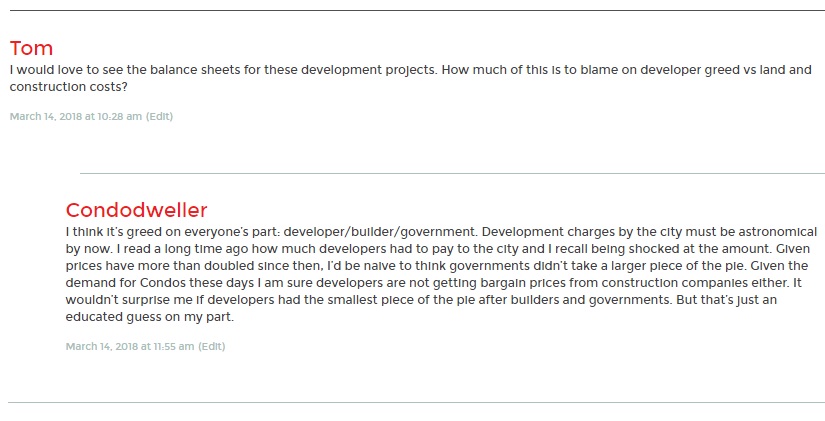
A comment, and response, on a previous blog post also spearheaded my desire to put numbers together, which reads as follows:
So I set out to put numbers together, and what I found in the end was that the average price per square foot, built, of condominium space in the downtown core was approximately $850 per square foot.
Whether you believe that figure, or not, now would be a good time to go back and read the blog post!
Condodweller was absolutely bang-on with his assessment above.
The city takes a massive piece of every unit built in Toronto, and construction prices, hard/soft costs have skyrocketed.
The developer truly does take the smallest piece of the pie in the end, although if a developer can leverage enough, then they’re doing okay in the end!
For those out there that believe “developer greed” is driving real estate prices in new construction, think again. It’s the easy answer, like blaming nameless, faceless, foreign buyers for higher real estate prices in 2016 and 2017. Perhaps it’s time we really look at just how fat the City of Toronto has gotten from sucking at the real estate teet for so long? I can’t wait to see them complain about how their “revenue” from land transfer tax is down in 2018, but that’s another story…
–
4) What Is The Government Doing To Tackle Consumer Debt?
This post definitely falls under the category of, “It’s on the list because of the response it elicited from the readers.”
116 posted comments, and all but a couple were posted within the first 48 hours.
I wrote this blog over last Christmas holiday, based on my experiences in Shopper’s Drug Mart and Canadian Tire.
Honestly, my mind never stops thinking about blog ideas. After 11+ years and 2,000+ blog posts, I always wonder, “Is today the day I run out of things to say?”
I like writing about real estate, but as you can tell, I also like writing about politics, personal finance, economics, and all things Toronto.
While most commenters agreed with the bulk of what I wrote (save for the complicated mathematics behind Shoppers Optimum Points), a few readers felt as though a real estate agent, who benefits from consumers taking out mortgage debt, sounds insincere in suggesting that other kinds of debt are “bad.”
That’s why I sat down and provided a well-thought-out follow-up:
January 10th: “Household Debt vs. Mortgage Debt: The Good, The Bad, & The Ugly”
Combine the two posts, take away the emotional responses, and I think that the readers concluded that it’s not necessarily “debt” that’s the problem in Canada; it’s financial literacy.
And this would become a recurring theme throughout the year, in my opinion, as I began to see financial literacy as a sub-topic in just about everything we discussed!
Just as I will suggest in Blog #3 that politics is in everything we do, I also think that so much of what we see out there in society today is impacted by financial literacy, or a lack thereof.
Now as much as I want to turn this into a conversation about how the public school system in Ontario has been bastardized to the point where kids graduate high school and no nothing about personal finance, I’m going to resist that temptation. Also mentioned in Blog #3 below: I’ve become too political for many-a-readers’ liking.
But after reading the comments in both blogs above – close to 200 in total, I realize that one man’s “good debt” is another man’s “bad debt,” and when you combine this with various levels of personal risk tolerance, and investor behaviour, it all simply boils down to financial literacy.
My story about the kid selling credit cards in Canadian Tire, and my story about the woman piling unwanted, impulse items on the conveyer-belt at Shoppers Drug Mart to score more “points,” both actually have less to do with debt, and more to do with financial literacy.
And same goes for the discussion in the follow-up post about household debt versus mortgage debt. I would probably argue that the government should spend more time looking into predatory lenders like Money Mart, who charge 7,000% interest, than look to make mortgages more unattainable. But he of dissenting opinion might suggest that if we educated people properly, they would understand how Money Mart and Cash Money actually work, and never use them in the first place.
This topic is going to show up in Wednesdays’ blog, so rather than writing more for you to read here, I would suggest you spend the time reading the first two blog posts instead…
–
3) Should Housing Be A Basic Human Right?
Oh, look, here’s me making something political again!
Well, what can I say?
I could have mentioned above, when I noted that in the past that the readers have given me their two cents on what could have been included in my “Top Five” lists, that one reader mentioned in 2016 that the blog about the birth of my daughter should have been included. He went on to say that it will be interesting to see how fatherhood, and Maya herself, would eventually shape my views, thoughts, and perhaps writings too.
It’s true.
Since Maya was born, I think I have aged about fifteen years. I am very close to being that old man who stands on the front porch and shakes his fist at young whippersnappers as they skate by.
And it’s also true that I’ve become more political, but I just can’t help it. Politics is in everything we do, and I’m almost bothered more by the people who don’t follow politics, and the decisions that are being made out there on our collective behalfs! Or maybe I’m jealous. Yes, that’s it, I’m jealous that they don’t lay in bed at night, trying to sleep, yet having a full-on argument into my pillow…
When I was away in Idaho during the summer, I kept up with the news, and I might argue I read even more since I had less on my plate. One of the hot topics at the time, it seemed, was “housing as a right.”
I believe there is no more misunderstood concept out there than “rights versus privileges” in today’s society, and it’s really, really tough to beat out “needs versus wants” in our all-consuming, debt-driven world.
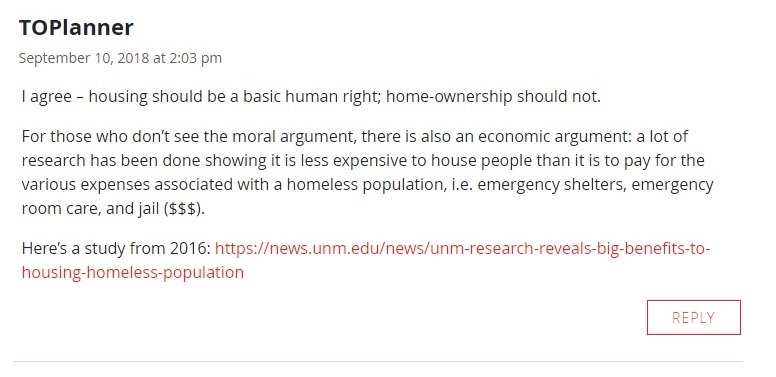
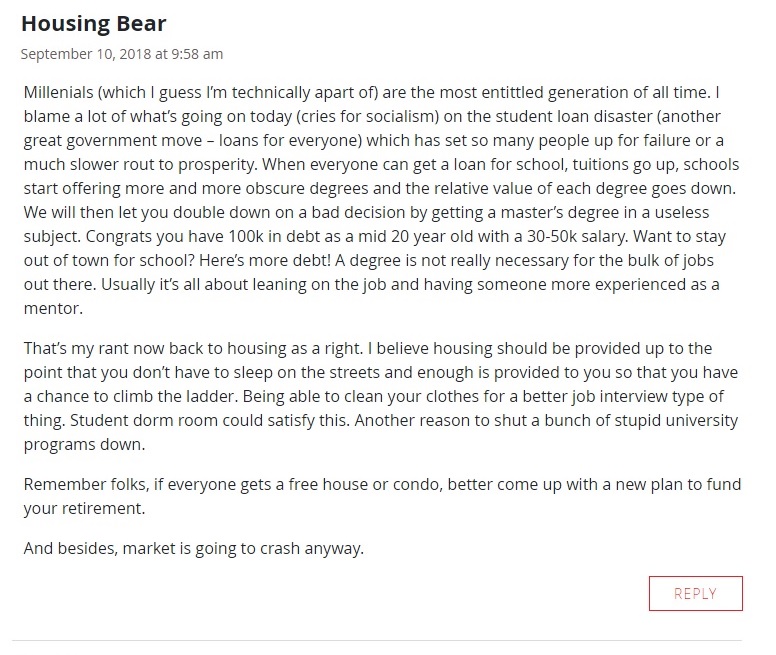
As much as I feel for people who can’t afford to live where, or in what, they want, I refuse to ever accept that home ownership is a right.
Housing in general? Absolutely.
I may be a fiscal conservative, but I’m proud of Canadian policies like universal healthcare.
Healthcare became a basic human right in 1948, when it was designated as such by the World Health Organization.
Also in 1948, the Universal Declaration of Human Rights was adopted by the United Nations, and Article 25 specifically states: “Everyone has the right to a standard of living adequate for the health and well-being of himself and of his family, including food, clothing, housing and medical care and necessary social services.”
This, of course, is not law; but I still believe in housing a basic human right, at least in first-world countries where it’s possible to actually provide housing for all.
Beyond that, my opinion would start to veer from those of many. I don’t believe that those who are looking to the government for free, or subsidized housing, have any right to demand where it is. We would all like to live in Toronto, if we had a choice. But is that a right? I’m not so sure.
I also don’t believe that home ownership is a right, and this is where the “housing as a human right” argument goes right off the rails.
Those that hold signs at protests saying “Housing Should Be A Human Right” are often protesting things like “high real estate prices.” If their argument was that governments should be building more affordable housing, more shelters, and providing more incentives for developers to create purpose-built rentals, then real estate prices shouldn’t factor into their arguments.
But I personally believe that a person who is likely to head over to Staples, purchase a large piece of bristol-board, create a sign and affix a stick to it, and head down to a protest, is more likely to protest at the furthest end of the spectrum, than somewhere in the middle.
And the more people who protest “high real estate prices,” the less the conversation remains on things the government actually can, and should be focusing on, like building affordable housing, and trying to direct the private sector toward building rentals instead of condos.
Home ownership should never be a right in Canada. If Justin Trudeau is elected for a third term, mark my words – it could be!
My readers were all over the topic back in September, and while there are so many great comments, I wanted to share these:


–
2) The Friday Rant: Has The World Lost Its Mind?
The Friday Rant used to be a Toronto Realty Blog regular feature, but as I slip into middle-age, it’s possible that I’m becoming a bit calmer.
I only produced three Friday Rants in 2018, although there were only two in 2017. While I’m at it, let’s see here….two in 2015, seven in 2014, nine in 2013, thirteen in 2012, ah you get the picture.
It takes a lot to get me riled up enough to consider something worthy of a “Friday Rant,” and earlier this year, I’d had enough with the whining, complaining, and the complete lack of self-responsibility when it comes to cancelled condominium projects, not to mention – freehold developers that were (egad!) offering properties at lower priced, after, yah know – market prices had dropped!
That was a mouthful, so let me explain this a little more eloquently.
In late-2017, a pre-construction condominium projected called “The Museum FLTS” was cancelled, and the media chose to focus, as they always do, on the evil developers rather than the risk-taking condo-buyers. Don’t get me wrong, I have opposed the purchase of pre-construction condominiums, in favour of comparable resale, for over a decade, for exactly this type of reason. Developers can do whatever they want, and often, do. But never are the pre-construction condo buyers, who take the associated risks, taken to task for a failed endeavour.
You can read my 2017 blog post here: “Another Pre-Construction Condo Project Cancelled. Who Is To Blame?”
After I wrote that blog, I received several emails from buyers in this project, ripe with self-pity, who refused to accept ANY responsibility for the outcome, and a couple who took things a step further – using words like “owed” and “should” and “deserve.”
I moved on, but it wasn’t long before a similar, and dare I say even more pathetic story ran:
“What did the neighbours pay? Whitby homebuyers just found out the answer: a lot less”
Remember this story?
I wanted to tear my hair out, I really did.
In a nutshell, a subdivision developer sold a bunch of houses to people, and then sold a bunch of other houses, to other people, at lower prices some time later.
And this is a problem?
Oh, right! I forgot! The price of real estate only ever goes UP, forever!
This article was ripe with sad-sack photos of the buyers, complaining that they purchased houses one year ago, only to find out that similar properties were now being offered for sale at a $75,000 to $90,000 discount.
Oh, the entitlement!
The quotes in this article were just unbelievable!
“To come back a year later and see the same house that we bought is now $90,000 cheaper, that’s not cool,”
“There are no building materials on site, there is no foundation poured, so I don’t understand how we are paying more than someone who bought a couple of weeks ago.”
Read the blog.
Read the article.
And then join me in a solid shake of the head.
This blog post produced 86 comments, most of which agreed with me, that we’ve turned into an entitlement-society where fewer and fewer people are willing to accept that actions have repercussions. There was some dissent, as there always is, but I was pleased to see that I’m not the only one jumping off a bridge.
I won’t belabour this blog post, because I’m going to bring this theme up again in my “Top-Five Real Estate Stories” on Wednesday. Spoiler alert…
–
1) “Realtor Stats: How Many Transactions Were Agents Doing In 2017?”
You might not think this is deserving of the “Top Post” of the year, but I assure you, it warrants consideration.
Picking the “top post” is going to be subjective no matter what, and as I said at the onset, the fact that I’m the one writing the posts and picking making this list could present some bias.
But having gone through 122 blog posts from 2018, and weighing about a dozen posts on my short-list, I have to think this is my most important post of the year.
Perhaps the public doesn’t quite care enough to warrant such a ranking, but I assure you, the ripple effects of this post were felt throughout the real estate industry.
For years, I have always made mention on my blog that there are a lot of licensed real estate agents that don’t actually do any transactions, and even more who don’t do enough to consider this their primary occupation. I’m very open about this fact, even though it’s a well-kept secret in the industry, because I think it speaks volumes about the top agents.
And to be blunt: I don’t care about the fly-by-nighters, nor do I owe them anything.
Real estate is not a brotherhood. There is no “blue wall” here like on the police force.
In fact, I probably talk more about bad real estate practices than any other licensed agent in the country.
And I do it with a big smile on my face.
Not because I’m a shit-disturber, but because I’m proud of myself, and other hard-working agents who strive to rise above the cess-pool that organized real estate has become, to provide top-quality service to our buyer and seller clients alike, while all the while, differentiating ourselves, and demonstrating our value, in comparison to the “rest.”
So upon discussing this theme of “how many transactions agents are doing,” it occurred to me that I possess the tools to actually come up with some statistics on the matter, ie. a little-known subscription to a website that tracks all Realtor sales, who I suspect is also in cahoots with TREB, but I’ll come back to that.
A colleague of mine who was working with Bosley Real Estate years ago had published a blog post on this subject years ago, and it flew under the radar, not getting the attention I felt it deserved. So I set out to provide a detailed, and accurate breakdown of Realtor transactions, and publish a blog post that would get noticed.
And oh, boy, did it get noticed!
The blog post itself only had 26 comments, and most were Realtor-bashing in nature, but that’s the nature of the beast.
The reason I have this as my #1 post of the year was not only because nobody has ever put these numbers out in the open, but also because of the response it generated, and the shit-storm it caused thereafter.
First, the blog was picked up by Real Estate Magazine, who reproduced the story in full, HERE. It’s worth mentioning that REM-Online is primarily read by Realtors, so the public wasn’t exactly salivating over this story, but those who did read it ended up re-posting my stats, and copying-and-pasting my charts to their social media in droves.
A week later, permanent real estate bear, Garth Turner, wrote a blog in response to my post, which he called “The Unloved.” Mr. Turner has a massive following, and this article currently has 257 comments, most of which, as you would surmise, are from real-estate-hating market bears, who also hate real estate agents.
About two weeks after I published my blog post, I went to log in to my stats program (I’m not going to name the company, because many of my colleagues still use it), only to find that my username/password didn’t work.
My spidey-sense started tingling, and I asked my manager if he could look into it for me.
Sure enough, he reported back to me saying that my account had been disabled.
The “stats company” had gotten wind of my blog post, and even though they couldn’t prove where I got my stats, they knew it was from them, and they threw a fit.
And they cancelled my account.
My manager went to bat for me, said the right things, and was able to convince them to restore my account.
And when I was given account access again, the company had provided me a password of “donotpublish.”
Oh that’s cheeky!
In any event, two weeks later, my account had once again been disabled.
My manager called the owner of the stats company this time, and the owner said something to the effect of, “David didn’t do anything recently to piss me off, but I was sitting here wondering, ‘Why did I give him access back? What’s in it for me?’ So then I just cancelled it. And he’s not getting it back.”
And that was that!
My manager also told me that at a recent Board of Directors meeting at the Toronto Real Estate Board, he had to recuse himself from a discussion on my blog post, and what, if anything, should be done about it.
And all the while, I’m sitting here wondering, “What’s the goddam problem?”
TREB seems to be very concerned about protecting the entire membership, since, in my opinion, seeing their membership cut in half would reduce the fees they receive, and probably cost jobs, and benefits, among other things. So whether it’s protecting sold data because they think that the public won’t use a Realtor if the sales data is readily-avaialble, or whether it’s silencing a loud-mouth blogger who is letting the world know that most licensed agents in Toronto are bums, TREB has always looked out for its entire membership first and foremost, even if that means alienating the agents who do 90% of the transactions, or prohibiting those agents from providing better service to their buyers.
A lot of licensed agents took issue with my blog post, but I assure you, not one of them were high-producing agents.
There isn’t a single brokerage in the city that doesn’t have a handful of bum agents. My brokerage is no different.
I could step outside my office right now and point to three desks that, apparently, belong to agents, but I haven’t seen those agents in weeks, or months, and those agents would be lucky to perform two transactions next year. Two transactions. That’s going to provide them with a net income of less than minimum wage. And this is most agents, keep in mind.
A representative of TREB told us at our company Annual General Meeting, “We don’t believe those numbers, and that article, presented an accurate depiction of the average TREB agent.” This was said, aloud, while not referencing my blog, or myself, but with the knowledge that I was in the audience.
And as I’ve said on TRB before, that official was right. That article did not accurately portray the average TREB agent. Because the average TREB agent is even worse.
–
So there you have it, folks.
Eek. Over 4,000 words.
In the worlds of Derek Zoolander, “Hmmm, that’s a little more than usual.”
I hope you enjoyed reading 2018’s blog posts as much as I enjoyed writing them, and if there was a particular blog that you thought should be considered for this list, or even one that you just liked, please feel free to comment below.
I’m back on Wednesday with the Top-Five Real Estate Stories Of 2018.


























Appraiser
at 5:05 pm
“The Dow closed 508 points lower, down 2.1 per cent to 23,593.
The benchmark S&P 500 dropped 2.1 per cent to 2,546, erasing all the gains it made in the past 14 months — since October 2017.
Meanwhile, the tech-heavy Nasdaq index lost 2.3 per cent to 6,754. It was dragged down by Microsoft (-3pc) and the ‘FAANG’ stocks — Facebook (-1.3pc), Amazon (-4.5pc), Apple (-0.9pc), Netflix (-1.5pc) and Google (-2.5pc).
All three indices have fallen deeper into correction territory since their values peaked around September.”
https://www.abc.net.au/news/2018-12-18/dow-jones-plunge-wall-street-correction-fed-rate-hike/10628096
Professional Shanker
at 7:00 pm
Why risk capital in the stock market when housing is so safe is the obvious angle here. They are all assets (S&P, Housing, etc.) just different classes and for that matter are all interconnected to some degree. If you cheer the downfall of equity valuations and believe they will have no impact on housing at all…well you may get your wish – predictions are heating up for a 2019/2020 recession!
Appraiser
at 7:37 pm
“The Russell 2000 index of small-cap stocks plunged into a bear market on Monday, reflecting a 20% decline since hitting a record high in late August.”
“The Dow declined 508 points on Monday, leaving it down about 12% from the record set in early October.”
https://www.cnn.com/2018/12/17/investing/russell-2000-bear-market-stocks/index.htm
Latest TREB data for November shows sale prices are higher year over year for 6 months in a row.
The stock market is actually crashing in real time, while all you bear-clowns keep praying for a real estate crash that never materializes..but is perpetually “just around the corner, you’ll see.”
Hilarious.
l
Chris
at 9:58 pm
Yes, the stock market seems to be correcting. It does that sometimes. Just like every market for every asset. Toronto real estate is probably not immune; it is currently down 4.8% from it’s peak in 2017 according to Teranet.
Take a broader view of the situation though:
http://www.crsp.com/files/2018-Big-Picture-Chart.pdf
And yes, housing also goes up over the long run. But as Nobel Laureate Economist Robert Shiller said in a 2013 New York Times article:
“Here is a harsh truth about home-ownership: Over the long haul, it’s hard for homes to compete with the stock market in real appreciation.”
Overall, I view all of this as an argument in favour of diversification, investing in stocks, bonds, commodities, real estate, etc., rather than one exclusively.
Shiller finishes his article with this sound advice:
“[Home] prices can go down as well as up. That is also true for investments in general, of course, and is why generations of portfolio analysts have advocated assessment of risks, and not just extrapolation of recent trends, as the key to intelligent investing.”
Appraiser
at 3:14 pm
“Here is a harsh truth about home-ownership: Over the long haul, it’s hard for homes to compete with the stock market in real appreciation.” ~ Robert Shiller.
Except that almost all analyses comparing the stock market to real estate conveniently leave out imputed rent. In other words, you can live in a house but not in a stock portfolio, and that simple truth has significant economic value.
https://www.businessinsider.com/imputed-rent-hidden-tax-break-homeowners-2016-9
Chris
at 3:30 pm
Wrong.
“It would perhaps be smarter, if wealth accumulation is your goal, to rent and put money in the stock market, which has historically shown much higher returns than the housing market,” said Nobel Prize-winning economist Robert Shiller at a Standard and Poor’s conference last week.
Shiller notes that the comparison between stock returns and home value returns is rough, given that stocks pay cash dividends and housing pays “in kind,” in the form of housing services; that is, you get to live in a house.’
Rather, many amateur economists, when doing this analysis, only compare appreciation, and omit any consideration of dividends. They also omit the costs of home ownership, including property tax, insurance, repairs and maintenance, mortgage interest, etc. Shiller discusses all of these inputs in his assessments.
Hence, I think I will side with Nobel Laureate Economist Robert Shiller on this one, rather than an anonymous Toronto real estate appraiser who has admitted to being unconcerned with ROI.
Appraiser
at 7:24 pm
You don’t know what imputed rent is and you didn’t bother to find out. Admit it.
Chris
at 7:39 pm
Did you even read the article that you posted?
” For economists, imputation simply means calculating data they don’t have. It’s a fancy way of estimating how much we spend on something.
But if the BEA left out imputed rent — all that money homeowners are not paying to landlords — a little over a trillion dollars would vanish from the national income, Browns said.”
So, when you rent a home, you pay rent. When you buy, you don’t pay rent, and economists account for imputed rent. Shiller addresses the value of this non-paid rent in the quotes I posted, and accounts for it in his assessments.
I don’t think you’re going to outsmart the Nobel Prize winning economist. Good try though.
Housing Bear
at 10:06 am
Equities and bonds can fall that fast because there is liquidity……. even in bear markets. Housing……. not so much. You can wait months to sell you home, while you watch its value plunge, carrying costs go up, and your neighbors losing their job. The only thing that stays is the debt.
Even, Benjamin ” Perma Cheerleader / Talking Head for most exposed Canadian bank ” Tal is starting to come around. Pointing out that in no other point in recorded history has housing been such a big part of our overall economy. Its now bigger than manufacturing and even oil and gas.
“As a result, any slowdown will be magnified in terms of its impact on the Canadian economy,” at least compared to previous downturns, they added
“It takes a year and a half for interest rate hikes to be fully felt in the housing market, so most of the rate hikes from the Bank of Canada since last summer have yet to have an impact, Tal and Mendes wrote. The fact that the market has turned down so sharply even before the interest rate hikes’ impact is “concerning,” they added.
https://www.huffingtonpost.ca/2018/12/17/canadian-home-sales-cibc_a_23620414/
So looks like the housing slowdown will lead to a recession. The recession will lead to a further slowdown and price drops. Price drops will deepen the recession. BOC is going to devalue or dollar. This will help lessen the overall crash but prices are still heading south from today.
Chris
at 10:28 am
Quite the bearish turn by Tal:
“It was a good run while it lasted, but the sun has officially set on the days of heady housing market growth fueling Canada’s national economy…
The Bank of Canada also keeps arguing that the worst is now behind us and that housing markets are stabilizing. But, from our vantage point, it’s difficult to agree…
The adjustment in the Canadian housing market in general, and in Vancouver and Toronto in particular, is not over yet, with the Toronto condo market likely to soften in the coming year.”
Appraiser
at 11:53 am
You mean like the famous condo crash of 2013? Yeah good times man, good times.
The major banks, like everyone else that pretends to know the future, have been absolutely piss-poor predictors of the real estate market.
Hey, I heard mullets are making a come-back. Book it.
https://izismile.com/2011/01/04/the_greatest_mullets_ever_20_pics.html
Chris
at 12:00 pm
Please share a link citing Ben Tal calling for a condo crash in 2013.
So, if you claim that nobody can predict the future of the real estate market, why would anyone heed your prognostications of continued appreciation?
Appraiser
at 11:24 am
“The stock market is on pace for its worst December since the Great Depression”
https://www.cnbc.com/2018/12/17/worst-start-to-december-for-the-stock-market-since-great-depression.html
Chris
at 12:03 pm
So should we all liquidate our equity holdings and flee to the safety of a portfolio comprised entirely of Toronto real estate? What exactly is your advice?
Would be great to hear some commentary, beyond simply posting different versions of what is largely the same article.
Housing Bear
at 12:26 pm
Appraiser, I thought you always shunned any comparisons to the past. If talking about great depression its worth noting that the stock markets crashed well before the economy was actually in a depression – depression being a 25% drop in overall GDP. Just curious what you think happened to real estate values during the great depression, or people who were holding debts at that time?
Chris
at 1:00 pm
Great points, housing bear.
https://torontorealtyblog.com/blog/how-high-can-we-go/#comment-54512
In this comment, appraiser scoffs at “digging back 30 years”. Yet digging back nearly 90 years is somehow acceptable in his books?
Do you have any comment on this apparent hypocrisy, appraiser?
Appraiser
at 1:23 pm
@ Chris: Yes, I do have a comment. You are confusing analogy with analysis.
Chris
at 1:36 pm
Which analysis exactly would that be? The comparison between the 1929 stock market and today’s? Or the comparison between the 1989 Toronto real estate market and today’s?
Kyle
at 11:33 am
If Benjamin Tal is right, some of those in the Real Estate sector should consider working at one of the 6000 new jobs Amazon is adding to Canada, this on top of the 10,000 already here.
https://www.newswire.ca/news-releases/amazon-expands-toronto-tech-hub-and-announces-plans-to-create-600-new-tech-jobs-703020061.html
Basically what we’re seeing is a shift in industry base. I personally don’t see a real estate sector lead recession, when other areas are booming.
Chris
at 11:58 am
Tech is definitely a large and growing part of our economy, don’t think anyone can deny that. But I believe it still pales in comparison to the GDP contributions made by real estate, rental and leasing, as well as the related components of finance and insurance, and construction. The way StatsCan reports things makes it a bit tough to parse out, so if you have a good source to share, I’m all ears.
Further, there is the impact on consumer spending and confidence from real estate appreciation (such as through the wealth effect) that could exacerbate a housing market downturn and lead to wider economic consequences. I don’t know if real estate will lead to a recession, but I don’t think it’s unfathomable.
Anyways, given there are 50,010 TREB realtors (according to David’s article linked above), may yet take some more growth in the tech sector to accommodate a significant chunk of them.
Kyle
at 1:22 pm
When it comes to economic impacts Realtors are unlike other industries, in Toronto it is the top 10% making 90% of the money. My feeling is that the bottom 90% were unlikely to be able to buy a home in bull times or bear times (i.e. the bottom 45,000 Realtors that do less than 10 deals a year), so any slow down in real estate activity is unlikely to make much difference. And the top 10% (i.e. the ~5000 Realtors that do 10 or more deals a year) are successful enough to ride out any slow down.
Housing Bear
at 12:34 pm
FIRE industries is the way to think about it. Finance, Insurance, Real Estate (RE comprising of construction, agents, brokers, appraisers, staggers etc). 600 new tech jobs in Toronto will help a few out. Might be tough though for some of the groups above to make the jump in tech however. Not sure how well plumbing skills translates into programming. I assume so sort of education and training will be required, will also have to start lower down on the totem pole and climb you way up. Might be hard for those that recently bought a property and are leveraged up to their eye balls.
Furthermore, as appraiser pointed out. FAANG stocks have been getting hammered. Most are already in a bear market (20% correction from peak and look like they have a lot further to fall. Corporate debt issuance is down and looks like a ticking time bomb……… Will these companies have troubling financing indefinite expansions?
Kyle
at 1:04 pm
I was mostly being facetious about people shifting careers, but not so when it comes to the shift in economic base.
My point is that, our economic base is shifting, and because of that there will be ebbs and flows. One can’t just look at the ebbs, while ignoring the flows.
In reality Finance and Insurance are only partially impacted by real estate (i.e. mortgages and home insurance). And any slow down due to a slow down in real estate, will really only impact the sales/client side (new business) of the mortgage and home insurance business. If you ask me who has a bigger impact on house prices, 600 Software Engineers or 600 Bank CSRs? It’s a pretty simple answer.
Similarly in Construction, do i think removing 600 dry-wallers or concrete formers will have as much affect on home prices as adding 600 AI experts?
When you look at the other major industries you mentioned: Manufacturing and Oil, both these industries have suffered major losses, with virtually no impact to Toronto real estate, because those aren’t the people actually buying houses. What matters is not just the size of the industry but the sensitivity of house prices to these industries.
Chris
at 1:24 pm
As of 2017:
Real estate and rental and leasing – 13.01% of GDP
Construction – 7.07% of GDP
Finance and insurance – 7.07% of GDP
Found a Government of Canada source citing Information and Communications Technology (39,000 companies, most within software and computer services industries) accounting for 4.4% of GDP in 2016.
Certainly these percentages have changed since these stats were published. And as I said before, the full construction and finance/insurance industries are not tied to residential real estate. But there’s a reason Ben Tal is claiming that the Canadian economy is more dependent on housing than ‘At Any Other Time On Record’. While it ebbs and tech flows, we may very well be in for some economic hardship.
Kyle
at 1:33 pm
Like i said i don’t think it’s the size of the industry that matters to house prices it’s the sensitivity. Manufacturing is over 10% of GDP and Mining, Quarrying, Oil and Gas Extraction is over 8%. And despite both industries evaporating, we’ve seen very little impact to Toronto house prices.
Chris
at 1:47 pm
I think you are misunderstanding the point I was trying to convey, and the point of Ben Tal’s musings. It is not so much that real estate prices will decline. Rather, it is that the slow down in the housing market will have outsize impacts on the rest of the economy, due to how reliant a large portion of our GDP is on related sectors.
I don’t think this is a very bullish outlook for housing prices, but that wasn’t the conclusion I was working towards.
Additionally, I don’t have the figures for the regional GDP, but I suspect Manufacturing is not 10%, and Mining, Quarrying, Oil and Gas Extraction is not 8% within the GTA (again, if you have stats for this, please share). Toronto is probably more exposed to the sectors listed above (Real estate and rental and leasing, Construction, Finance and insurance). Granted, it is also probably heavier in ICT and other service industries, so that may cushion some of the downturn in the real estate market, as our economy flows more in this direction.
Kyle
at 1:56 pm
Bingo, looking at National GDP contributions will not translate to Toronto real estate prices. But also neither will size, even if we had the regional breakdown, because house price sensitivity is not the same to all industries.
Chris
at 2:05 pm
Again, I think you’re misunderstanding.
I was not looking at national GDP contributions as a method to determine what the future holds for Toronto real estate prices. Rather, I (and Ben Tal in his report) were primarily discussing the impact that a slowing real estate market will have on the overall economy.
I’m not entirely sure why you keep shifting the discussion to the impact on home prices. Is this something you’re interested in debating?
Kyle
at 3:21 pm
Because this is what Housing Bear and i were talking about…
“So looks like the housing slowdown will lead to a recession. The recession will lead to a further slowdown and price drops. Price drops will deepen the recession.”
Chris
at 3:42 pm
Housing Bear posted that in another thread, following his posting of Benjamin Tal’s report. He is taking the scenario to its conclusion.
As I said above, I don’t know if the slowing housing market will lead to a recession, but I do think it will negatively impact the economy (as Ben Tal said). I didn’t comment on home price predictions in this thread, hence my confusion at why you kept moving the discussion to it.
However, if we enter a recession, I would say it is certainly fathomable that Toronto real estate prices decline. After all, credit will likely tighten further, consumer confidence will decline, all things that aren’t exactly bullish for home prices. In the last Canadian recession of 2008, Toronto real estate prices declined, although it admittedly rebounded soon after and far surpassed the previous peak.
Housing Bear
at 4:57 pm
I did say I believe a recession will lead to a price correction in the GTA (on top of other factors, primarily current debt loads and the credit cycle) and any bull who has said that prices who are justified or will be supported by a strong economy should not disagree with that.
RE and related industries have made up a huge proportion of the GDP growth in the GTA over the past decade. We do not have oil and gas jobs here and a lot of Ontario manufacturing jobs are outside of the GTA. Most of the rest of the country has had no where near the same GDP growth attributable to the RE and related sectors as we have. Ben Tal however, was pointing out how a slow down in this sector could impact the Canadian economy as a whole not just the economy of the GTA.
When you combine this with the spin off effects of this industry in the GTA, for example people employed by RE and related activities going out to bars, restaurants, and buying more stuff (which employs more people, who buy and consume more stuff) its not too hard to see that a chain reaction could be set off. Then there is also the wealth effect. When people see the value of their assets go up, they are more likely to go out and spend.
People without great job security lose their jobs. IF they own property or have debts they could be put in a default situation. If defaults tick up, bank rates go higher making it harder for existing debt slaves to renew and service their loans, and makes it much harder for the next person to get into the market. Again, not great for prices.
Chris
at 5:09 pm
Bear, I do agree that that is a very plausible series of events.
Housing Bear
at 1:31 pm
The skilled trades folk actually make more on average per year than the average tech worker in Canada.
That being said, the economic base is shifting in the sense that this is where job creation will come from and the next wave of workers and younger folk are developing the skills to meet this.
The issue is that we currently have way more people employed by sectors that are losing jobs than we do in these new fields. The former group also tends to be older and already have financial commitments like families and mortgages. Hard for them to develop new skills. If they end up being tied to an underwater mortgage it is also hard for them to move for better economic opportunity. Bankruptcy and a personal reset is always an option….. just tough if you have kids and spouse, and not very bullish for housing prices
Kyle
at 1:43 pm
It’s possible there will be some house price fall out from lost skilled trade jobs, but IMO, it is predicated on a lot of “ifs” – “if” real estate slows down, and “if” it actually impacts a significant number of workers, and “if” those workers actually make enough to afford a home, and “if” those workers were planning to buy a home in the absence of any downturn, and “if” they end up not being able to and instead choose to rent or move elsewhere…..
…then we could see house prices fall
This to me seems to be a pretty tenuous connection. On the other hand, “if” tens of thousands of new $100K + tech jobs have been created as has been the case in Toronto, then it’s a pretty direct connection to house prices going up.
Chris
at 1:53 pm
Not really an “if” the real estate market slows down. It already has. Now it just remains to be seen if it continues or if sales volumes bounce back.
As to tech jobs, 2016 Government of Canada report found average ICT sector earnings to be $75,960. May be higher in Toronto, given higher cost of living?
Bill
at 6:59 pm
San Jose is a global city, notable as a center of innovation, for its affluence, Mediterranean climate, and extremely high cost of living. San Jose’s location within the booming high tech industry, as a cultural, political, and economic center has earned the city the nickname “Capital of Silicon Valley”. San Jose is one of the wealthiest major cities in the United States and the world, and has the third highest GDP per capita in the world (after Zürich, Switzerland and Oslo, Norway), according to the Brookings Institution. The San Jose Metropolitan Area has the most millionaires and the most billionaires in the United States per capita. With a median home price of $1,085,000, San Jose has the most expensive housing market in the country and the fifth most expensive housing market in the world, according to the 2017 Demographia International Housing Affordability Survey.
I don’t think 6000 jobs will make that large of an impact.
Appraiser
at 12:27 pm
David Madani, of Capital Economics in 2011 predicted housing would crash by 25%. He stuck by that prediction in 2014.
Hilliard Macbeth predicted housing would crash by 50% in 2014. He also added that” just because you’re off by a year or two – doesn’t mean you’re wrong.”
In 2008 Garth Turner said housing would crash by 30%. In 2014 he modified that to just 15%.
https://business.financialpost.com/personal-finance/mortgages-real-estate/nobody-blows-bubbles-like-these-real-estate-writers
Much like the bear-clowns here, they will simply keep on dancing until it rains- and then declare victory.
Housing Bear
at 12:38 pm
Its like warning a person with a terrible diet that their life choices are not sustainable. Is it better to start warning them before SHTF or after they have gone into cardiac arrest.
The time to repair a roof is when the sun is shining
– JFK
Chris
at 1:11 pm
“I will tell you my secret if you wish. It is this: I never buy at the bottom and I always sell too soon.” – Baron Rothschild
Housing Bear
at 12:43 pm
Also if prices correct back to say 2013 levels in inflation adjusted terms…….. was the person who made a warning in 2014 wrong?
Kyle
at 1:10 pm
Short answer – YES!
Housing Bear
at 1:23 pm
Warren Buffet called out Bitcoin two summers ago when the price was at about 5k. It then rose to 20k. Now it is back in the 3k zone.
Was he wrong?
Sure you can miss out on some gains, but those gains only count if you actually liquidate and lock in those gains. If your investment is now worth less than you paid – its unfortunate. If you used debt to buy the asset and now its value is worth less than the debt – its devastating
Chris
at 1:31 pm
Fully agreed. Very few can accurately call the top, and crystallize this peak gain.
Kyle
at 1:46 pm
Warren Buffet was wrong too.
If time is not a factor, then no one can ever be wrong and everyone is always potentially right.
Blog Guy
at 2:08 pm
Alan Greenspan (in)famously coined the term “irrational exuberance” (which the aforementioned Dr. Shiller co-opted for the title of his 2000 book) in reference to stock market prices in December 1996. He may have turned out to be “right,” however if an investor had followed the FMC chair’s implied advice at the time, he/she would have been more than four years premature and missed out on huge potential gains. So yes, of course timing matters, hugely.
“I will die” is a 100% true statement, yet is obviously meaningless and, more importantly, unactionable.
Housing Bear
at 2:09 pm
There is a difference between saying something is no longer supported by fundamentals vs the market will crash tomorrow or by x date. The former is based on math and analysis, the later is a guess. AND YES – I have made a bet with Appraiser that prices will be lower in July 2019 vs 2018. I made this bet because the correction has already started and I am guessing that it will begin picking up speed.
In the buffet/bitcoin example. He was claiming that BTC is a ponzi scam not supported by any qualitative fundamentals. The masses still pilled into for another 6 months until it reached its peak in January of 2018.
Appraiser
at 1:11 pm
Yeah because goofball analogies and endless “what-ifs” are so compelling.
Chris
at 1:19 pm
Almost as compelling as compendiums of mullet photos.
Housing Bear
at 2:04 pm
At least mullets are topic he can almost fully grasp and understand.
Chris
at 1:08 pm
Still waiting for your answers, appraiser.
What is your investing advice given the stock market turmoil; is it to put your full net worth into Toronto real estate?
What is your guess for when the TREB Average Price re-attains its peak value of $921K?
Why should we heed your prognostications when you claim that nobody can predict the future of real estate? What makes you an exception to this self-proclaimed rule?
I look forward to your reply.
Appraiser
at 1:18 pm
@Chris: Sorry, busy working on my mullet. I predict that my hair will grow 10 inches in the back by the end of next year, unless I go bald before then. Book it.
Chris
at 1:28 pm
Ah, so you have no response at this time, as I’m sure many suspected. Noted. I’ll check again later.
By the way, when you reply to a comment, you don’t really have to preface it with “@Chris”. By replying, it’s typically implied that it is, well, a reply to the person who posted the comment.
Appraiser
at 1:53 pm
Someone just told me that if you’re bald on top and you let it grow at the back – that’s a “skullet.”
Either way, I’m certain it’s making a comeback.
Professional Shanker
at 1:50 pm
Completely agree with you – everyone usually doubles down on their previous prediction incorrectly which does not include reevaluation of the current market factors – you don’t see how you are doing this – prediction real estate to continue to increase?
Long Time Realtor
at 4:07 pm
1. Garth Turner: In 2008 the average price was $360,000. A 30% correction, as predicted, would have decreased prices to $250,000, instead by the next year prices had climbed to $395,000.
2. David Madani: In 2011 the average price was $450,000. A 25% correction, as predicted, would see prices fall to $340,000. By the next year they rose to $520,000.
3. Hilliard Macbeth: In 2014 the average price was $550,000. A 50% correction, as predicted, means prices should have declined to $280,000. Instead by 2015 the average was $610,000.
The average price this month is $790,000. A colossal and unforgivable miss on all counts, even after accounting for inflation.
The problem with all of these bear predictions is that they didn’t just forecast how much, they also said when.
(Note: Data above reflect average prices as of December of each year and have been rounded).
Chris
at 4:35 pm
I will not argue that these three were correct, because, as your math succinctly demonstrates, that would be quite the stretch.
However, the fact that Garth Turner was wrong in 2008 does not mean that I or Housing Bear are automatically wrong today. Appraiser seems to think that all bears can be lumped into one camp, and the fact that some were wrong before means that all are now wrong forever. It is a false equivalency.
I do not recall the exact date when I became bearish on Toronto real estate, but it was probably around 2016, when I started posting here, I believe (I reserve the right to be wrong about when I first started posting here, because I honestly cannot recall very well, but I think it was early to mid 2016).
Housing Bear
at 5:37 pm
Good way to articulate that Chris. Its also worth highlighting the fact that prices have more than doubled since some of those predictions came in. Any weaknesses or disconnects that they thought they were observing back then have only been magnified since that time. Also, who could have predicted interest rates would have stayed this low for this long, or that China was going to have a trillion dollars flee their country between 2015-2016, or that it Canada would be identified as the worlds laundromat.
And similar story, I only started posting here after I had turned bearish as well My opinion was changing towards the end of 2016 but was still debating whether or not to sell, when I saw the crazy spike in early 2017 I knew I had to get out. Got out in early April 2017. Have been a happy renter ever since. Talking crap on here since fall of 2017
Appraiser
at 7:07 pm
Nice story. Rationalize and dress it up any way you want.
Let me summarize your thesis here: I would have been right if I wasn’t so damn wrong.
Keen Observer
at 7:11 pm
No fair, we would have won, if the other team hadn’t scored 3 more touchdowns than us. Who could have predicted that?
Housing Bear
at 10:03 am
Well I held my property through the china cash flood and all of the low rate period. Got out 11 days before Fair housing, about 2 months before the first rate hike.
I’d compare Garth et all to the old leafs. We have gone through the rebuild, HB and Chris are the new face. Your talking to 34 and 16 now my friend. Just over a year ago the Senators were going to the cup! Now they are a dumpster fire covered in shit…………Plan that parade!!
Chris
at 10:25 am
As a lifelong Leafs fan, love that analogy!
Kyle
at 11:50 am
LOL, while you pat yourself on the back for having what you hope will be a good season, realize that i’m Larry Tanenbaum in this anology.
Blog Guy
at 12:38 pm
“I would probably argue that the government should spend more time looking into predatory lenders like Money Mart, who charge 7,000% interest, than look to make mortgages more unattainable.”
David, you do realize I hope that the only political party in this country that has ever addressed this issue is your hated NDP.
Just sayin’.
Far and Away
at 12:49 pm
“Real estate is not a brotherhood. There is no ‘blue wall’ here like on the police force.”
Good thing, too.
Blog Guy
at 2:09 pm
Sorry, typo above. meant FOMC of course.
Housing Bear
at 4:37 pm
Interesting, in 2016 we were hearing about how numerous bank executives were selling off their GTA properties.
https://www.huffingtonpost.ca/2016/06/16/bank-execs-put-homes-on-sale_n_10508922.html
Now we are starting to hear about bank execs selling off their shares in their own companies.
Subscription required
https://www.theglobeandmail.com/investing/markets/inside-the-market/article-tuesdays-insider-report-senior-vp-unloads-over-8-million-worth-of/
“On Dec. 12, Frank McKenna, deputy chair of TD Bank Group, exercised his options and sold the corresponding number of shares received (18,960) at a price per share of $70.03, eliminating his portfolio’s position.”
Position he sold off was only worth just over 1.3 million. But he now has zero skin left in the game. And thats TD bank.
CIBC is most exposed to Canadian real estate debt. As per my post above, we know how one of their lead economist feels about the market.
Appraiser
at 5:54 pm
“Dire Canada Real Estate Predictions Are Defied By This Single BMO Chart.”
https://s-i.huffpost.com/gen/4115650/original.jpg
Chris
at 6:12 pm
So a graph from 2016 says that da bears of the mid 2000’s were wrong. As outlined above, Garth Turner being wrong does not equate to me or Housing Bear being wrong today. As your link says, the bears may be right one day, but the timing is the tough part. Although, it appears that Bear nailed the timing almost perfectly.
By the way, a couple months later the chief economist of BMO Capital Markets declared a bubble in Toronto.
https://www.cbc.ca/news/business/toronto-housing-bubble-1.3985497
Funny how their tune changes when the data warrants it. You should consider trying it sometime.
Appraiser
at 6:40 pm
There was a bubble. There was a correction.
Why can’t you bears accept it?
It’s clear that the 10% correction wasn’t enough blood on the streets for you clowns.
So you just keep on beating the same old drum?
Chris
at 6:53 pm
Poloz said housing was overvalued 30% in 2014.
https://www.cbc.ca/news/business/stephen-poloz-says-up-to-30-overvalued-housing-big-risk-to-economy-1.2867184
Falling 10% from the 2017 peak does not return us to fair value, in my opinion. Sorry.
Condodweller
at 12:45 pm
I agree with all five choices here with the possible exception of #2 and perhaps the order but that’s subjective and inconsequential in the end.
I think #2 could be replaced with one of the many pricing strategy posts perhaps with the marathon series that seemed to span 10 posts.
The observation that financial literacy is key when it comes to making decisions involving large amounts with significant transactional costs, sprinkled with some critical analysis/thinking cannot be overstated in situations where there are no simple right/wrong answers as everyone’s financial situation and risk appetite is different.
It’s also good that David has realized that posts with the most comments aren’t necessarily the best ones. This post is a great example of that. 70+ comments and virtually none of them are on topic.
All in all, this is a good post in itself.
Parkhurst.bessborough
at 5:54 pm
I’m glad you aren’t afraid to speak your mind and say what might not otherwise be politically correct.
Hairstyles
at 8:46 am
I’m still learning from you, as I’m trying to achieve my goals. I absolutely liked reading everything that is written on your site.Keep the information coming. I liked it!
Makeup
at 9:03 pm
Excellent post. I was checking constantly this blog and I’m impressed! Extremely useful information specifically the last part 🙂 I care for such info a lot. I was looking for this certain info for a very long time. Thank you and best of luck.
Food
at 9:12 pm
It is indeed my belief that mesothelioma will be the most lethal cancer. It’s got unusual features. The more I really look at it the harder I am persuaded it does not respond like a true solid cells cancer. In the event that mesothelioma can be a rogue virus-like infection, so there is the probability of developing a vaccine along with offering vaccination for asbestos exposed people who are open to high risk with developing long run asbestos associated malignancies. Thanks for giving your ideas on this important health issue.
who manufacturers cannaxil cbd powder
at 11:16 pm
Hi everyone ! can anyone recommend where I can purchase CBD Gummies 10mg 10pc By Blue Moon Hemp?