

I don’t know about you, but I’m getting tired of A.I. already.
And not to be “that guy,” but is anybody else concerned about this?
No, I don’t mean concerned about A.I. taking our jobs one day and forcing us back into the coal mines.
I mean concerned about living in a real-life version of one of the greatest films of the 1990’s.
I’m talking about Terminator 2: Judgment Day.
Looking back at past predictions on the advancement in technology can be both amusing and scary.
Three examples immediately come to mind for me:
1) Bryant Gumbel and Katie Couric in 1994 asking a cameraman on their morning show what the @ symbol meant.
“The ‘a’ with a ring around it,” he said, before offering the classic question, “What is ‘internet’ anyway?”
Link HERE.
Looking back, that’s funny!
2) David Letterman asking Bill Gates if he has one of those “internet-dealies.”
“Record a baseball game to listen to it? Ever heard of radio?”
Link HERE.
Looking back, that’s cute!
3) Watching Artificial Intelligence, created by man, gain consciousness and fight back against its creators in Terminator 2.
“The system goes online. It begins to learn at a geometric rate. It becomes self-aware. Skynet fights back.”
Looking back, that’s downright scary!
If you haven’t seen Terminator II, first of all, what’s wrong with you? Second of all, you need to go back and watch it.
The premise of the movie, which was released in 1991 and took place in 1995, was that mankind would create A.I. so powerful that it eventually became self-aware and sought to eradicate the human race.
I know it’s early on Thursday morning, and many of you are drinking your coffee and settling into your day, but seriously – aren’t we living in the early stages of Terminator 2 right now?
How long until Skynet strikes??
Well, it’s not going to be today, and it’s probably not tomorrow.
So in the meantime, we can all enjoy the softer side of A.I., like having your children ask Siri funny questions like ,”Are you my friend?”, or asking Google who’s going to win the Stanley Cup this year.
Earlier this week, I had the idea for today’s blog post, and I figured, just as a fun exercise, I should ask the question to Google:
“Is The First Offer Always The Best Offer?”
Here’s the response I received:
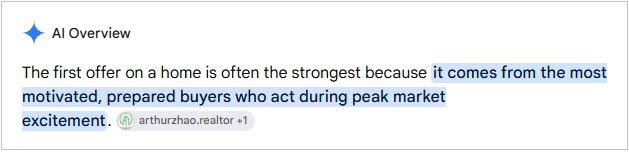
Okay, well, should we just wrap it up?
Roll credits?
Not so fast.
As with all of Google’s AI Overview responses, this is just something that’s been taken from the Internet. We don’t really have a “Skynet” that can do the thinking for us…..yet, so as a result, we have to rely on whatever Google can find for us.
Sometimes it’s a random dude’s website (like the gentleman quoted above), or even some random dude’s blog (like mine, from time to time).
Then again, depending on when you ask the question, and how, the answers might differ.
I asked the question to Google again one day later, and this is what I received:
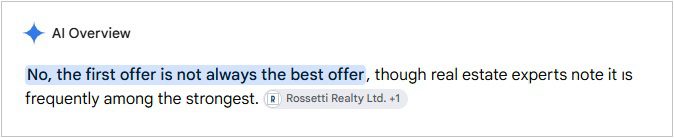
That’s a little different, isn’t it?
It’s almost as if this A.I. thing isn’t quite Skynet…
The following day, I asked Google for a third time, and this is what I received:

That seemed to completely contradict the A.I.’s answer the previous day.
And while I figured that, “Quit while you’re ahead” might be prudent here, I just couldn’t help myself.
So just this very moment, I asked the question again, and this is the response I received:

Interestingly, the source here is the same as our second result. It just reads differently.
I wonder: how is the “strongest” offer not the “best” offer?
It’s almost as though A.I. has no clue what it’s talking about.
It’s almost as though (gasp!) the A.I. is simply taking different opinions from around the Internet and using them as a reply to user queries.
Not only can A.I. not give us a definitive answer, but it will never be able to give us examples!
That’s what I’m here for, of course.
So let me work through a few examples of transactions that will ask (and hopefully answer!) the question, “Is the first offer always the best offer?”
–
Scenario #1: The Falling Market
While we really want to know whether the offer on the second day of the listing will be better than the offer submitted on the fourteenth day of the listing, we first need to discuss the elephant in the room, which is:
In a declining market, offers will get worse over time.
How much is the decline? How steady? Where along that timeline? How much worse?
These questions all affect the answer, but here’s a transaction that I worked on.
In 2024, I was called to offer my thoughts on a west-end home that had been previously listed.
The elderly couple had the home listed for sale for $2,899,000 with another agent in 2023, eventually dropped their price to $2,799,000, and then terminated the listing after six months.
I priced their home around $2,500,000, and they looked really disappointed.
But after discussing it, I learned that they weren’t disappointed in my pricing, but rather “what could have been.”
The wife explained, “We had an offer for $2,600,000. We didn’t work with it.”
Listed at $2,799,000, you might agree that working with an offer of $2,600,000 didn’t make sense at the time. But I wasn’t told whether this was a “first, best, and final,” or whether there was room for the buyer to improve.
In any event, I told the couple, unequivocally, that the house was worth upwards of $2,500,000.
“And that’s why we should list at $2,449,000,” I told them.
Their house wasn’t in the best area, and the market in the fall of 2024 wasn’t the strongest.
“We have a limited amount of time to sell the home before the market slows down for Christmas,” I told them.
But they wanted to try the listing at $2,549,000, just to ensure they “didn’t leave any money on the table.”
I told them it was a mistake; they thanked me for my honesty, and we forged ahead in the fall of 2024.
We sold for $2,350,000 in the spring of 2025.
Hindsight is 20/20, but as they say in golf, “Mistakes can compound.”
–
Scenario #2: The Detached Starter Home
How can a detached house at $1.8 Million be considered a “starter home?”
Well, because everybody who was looking at this property, evidently, was looking to buy their first home! That’s the feedback we were getting, anyway.
We priced this home at $1,799,000, which I thought was really good value. It checked a lot of boxes, maybe missed a couple of others, but overall, this was a fantastic value play.
I certainly didn’t expect to be blown away with a huge number of showings, but the activity was quite slow at the onset.
Eventually, we received an offer.
$1,600,000.
It was awful.
The buyer had come through our open house and told my team, “I’m not working with an agent.” He then called me on the following Monday to ask questions, but I asked him again, “Are you working with an agent?”
He said that he was, gave me the agent’s name, and I told him, “Please ask questions through your agent. I’m not trying to be unhelpful, but rather I’m adhering to industry regulations.”
His agent called me and asked a handful of questions that he already knew the answer to, and I had a feeling that a lowball offer was coming in.
I certainly did not expect it to be $1,600,000 on a $1,799,000 listing!
My clients said that they saw no point in working with the offer, and I agreed.
The buyer’s agent begged me for a sign-back, so I told him, “I could get you $1,780,000, just to keep hitting the ball over the net, if you’d like,” and he agreed that this was worth pursuing.
So my clients and I drafted a sign-back of $1,780,000 and sent it over.
And then?
Nothing.
Radio silence.
It was a very odd move from an agent who was pestering me for a sign-back, but hey, we all do business differently.
He eventually caught up with me that weekend and gave me the gears about value, our list price, competing sales, etc. I knew that he simply had a client that he couldn’t control, and a client that wanted to lowball houses until he “got one,” but I told him that it wasn’t my job to rescue him from his runaway client.
Over one month later, the buyer came back into our open house again and started talking to a member of my team about how much he wanted the house, and unveiled his “strategy” to acquire it.
Two days later, his agent called me and gave me a verbal offer of $1,650,000.
I told the agent, “This isn’t an offer. It’s not on paper. But the answer is still ‘no’.”
About two weeks after that, and now about one month on the market, my clients asked me, “Do you think that’s something we would need to consider?”
I told them “no,” and as though the real estate Gods were listening, a different buyer came forward a couple of days later.
We ended up selling the house for $1,750,000, much to the chagrin of that initial buyer, who told his agent to give us another verbal offer of $1,680,000 before we pulled the trigger…
–
Scenario #3: The One-Bedroom Condo
There are a lot of one-bedroom condos on the market, aren’t there?
I know, I know, yours is special.
I have this running joke among my team where I pretend to be the optimistic seller and I meme, “Oh, but seriously, you’d have to see my place!”
In today’s market, they’re all pretty similar.
Better locations, better neighbourhoods, better buildings, and better layouts, but once you get into the building and into the unit, buyers are shopping for price.
Earlier this spring, I listed a unit for $589,900, which was, admittedly, a reasonable price at the time. But as the spring wore on, it was evident that the market was getting away from us.
We received an offer very early on for $540,000, but those buyers only came up to $555,000, and my client decided not to pursue the opportunity any further.
It was two months before we received our next offer, which came in at a downright stupid $500,000 even. They verbally came up to $530,000, but that was still a poor price for the unit.
More importantly, it was $25,000 less than the previous offer, and my client said, “I would never sell for less than the offer I had.”
I asked her, “If you had $555,000 again, would you accept it?”
She said, “Hell, no.”
I asked her, “What’s the price you’d consider today?”
She answered, “Probably something in the $570’s.”
We had been on the market for four months now, and I told her, “In the spirit of honesty, I’m telling you, you’re never going to see something in the $570’s. You would be lucky at this point, if you still wanted to sell, to see something in the $550’s.”
A few days after that conversation, we received an offer for $530,000. Same price as the last time, but from a different buyer.”
My client rejected the offer and took her condo off the market.
–
Scenario #4: The Do-Over
This one is fascinating, mainly because I still can’t believe it happened…
I had a condo on the market for $1,049,900, which the seller felt, as all sellers do, was too low.
We received an offer after two weeks on the market, and after signing it back-and-forth a couple of times, the buyer topped out at $1,000,000.
I told my client, “In this market, we’re not going to see a better offer,” to which she responded, “Maybe, but I don’t know that. And I’m willing to find out.”
The buyer agent was incredibly pleasant and said, “David, we’re not going anywhere. This is a great unit, my clients love it, and if your seller changes her mind, come back to us.”
On the one hand, this is extending a warm hand, acting professionally, and keeping the door open.
On the other hand, this is weak, giving up leverage, and failing to take advantage.
In any event, two weeks later, we received an offer from a different buyer, and after one round of sign-backs, the buyer said “final offer” and put $970,000 on the table.
My seller elected to sign this offer back at $1,000,000, which was the same price she had turned down from the first buyer, but this buyer walked away.
That’s when my client said, “Okay, can you go back to the first buyer and see if they still want the unit?”
So I called that pleasant agent who kept the door open and said, “Hey, we’re ready to take $1,000,000.”
I even told the agent we would revive their previous offer with a sign-back, so there was no foolin’, and we sent the paperwork over.
They accepted.
So here’s a case where the first offer was the better offer than the second, but where the seller didn’t get burned in the end.
–
Scenario #5: The Detached Move-Up Home
This one is fun because it’s happening as we speak!
And best of all, one of our favourite blog reader/commenters…
There’s a house listed for $2,399,900, which has been sitting on the market for 25 days.
It’s a great house with loads of potential, but as is often the case, it’s not selling because it’s not perfect. Only the perfect houses are selling right now, and while I could make a compelling argument that this is worth every penny of $2,399,900, I won’t, since I’m on the buy side.
The listing agent has been calling me incessantly, and during one of our conversations, he said, “The price is going to be an issue.”
Not really leading with your best foot forward, right?
He said, “The seller had an offer of $2,320,000 very early on, and I don’t know how he’s going to respond to the next offer.”
I told him, point blank, “You’re never going to see $2,320,000 again. You’re approaching one month on the market in an area where houses sell pretty well. Your next offer is going to be $2.2 Million.”
He admitted that this was likely true, but then added, “I just don’t know how my client is going to take less than he had.”
I told him, “Your client has owned this house since 1988. It owes him nothing.”
A couple of days later, we put an offer of $2,150,000 on paper, and we’re waiting to see how the seller responds.
Remind me in the comments to update this as we move along this week…
–
So did I answer the question?
Probably not.
But that’s exactly the point; you can’t really answer the question with any level of certainty, and every situation is going to be different.
It’s easy to conclude, “The first offer is always the best offer except in those cases where the offer is a lowball.”
Sure. But then there are cases where, a few months later, that “lowball” doesn’t seem like a lowball anymore…





























Anwar
at 11:41 am
This is the 48th time you’ve mentioned Terminator in a blog post.
Graham (the real deal T-1000)
at 1:08 pm
Yet I feel like it’s still not enough
Daniel
at 10:24 pm
Tell me you and Verbal Kint finally patched things up and he’s buying a house through you?