

Don’t you just love office Christmas parties?
Er, I mean, Holiday parties, and I apologize to the 0.001% of people offended by my use of the word “Christmas,” but it is 2024, and thus the other 99.999% of us must continue to cater to the desires of the loudest minority.
Yikes. How’s that for an intro today?
What can I say? It’s almost the end of the year! It’s time to let loose, let our hair down, and drink away our inhibitions!
Last Thursday night was our company Christmas party, and you can imagine just how much I let loose.
The highlight of the party was when I snuck away from the other hundred or so attendees, found a quiet place on a couch in a dark corner, and bid on a graded hockey card on eBay.
But there was an interesting conversation; at least one.
An agent who has been reading my blog essentially since I started it back in 2007 asked me, “How was it different then compared to today?”
The irony is: she’s been reading that long! But it’s been so long that she actually can’t remember.
When I started this blog in 2007, I wrote five times per week. The posts were only about 600-800 words, but the frequency of posts was intended to keep the content fresh.
It wasn’t long before I went down to four posts per week, however, and the length of the posts continued to grow.
Some time around 2015 – I believe when I launched Pick5, I cut back to three posts per week, and the Monday, Wednesday, and Friday schedule that we all knew and loved lasted for almost a decade.
Last year, I decided to cut back to only Monday and Thursday, but I added a weekly podcast called “The Last Honest Realtor,” the name of which was intended to infuriate complete strangers and solicit online ridicule and scorn.
My average length of post in 2024 was a ridiculous 2,850 words, but for those who tell me, “I can’t read it all,” let me remind you that you can watch an eleven-minute video of an “influencer” demonstrating her evening hand lotion routine on Instagram, so anything is possible!
There have been a lot of readers and commenters over the years, and suffice it to say, they’ve come and gone.
But if I had to pick my favourite comment of all time, one which might have appeared in an email and not on TRB itself, it would have to be this one:
The first time I ever read your blog, it was a story about how furious you were that you couldn’t get into a King Street West nightclub because you weren’t wearing the right shoes that Saturday night. All these years later, you’re now telling stories about how you couldn’t get into the Paw Patrol Live musical because you refused to give up your coveted Tim Horton’s coffee that Sunday morning.
Yeah, a lot has changed over the years. But tell me: how are you different today than you were in 2007?
I have no doubt that the content and narrative have changed over the years, but I think I’m just about as honest, transparent, and forthcoming as I always have been.
The topics might have become more political in nature, but that’s just something that comes with age, and I’m sure many of you can relate to that.
So today, let me provide you with a recap of 2024 on the Toronto Realty Blog by sharing what I think are the “best” five posts of the year, for a multitude of reasons.
Hope you enjoy!
–
#5: “How Can An Increase In Taxes Mean An Increase In Affordability?”
You just knew that one of my “top” posts was going to be political in one way or another, right?
In fact, you should consider yourselves lucky that only one post on the list is some sort of “Friday Rant” or “Monday Morning Quarterback,” since there have been a lot of these over the past twelve months.
Spoiler alert: you’re going to see this post and others like it next week when I go through our “Top Five: Real Estate Stories” feature.
Something tells me that nobody is surprised…
Here’s the link to the blog post:
February 5th, 2024: How Can An Increase In Taxes Mean An Increase In “Affordability?”
Twenty-nine comments were posted on the blog post, although if this was 2017, I think we’d have over 100.
Sidebar here for a second: have any of the long-time blog readers noticed that trend over the years?
Web traffic is up about 400% since since 2017 but comments have been more than cut in half. I’m told that this is simply “a sign of the times,” that people are less likely than they were a decade ago to leave a comment and that the advent of the “like” button on Instagram and other social media sites has provided readers and viewers with other, easier ways to interact with a post.
Nevertheless, this blog post served as one of my favourite of 2024 if for no other reason than the fact that it give me the opportunity to finally create a complete list of ALL the taxes that relate to real estate.
If you read the blog post earlier this year, you might recall the list:
Ontario Non-Resident Speculation Tax (NRST)
Municipal Non-Resident Speculation Tax (MNRST)
Federal “Anti-Flipping” Tax
Toronto Vacancy Tax
Underused Housing Tax (UHT)
Ontario Land Transfer Tax
Toronto Land Transfer Tax
Municipal Development Charges
Property Tax
Harmonized Sales Tax (HST) On New Homes
Harmonized Sales Tax (HST) On Everything Else
That’s kind of a lot, wouldn’t you say?
A couple of weeks after I wrote this blog post, I was having lunch with a group of bankers in from New York City (so cliche, right?) discussing all things real estate and economics, and I read them this list. They weren’t all originally from New York City, by the way. These guys were from Texas, Wisconsin, New York, and Massachusetts, but all of them were aghast when I read this list.
It shouldn’t matter where you’re from; you should be aghast at this list.
I have long opined that all three levels of government have but one idea when it comes to solving a problem in 2024: taxing their way out of it.
The issue, the problem, the people, the geography, and the complexity need not matter, as a tax always seems to be the solution.
Housing is too expensive?
Forget about building more of it! Simply create more taxes! That should solve the issue!
I might not be as spry as I was in 2007 and I might not be able to squat or bench press the same amount (or do either without pain…) but I sure as hell am more informed than I was when I started this blog. More opinionated? Yes. More cynical? Yes. More critical, accusatory, and suspicious? Yes, yes, and yes. But how can anybody not be when we’ve witnessed the introduction and/or expansion of those taxes listed above over the last two decades?
Taxes have become such a huge part of the real estate conversation in Toronto these days that I feel as though it’s a topic I write about monthly. In fact, the entire reason that I delayed my year-end blog posts was that I simply had to pen one last essay on the impact that taxes are having on new homes in this province:
December 9th, 2024: The Increasing Tax Burden On New Ontario Homes
That post is literally from three days ago. I wasn’t kidding when I said taxes have become a huge part of the conversation!
But as the blog explains, a new report revealed that a whopping 35.6% of the cost of new homes in Toronto are some form of tax.
How did we get to this point?
Mark my words, there will be discussions in 2025 about how taxes can solve problems in the housing market or, my favourite, “help with affordability.”
That’s the part that really rattles me: when politicians stand up and talk about affordability and then introduce a new tax that raises revenue for the government but, more often than not, has an adverse effect on the price of real estate.
Folks, I wish that my #5 favourite blog post of 2024 was more uplifting and positive, but alas, we had to start somewhere…
–
#4: “Does Real Estate Investing Advice Go Out Of Date?”
This one might seem incongruent with the others in that it’s not a search engine darling, it’s not exceptionally helpful, and it wasn’t a two-part blog special.
But if I’m telling you which were my favourite blog posts of the year, this was one where I had a ton of fun writing it.
In fact, I distinctly remember laughing out loud in my office as I wrote this post last summer!
Here’s the link:
June 20th, 2024: Does Real Estate Investing Advice Go Out Of Date?
What’s funny about it?
Why would I laugh out loud in my office and have Lindsay continuously ask, “Hey, Rainman, what’s so funny about that book?”
Well, exactly that: the book.
This blog post was about a book called “Creating Wealth,” by Robert G. Allan, which was written and published in 1983, and which I read somewhere around the year 2000.
When the book was written, and when I first read the book, there was nothing funny about it.
But read in 2024, some parts of this book are downright hysterical.
Time has a way of doing that though, right?
Here’s an excerpt from a 1950’s book offering advice on “How To Be A Good Wife,” specifically with regards to how to treat your husband upon his arrival home in the evening:
- Greet him with a warm smile and desire in your sincerity to please him.
- Arrange his pillow and offer to take off his shoes.
- Have him lean back in a comfortable chair, or have him lie down in the bedroom.
- Have a cool or warm drink ready for him.
- Speak to him in a low, soothing, and pleasant voice.
- Don’t ask him questions about his actions or question his judgment or integrity. Remember, he is the master of the house, and as such, will always exercise his will with fairness and truthfulness. You have no right to question him.
Hmmm…..where’s the emoji I’m looking for.
Ah, here, it’s this one:
😱
Yeah, I think a few things have changed since 1952.
But a few things have changed since 1983 when “Creating Wealth” was first put on bookshelves, and that was what this blog post, “Does Real Estate Investing Advice Go Out Of Date?” was all about!
In certain sections of the post, I simply pointed out “how times have changed” since 1983, like this section about Buying Discounted Mortgages where we’re told:
The goal is to find deeply discounted mortgages secured by excellent property in excellent locations. How do you find these “motivated mortgage holders” who want less cash now rather than more cash later?
There are five major sources of these kinds of loans:
1. The newspaper
2. Mortgage brokers
3. Realtors and exchanges
4. Referrals
5. The county courthouse
Yes, we can all relate to driving our Datsun down to the county courthouse in search of discounted mortgages!
Nevertheless, aside from the mediums of conveyance and communication, which have changed substantially, what I found about the advice offered in the book was that expectations have changed significanlty.
Take this piece of advice, for example:
Your rule is never to invest more than 10 percent in a property unless you can buy it at least 20 percent below market value.
Was it really this easy back in 1983?
Can you imagine telling your real estate agent, “I want to buy a $2,000,000 house in Leaside for $1,500,000, and despite the CMHC guideline that necessitates a 20% down payment on the first $1 Million and potentially more than 20% on the balance, I would only like to invest 10%.”
Oh, and of course, the expectation is that this “investment” is cash-flow positive!
Because this is the part of the book that is the most widely out-of-touch with today’s market:
An ideal target property should have the following description: a three-bedroom single-family detached house or condominium that is located in a stable neighbourhood within a fifty-mile radius of your own home, priced at less than the median price in your city and worth at least 10 percent less than your cost; and can be bought with less than 10 percent down and terms that allow the buyer to rent out the home with little or no negative cash flow.”
So we’re looking for detached houses that are cash-flow positive when we buy them with a 10% down payment and rent them out, are we? And at 10% below market value?
Who knew that making money in the 1980’s was that simple!
I thoroughly enjoyed writing this blog post, and I hope you thoroughly enjoyed reading it!
Every once in a while, we all make ourselves laugh…
–
#3: “The Problem In The Rental Market That Nobody Will Talk About”
While I don’t think that any of the top five real estate stories will be about renters this year, I’m not at all surprised to apply the “favourite” label to a blog post about the rental market.
In fact, the #5 post from 2023 was about renters as well:
September 18th, 2023: Landlords & Tenants: The Modern-Day Hatfields & McCoy’s
I had to pinch myself when I realized that I wrote this post almost fifteen months ago, but like the Steve Miller Band once said: “Time keeps on slippin’, slippin’, slippin’, into the future…”
Yes, that was then, and this is now. Er, this was in September.
Here’s the link:
September 16th, 2024: The Problem In The Rental Market That Nobody Will Talk About
It could have easily been problem(s), plural, since there are oh-so-many issues in the Toronto rental market, but in this blog post, I wanted to discuss one major problem that I have never directly, specifically, pointed the finger at:
Everyone in the rental market is afraid of being accused of discrimination, for absolutely anything and everything.
It’s true.
And in the system in which we operate, it’s “guilty until proven innocent.” A simple accusation often has effects that can’t be undone.
What I described in the blog post was essentially a situation that has been created by measures set out with the exact goal of preventing that situation.
Connect the following dots:
- The Landlord & Tenant Act is established to protect tenants.
- The Landlord & Tenant Act, and the Landlord & Tenant Board, overwhelmingly favour tenants.
- The Landlord & Tenant Board has a massive backlog.
- There are no immediate remedies for landlords when tenants don’t pay rent.
- Landlords are becoming far more selective.
- The Ontario Human Rights Commission has published a list of “prohibited grounds of discrimination.”
- Many prospective tenants feel discriminated against.
It’s almost ironic.
Because laws exist to protect tenants, and because the system has bent over so far backwards in that one direction, the end-result is that tenants are having a very difficult time either finding properties to rent, or communicating with landlords who live in fear of being accused of discrimination.
But a bigger part of the problem is that the definition of “discrimination” in 2024 has become absolutely nonsensical.
The Ontario Human Rights Commission, in their infinite wisdom, have decided that it’s discriminatory to use any sort of “minimum income criteria” in assessing a potential tenant’s candidacy.
Huh?
Wait, what?
The OHRC doesn’t think that landlords should have any interest in whether or not the tenant can pay the rent?
Yes. That’s exactly what I’m telling you, and you need look no further than this section of their website:
Ontario Human Rights Commission – Minimum Income Criteria
Link HERE.
Those seeking rental housing who are in receipt of public assistance, as well as other Code-identified individuals with low incomes, have been particularly affected by the application of minimum income criteria.
Many landlords apply a standard guideline that a tenant applicant should be spending no more than 25-35 percent of his or her income on rent.
Those who fall short of this ratio are rejected.
While this is rationalized as a necessary means of assessing an applicant’s ability to pay the rent, its use results in the denial of access to rental units to members of disadvantaged groups protected by the Code who frequently have lower incomes.
There is no evidence that individuals from disadvantaged or low-income groups, when spending more of their income on housing than a rent-to-income ratio would allow, are more likely to default on rent payments.
Ah, yes, “the code” is there to protect people who can’t afford housing from being discriminated against, due to the fact that they can’t afford housing.
Sarcasm warning: imagine the audacity of a private sector member not wanting to take on a public sector role in subsidizing the cost of housing?
The Ontario Human Rights Commission’s view on housing reads like a communist manifesto. It essentially vilified hard-working, successful, intelligent, private-sector individuals for wanting to keep their investments in good standing by not renting to people who can’t afford it.
And this is only part of the “problem in the rental market that nobody wants to talk about.”
It’s a symptom, essentially, of a system that punishes landlords and other market participants for anything resembling common sense.
The result, as I explained in my blog post, is a rental market where tenants and leasing agents are too lazy or discouraged to even view properties, for fear of learning that the landlord won’t rent to them, but where landlords and listing agents are too afraid of a discrimination accusation to be honest about that tenant’s candidacy.
Quite the catch-22!
And quite the blog post too!
When Francesca, Marina, and Moonbeam all chime in with their stories about landlording (plus a great movie reference from Moonbeam!), you know it’s a great day on the blog, and in the comments section.
As I said with #5, I wish that more of my “favourites” were positive in nature, but this was simply a blog post that needed to be written, with an honest “problem” that needed to be confronted head on…
–
#2: “Selling Your Parents’ House: The Trials & Tribulations”
Technically, this is #2(a) and #2(b), since it was a two-part blog series, but some of my favourite and often the most memorable blog posts are the ones that spanned multiple chapters.
Here are the links:
June 24th, 2024: Selling Your Parents’ House: The Trials & Tribulations (pt1)
June 27th, 2024: Selling Your Parents’ House: The Trials & Tribulations (pt2)
What made this one of the “best” posts of the year, in my estimation?
As you’ll see shortly with the #1 post of 2024, this one turned out to be a Google-darling! Not that I live my life for “clicks” but rather it provides an indication of what people out there are searching for on Google, and thus what’s on people’s minds.
In this case, I realized that “what’s on people’s minds” could be taken a step further to essentially describe “what people are having trouble with.”
That’s why they’re searching for it on Google.
That’s why there’s no easy answer.
And as my team and I experienced throughout 2023 and 2024, this is a part of the business that we’re becoming more and more familiar with, and I don’t see that changing.
I have worked with the “children” of elderly home-owners before, but never as much as I did this year, and never in the capacities that we experienced in 2024.
In the fall of 2023, I met three siblings who sought to sell their late father’s house in 2024. I worked with them for eight months to get them out of the starting blocks and across the finish line.
Also in the fall of 2023, I helped long-time clients to get their elderly parents out of a home in which they’d lived for fifty years, and into a condominium where they could live comfortably for the remainder of their lives. I then worked with them to sell their parents’ house in early 2024, which was an absolutely epic experience, for many reasons.
Also in the fall of 2023 (perhaps you’re starting to see how long these moves and sales can take?), I met with the parents of long-time clients to discuss getting them out of their home – in which they had “only” lived for forty years (compared to the folks noted above), and getting them into a condo within their desired geographic and cultural community.
In the early-summer of 2024, Matthew and I listed and sold a condo on behalf of an elderly seller who moved into supportive housing, and worked with her “children,” who were in their late-50’s, in order to do so.
All four of these experiences took place in a short window to start out 2024, and they provided me with the impetus for the two-part blog series.
These listings were a lot of work, make no mistake. But my team and I aren’t afraid of hard work when it’s fulfilling, inspiring, and ends up being something that we can be proud of.
One of these houses was absolutely full of stuff, and it became my team’s job to get the house empty and ready for sale. We held an auction through MaxSold, we donated truck loads of items to various charities, and when push came to shove and there was nothing left but refuse, we hired some of the kids from the Leaside football team to come and throw everything into the largest dumpster available for residential use.
That was an experience!
In another one of the situations described above, my team and I showed up one afternoon with a U-Haul and took about seventy boxes and totes to storage, where we kept the items through the sale of the home, past closing, and until the sellers had moved into their new home and were ready to unpack what they had stored.
One of the other scenarios saw at least a dozen Zoom calls with six family members, none of which could take place without all six family members – and trust us, we tried!
Whether we were packing, moving, storing, donating, auctioning, or junking, my team and I were doing the things that we knew the home-owners couldn’t do, and that we knew would have a massive impact on the sale of their homes.
We expected the hard work; maybe not to the extent that we experienced, but it came as no surprise.
What did come as a surprise, however, was the sheer amount of emotion involved in the process on behalf of the sellers, their children, and any and every other stakeholder involved.
Some of the participants in the process were completely hands-off, while others worked around the clock with us, and on their family’s behalf. We saw and experienced it all.
We witnessed love and hate. We saw family members get along and quarrel. Some were happy with the outcome, and some were never going to be happy, no matter what.
I’m 44-years-old so who am I to judge anybody for what they thought or felt during the process of selling their elderly parents’ home? Or sadder still – their late parents’ home and estate…
In the two-part blog series above, I offered the following three pieces of advice in terms of what one would “need” to do when selling Mom & Dad’s home:
You need to decide if your parents are signing legal documents or if you’re going to be a Power of Attorney.
You need to decide what to do with all the “stuff.”
You need to decide if the home is being sold in “as is condition” or not.
All three were significantly expanded upon in the blog, as you would imagine.
In the second part of the blog, I offered advice on situations that one “might” experience during the process:
You might disagree with your siblings, or worse.
You might have a different plan than one of the other children, heirs, or executors.
You might feel nostalgic going through old things.
You might encounter a “neighbourhood genius” or two.
You might not understand the current market conditions.
You might need help with the tax implications.
You might encounter issues with vacancy tax or increased insurance premiums.
As with the first list, these were greatly expanded upon as well.
Since I wrote that post, I’ve had two blog readers reach out and ask to chat about their parents situation, and I expect that many others have read the posts and mentally packed away the contents for when they’re ready to act.
Some of my favourite blog posts are the ones where I feel I’m being the most helpful and offering the most insight and advice, and that’s exactly why this two-part series placed so highly on my list for 2024.
–
#1: “How Do You Evaluate A Toronto Investment Condo In 2024?”
Of course, this one is also a two-part blog series!
But I assure you, that wasn’t intentional!
Once again, I looked back upon the topics, titles, content, and comments, and then considered the relative “importance” or the educational value of each post, and, well, voila!
Here are the links:
August 19th, 2024: How Do You Evaluate A Toronto Investment Condo In 2024? (pt1)
August 22nd, 2024: How Do You Evaluate A Toronto Investment Condo In 2024? (pt2)
I didn’t set out for this to be a two-part post, however. But upon reaching about 5,000 words in my initial writing, it became quite apparent that a “TO BE CONTINUED” was going to be involved in the first post.
Trust me though – this wasn’t a case of me being verbose, which, to be fair, is quite common.
Instead, this was a case of the post being long out of necessity because it was a topic that couldn’t be properly addressed otherwise.
As I noted in the blog itself, the idea was given to me by a long-time reader, who noted in a previous post:
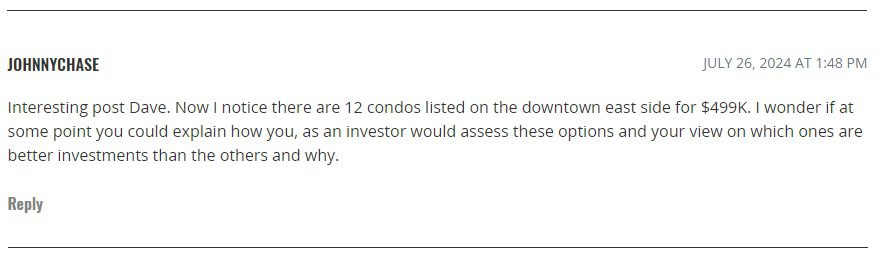
Very often, the best blog posts spawn from ideas or comments by the readers, and since this is also my best-performing post on Google in 2024, even though it was written more than halfway through the year, I have JOHNNYCHASE to thank.
If you recall, I wrote the following post in February:
February 12th, 2024: Putting My Money Where My Mouth Is!
This was a very detailed account of my purchase of a King West condominium for investment purposes.
But then in August, I was at it again:
August 5th, 2024: Putting My Money Where My Mouth Is…..Again”
And again…
August 8th, 2024: Putting My Money Where My Mouth Is…..Again (pt2)
Yes, that story also necessitated two blog posts, and yes, I wrote, for a second time, about my purchase of an investment condo.
But that second post also resulted in the above-noted comment from JOHNNYCHASE, and while I’m not sure if I described this in any of the preceding blog posts, but once Johnny laid down that challenge, I opened up an Excel worksheet, cracked my knuckles, and started to import some data.
It was a brilliant suggestion! I wish I had thought of it myself.
I truly did start on this post as soon as I saw the comment. Having written blogs now for almost two decades, I can tell you that you have to “strike while the iron’s hot” and if you have an idea, you’ve gotta go with it, or risk losing the inspriation.
Either that or I’m just really obsessive and wanted to start work on a spreadsheet.
Either way, I downloaded the data from the twelve properties from MLS and began to formulate the blog post and the evaluation.
Here’s the hypothesis:
While every investor has different criteria, in the case of a one-bedroom condominium as an investment, there is likely a “best” option.
Ultimately, the way to evaluate an investment at the time of disposition could be viewed solely in terms of the return on investment (in this case: appreciation and cumulative monthly gain/loss), but in the case of a one-bedroom condo, we would also have to consider the “pain in the ass” premium associated with a bad tenant and the time, effort, and energy (ie. aside from money) that various investments could require.
During two blog posts, I offered the following ten categories for evaluating each of the twelve properties:
1) Price per square foot
2) Parking
3) Location
4) Maintenance fees
5) Building – age, size, reputation
6) Relative value
7) Previous purchase price
8) Layout and functionality
9) Condition
10) Leverage
All of these have elements of subjectivity and objectivity, but maybe that’s what makes the exercise fun?
For example, to suggest that a condo investment at $1,000 per square foot is “better” than a condo at $1,200 per square foot isn’t a fair argument, because it ignores a ton of other factors.
That’s why all ten criteria need to be analyzed, and why the “best” property, in the end, is one subjectively chosen according to where it places in all ten categories.
As I noted in the blog post, the property I purchased two months prior, and wrote about on TRB one week earlier, was, in fact, the one that looked the “best” when the twelve properties were analyzed.
And while the comments on these two blog posts weren’t exactly world-beating, I heard from a lot of agents in the business, surprisingly.
One established agent who has been in the business for over three decades asked me, “Why the hell would you put all that in an open forum for anybody to read?”
I asked him, “I mean, you’re familiar with Toronto Realty Blog, right?”
He said, “Yeah, yeah, you know I’m a fan, dude. But I mean why put that all out there – for free, for everybody to read? Now you’re just going to get some guy who reads the blog and hires his uncle in Barrie to do the paperwork for him when he buys.”
Maybe.
But is that any different from how real estate usually works?
Another agent, one from my brokerage, asked me, “Don’t you feel like you just shared your ‘secret sauce’ with everybody?”
Maybe.
But who cares?
It made for a great read for the TRB regulars and that is what Toronto Realty Blog is all about.
While writing that blog post, I felt, at times, like I was back in Grade 10 doing our “History Fair” project at Leaside High School. I did all the work while four other guys shared in the glory, but in the end, I did it because I wanted to and because I thoroughly enjoyed it.
That’s why I’m still writing blog posts after almost twenty years, and showing anybody who’s interested out there, “How to evaluate an investment condo in Toronto” was enjoyable.
–
Well folks, if you’ve made it this far, you’re either skimming, or you’re a diehard.
Just as it’s true that 23.6% of all statistics are made up, it’s true that 31.8% of all TRB readers fail to make it to the end of these girthy year-end posts.
Stay tuned for another magnum opus on Monday when I regale you with the top five real estate stories of 2024!






























RPG
at 12:54 pm
Fantastic all around! Bravo!
Another year of free real estate advice and insight is appreciated.
Kevin
at 5:17 pm
I think the two blogs you wrote about buying investment condos (putting my money where my my mouth is) were my favourite this year.
I’m not in the market to buy nor will I be, but I just think it takes some real stones to divulge something so personal, especially in the arena of personal finance. I really felt your conviction in those stories.
Jenn
at 6:16 pm
What happened to “More mls musings”??
That was my fave!!
David Fleming
at 9:16 pm
@ Jenn
I figured that cutting back from three posts per week to only two meant those two posts were more important, and the silly theme of “funny MLS photos” was somewhat wasted. I know people enjoy it, but I think there’s more value in writing about the active market.
London Agent
at 8:58 am
I think the post that stuck out most to me was about self represented parties. I also think there could be a #6 each year: the 12 monthly statistics posts collectively. How could those not be top posts, everyone loves stats!