

Are you familiar with the Kiss of Death?
It was an absolutely awful movie starring David Caruso and Nicolas Cage, with appearances by Samuel L. Jackson, Ving Rhames, and Helen Hunt. With a cast like that, you might think the movie was watchable, and yet, it wasn’t.
David Caruso is famous for, among other things, “Pulling a Shelly Long.”
For the folks my age and older, you know what this means.
After a star has one great season on a new, popular “hit” television show, that star makes the unadvisable decision to leave the show and seek a career in movies.
This is what Shelly Long did after the first season of “Cheers,” and her career never recovered.
After David Caruso’s first season on the hit police drama, “NYPD Blue,” he too decided to leave the show and try to be a film star.
People said, “He’s pulling a Shelly Long.” They even said this to his face!
But David Caruso told people not to worry and that he had some big projects coming down the pipe!
Kiss of Death (1995) was an absolute bomb both at the box office and with critics, and meanwhile, cast members of NYPD Blue, Dennis Franz and Jimmy Smits, went on to be massive stars. But I digress…
There are likely hundreds of uses of the phrase “kiss of death” in everyday vernacular, and the real estate industry is certainly not immune.
For many years, we regularly used a term that we coined as “the real estate kiss of death.”
Now, the irony is, once I tell you what this actually is, you’re going to think, “Huh? Why is that so bad?”
Trust me.
Here goes…
“Re-listing a property for sale at a higher price, after an unsuccessful offer date, is the ‘real estate kiss of death’.”
See what I mean?
In 2026, this happens all the time! We’re used to it. For those of you who are newer to the real estate market, you can’t imagine a time when this was unexpected.
And yet, if you were to go back to 2007, or 2012, or perhaps 2017, you just weren’t used to seeing properties not sell on the scheduled offer night. And when it they didn’t, and the property was re-listed two or three days later for a higher price, we’d all be collectively shocked.
“That’s the real estate kiss of death,” we would say.
Nobody wanted to see it.
Buyers would devalue the property in their minds, and buyer agents couldn’t really argue.
“Nobody wanted that house, eh?” buyers would say. “They re-listed it higher? Ugh, good luck!”
The problem wasn’t that the concept was unreasonable. After all, a $1,300,000 house, listed for $999,900 with an offer date, failing to sell, and being re-listed for $1,299,900 wasn’t unreasonable. But rather, the issue was that buyers were so used to seeing houses sell on offer nights that any house that failed to do so was deemed to have “something wrong with it.”
The real estate kiss of death is no longer.
I listed a house in the first week of September, and I told my clients, “Realistically, we have a 20% chance of selling this house on the scheduled offer night. I just want to set expectations.”
We didn’t sell, by the way. But that was part of our listing strategy.
We wanted to under-list and see what the feedback was like, what type of questions buyers asked, and ultimately what prices buyer agents would throw at us. We also wanted to keep the door open “just in case.”
As I’ve said before on TRB over the last couple of years, just because properties aren’t automatically selling on “offer nights” doesn’t mean that agents are going to stop listing them accordingly.
So let’s take a look a handful of houses that were listed, re-listed, and in some cases, re-re-listed…
As always, I’m going to black out the addresses, and in case you’re wondering why the MLS screen-shots have “Restyle” in blue on the photo, I honestly can’t tell you. Chalk this up to yet another “feature” that the Toronto Regional Real Estate Board gave to us, without asking, told us we wanted, and then refused to accept feedback on…
…so here we go!
This 2-storey, semi-detached, 3-bedroom house was listed for $1,099,000 with an offer date, but failed to sell:
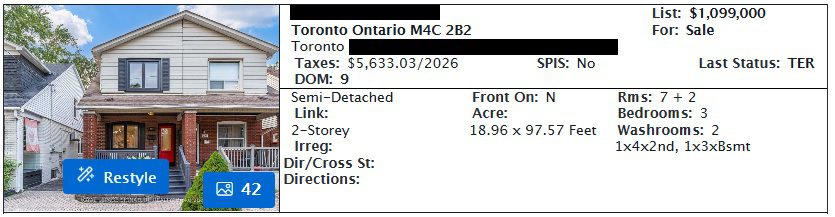
It was re-listed for $1,330,000 two days later.
It promptly sold only 9 days after that:
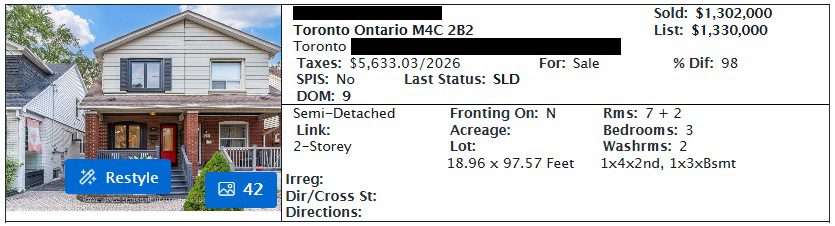
Easy-peasy.
That’s about as simple an example as we can come up with!
- House is listed with offer date.
- House fails to sell on offer night.
- House is re-listed at a higher price.
- House sells via new price.
It’s as simple as that.
I’m not sure if the sellers and the listing agent figured they could “get away with” the strategy that failed to produce a result the first time around, but call it luck or tell me that the great properties all sell; either way, this one did.
Here’s another example:
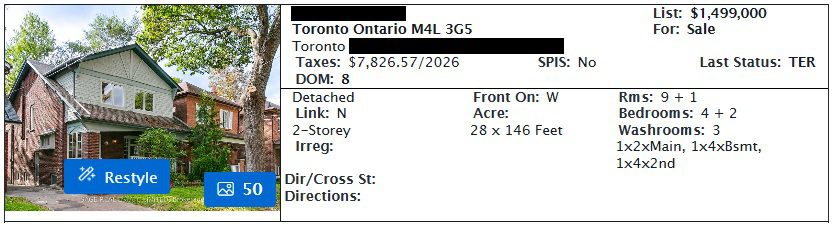
This detached, 2-storey, 4-bedroom house was listed for $1,499,000 with an offer date.
The house did not sell on the scheduled offer date.
In the previous example, the house was re-listed at a price $231,000 higher, which equates to 21%.
This home was only listed for 10% more:
Unlike in the previous example, where the home was listed for $231,000 more, or 21%, this house was only listed for 10.1% more:
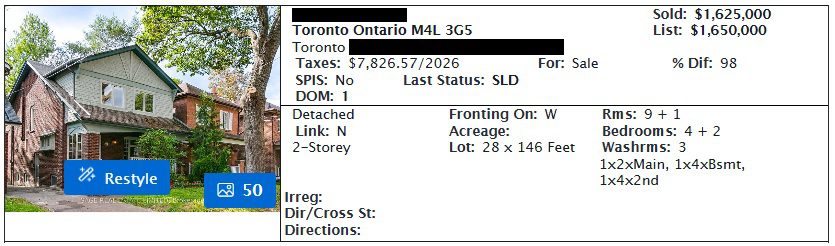
And it sold after only a single day at the new price!
In a case like this, it’s possible that a buyer who had an offer on the scheduled offer night, when the house was listed for $1,499,000, came back after the re-list at $1,650,000 and engaged in further negotiations. Or, it could have simply been a new buyer who entered the market at the right time.
Here’s another house to consider.
A very nice detached home on the east side, nicely renovated, great floor plan, and with parking:
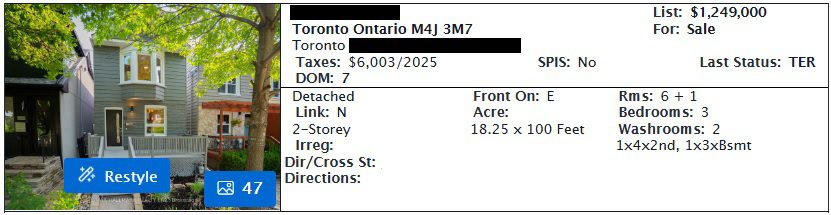
This home was listed for $1,249,000 with an offer date, as is the custom.
But didn’t sell.
So they terminated after 7 days on the market and re-listed for $250,000 more, or 20% higher:
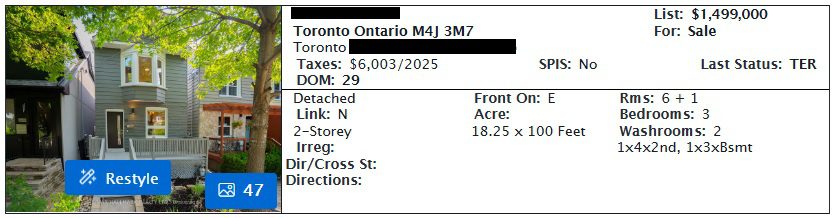
Unlike the first two examples, which were “easy-peasey,” this one would be far more complicated.
This new listing did not bear fruit, as was the case with the two properties we examined above.
So the sellers moved on to a third listing.
The property was re-listed for $1,349,900…..with an offer date.
Wait, what?
Another offer date?
Yes, it would seem so!
And believe it or not, the property sold:
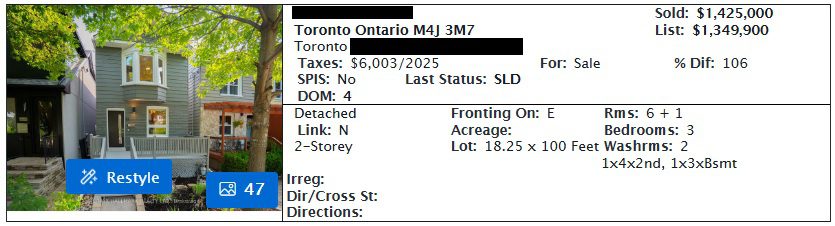
I can’t help but wonder: why did the person who paid $1,425,000, on a listing price of $1,349,900, decide not to make that offer of $1,425,000 when the property was languishing on the market for $1,499,000? The property was up for 29 days! They had lots of time!
Would you say that the seller’s strategy “worked?”
They got the property sold, didn’t they?
Here’s a similar example, but the outcome was much different…
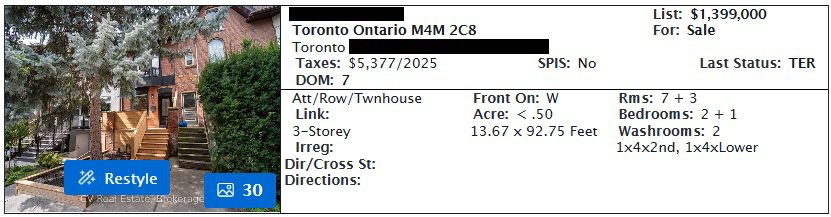
They listed for $1,399,000 with a “holdback on offers,” but the property didn’t sell.
Duh.
That’s our theme today, after all!
Sohey re-listed at $1,519,000, which is 8.6% higher:
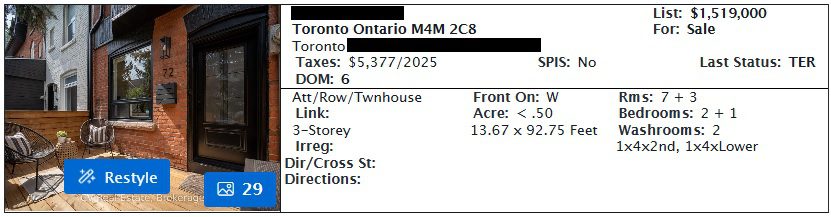
As you can see, they didn’t sell!
The listing was terminated after 6 days.
The property was re-listed for $1,149,000.
This feels a lot like the previous example, right?
Except I told you that the outcome was different.
Have a look:
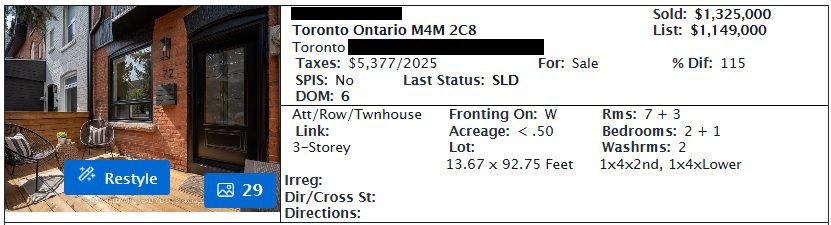
Wait, they sold.
So how is the outcome different?
Well, because in the previous example, the property was listed for $1,249,000, re-listed for $1,499,000, and then sold for $1,425,000.
In this example, the property was listed for $1,399,000, re-listed for $1,519,000, and then sold for $1,325,000.
Do you see where the difference lays?
With the second property, the sale price was lower than the original “under-listed” price. They sold for $1,325,000 after their “bait price” was originally $1,399,000.
That’s wild.
But they got the property sold in the end!
So maybe the buyer and seller both won?
Like I said: the buyer and seller both won.
Now, where do we see this strategy not working?
Well, in cases where sellers won’t sell for fair market value, obviously!
But more specifically, I would say with respect to “builder homes,” which is a vague term we often use to describe homes built by a builder, apparently lived in for a short while (so the builder doesn’t have to pay taxes or provide a TARION warranty), and now offered as a “resale.”
Here’s an example…
148 Builder Crescent is listed for $2,199,000, with an offer date.
The offer date doesn’t work. It was never going to. Trust me.
The property is re-listed for $2,699,000, which is an egregious number for a house that’s probably “worth” $2,400,000, but for which the builder would have to sell at a lower price, just to get somebody to pull the trigger.
The property sits on the market for 60 days, and then the price is lowered to $2,599,000.
But that doesn’t work.
The property sits for 90 days this time.
But then comes the brilliant idea!
The property is re-listed for…..wait for it….$1,999,000…
…with an offer date.
A second offer date, eh?
Well, we saw it work in the examples above, didn’t we?
But those sales were for houses sold at market value. In the case of our builder, he always overvalues his home, and the listing agents who work with builders often simply hang on for the ride…
The property, listed for $1,999,000, doesn’t sell on the offer night. They might not have even received an offer.
So the price is raised to $2,499,000, this time without a “new” listing, but just as a price change.
Why the price change and not a new listing?
No clue!
And I often wonder if the builders have a strategy here, or if they’re just looking to sign one document instead of three.
The property sits on the market for 145 days at $2,499,000, then the listing is terminated.
Then a new agent takes over, lists for $2,399,000, and the property sells for $2,200,000.
Sound familiar?
It’s every builder, just about every time.
As an aside, I wrote about this on my blog last year:
July 17, 2025: “Why Infill Home Builders Always Make The Same Mistakes”
But that’s a topic for another day…
So if you’re a buyer out there in today’s market, consider just how common it is to see houses sail through their scheduled “offer nights” and get re-listed at a higher price.
If you’re a seller this fall, remember that the “real estate kiss of death” no longer exists.
And if you’re a fan of CSI: Miami and you’re wondering why I’m slagging David Caruso, well, Horatio Caine was no John Kelly, and we all know John Kelly was certainly no Andy Sipowicz…





























Different David
at 7:21 am
Die Hard 2 would be significantly worse without Captain Lorenzo’s character played by Dennis Franz.
LLoyd Mosby
at 1:21 pm
David – I find it hard to believe you were a big Cheers or NYPD Blue fan. Weren’t you too young at the time for those?
David Fleming
at 3:11 pm
@ Lloyd Moseby
I was not a Cheers fan, although I occasionally watched re-runs.
NYPD Blue, however, I watched religiously.
Since I was really cool in high school and never went to parties, I regularly watched the show on Tuesday nights at 10:00pm with my parents. My dad was a criminal lawyer so it was always very interesting to hear his commentary…
Ace Goodheart
at 12:51 pm
I liked Kristie Alley’s character better than Diane anyway. Rebecca was much more believable. She was damaged, human, vulnerable. Diane was like a robot. I never understood why people liked her at all. I remember when Cheers came back for the sixth season (Long played Diane for five seasons, not one as stated above – from 1982 to 1987) and Rebecca showed up, I liked the show so much more. I still miss Kristie Alley (RIP Dec 5th 2022). Her Cheers character was really good, and there was way, way more chemistry between her and Sam Malone (Ted Danson) than there ever was between Sam and Diane (Shelley Long)
Clark Blair
at 11:23 am
One important correction David — Jimmy Smits was already a massive star before NYPD Blue. Remember Victor Sifuentes on LA Law?!?
David Fleming
at 7:28 pm
@ Clark Blair
I just checked with my mother, and she gave me flak for not knowing that Jimmy Smits was on L.A. Law.
The show started in 1986 when I was in Grade One, so I didn’t catch a lot of episodes! 🙂
I remember “LA Law” and “Thirty Something” being the shows that my parents talked about with their friends in the late 80’s or early 90’s.