

Once upon a time, there was a widely held belief that properties being sold under power of sale could be bought on the cheap.
“Pennies on the dollar,” as the saying goes.
We would hear words like “distressed” to describe the houses, and/or the sale process itself.
The word “auction” was also thrown around quite a bit, as many people believed that you could, in fact, purchase distressed properties under power of sale at auction for pennies on the dollar, and so on.
I wrote about this many years ago, telling stories about enterprising, albeit exceptionally inexperienced and naive young men, calling me and asking how they could purchase properties for pennies on the dollar.
But we live in a different world today, right?
With A.I., every one of our questions can be answered immediately!
“Are there good deals on power of sale?”
I’m not sure.
What does Google’s A.I. tool think?
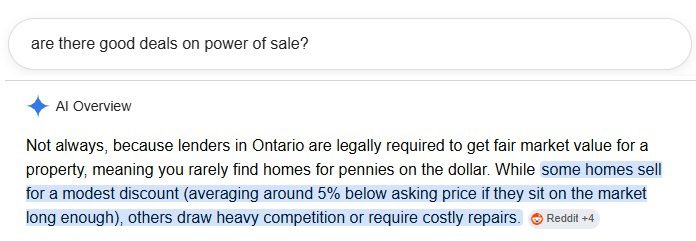
“Not always,” they explain.
But it’s not really Google doing the explaining, of course. It’s really just the A.I. tool quoting…………Reddit.
Yes, because Reddit is where you want to get all your facts.
Maybe we can try asking the question in another way?
What if we simply queried:
How to get a deal on a power of sale
Here’s our result:
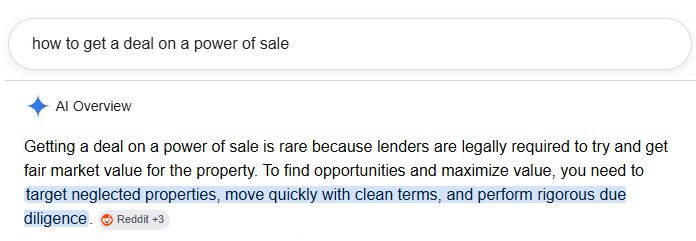
Ugh, they’re quoting Reddit again.
Can it get any worse?
Let me be more specific.
We’ll ask:
“Can I get a deal on a power of sale property in Toronto?”
Adding a major city like Toronto and adding the word “property” should get us better results, right?
Here’s the A.I. Overview from Google:
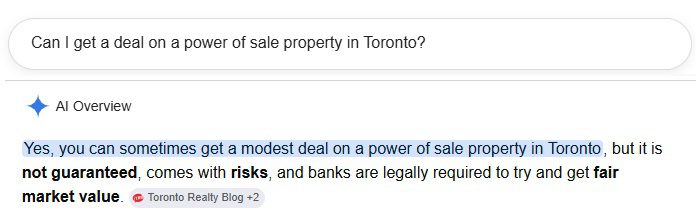
Oh, great.
The only source less reliable than Reddit is some random guy’s blog…
I’ve always been fascinated by properties being sold under power of sale, but maybe not for the same reasons that you would provide.
The questions that most often come to mind:
- Is the property listed at a great price?
- What type of brokerage is listing the property?
- Which lender is it?
But there’s one question that always piques my interest more than any else.
Every time. No matter what.
“How did the defaulting borrower get the position to have their home sold under power of sale in the first place?”
With access to the MLS archives, and of course, with the benefit of hindsight, we can answer this question for just about any property being sold under power of sale.
I’ve picked one property from MLS just now, completely at random, for us to analyze.
Let’s start from the beginning…
March 19th, 2020, the property was listed for $699,900:
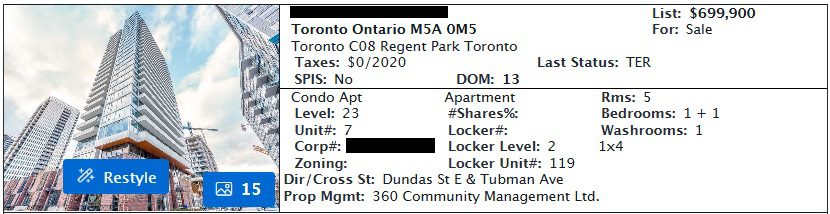
The property was listed for 13 days before the listing was terminated.
Wait, wait, wait…
(beep, beep, beep)
That’s me, trying to back it up!
Because while the unit was first listed for sale on March 19th, 2020, this wasn’t the first listing for the condo:
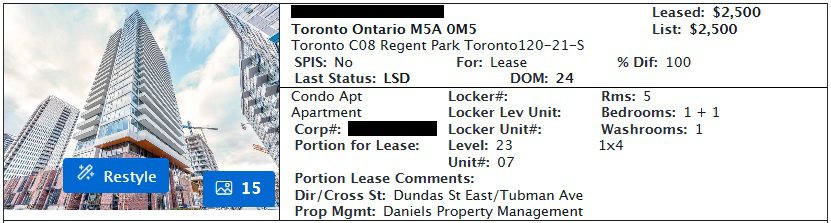
That’s right, the condo was listed for lease before it was listed for sale thereafter. This is really the start of our power of sale journey.
The condo was listed for lease on December 22nd, 2019, and was leased on a one-year term on January 15th, 2020.
Perhaps that was the first mistake, but I digress.
So now we have a condo, leased in January, up for sale in March for $699,900.
That listing was terminated, as mentioned before, on April 1st, 2020.
The property was re-listed later on April 1st, 2020, for $675,000:
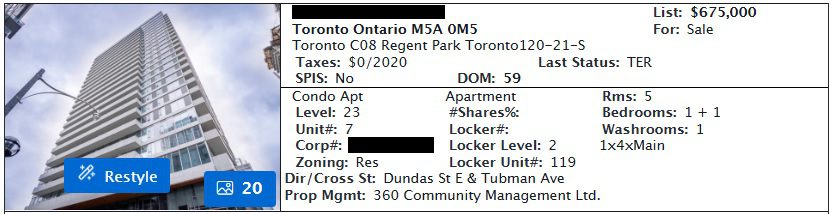
April 1st, 2020, was the height of the pandemic, so nobody was going to buy this condo.
The unit remained on the market for 59 days until the listing was terminated on May 30th, 2020.
On May 14th, 2020, the property was listed for lease again:
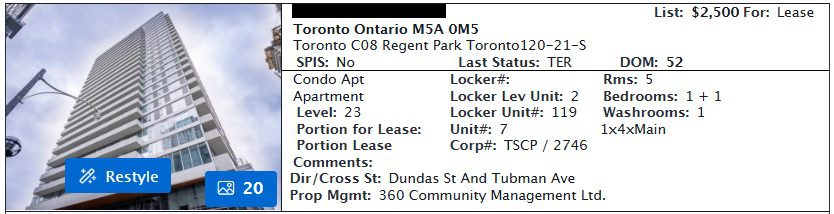
Presumably, the existing tenant walked out during COVID, as tenants were doing en masse, but it was still an interesting decision to list the property for lease after trying it for sale.
But it didn’t work.
The listing was terminated on July 6th, 2020.
But interestingly enough, this seller decided to hedge their bets.
On May 29th, 2020, the condo was listed for sale for $665,000:
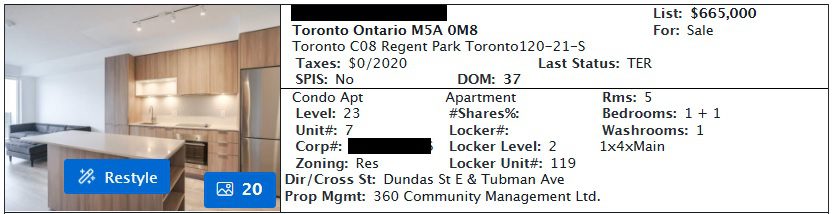
So back up here…
The condo was listed for lease at $2,500 per month on May 14th.
The condo was listed for sale for $665,000 on May 29th.
That means, two weeks into the lease listing, the seller said, “I might as well try this up for sale as well.”
Neither attempt worked, however, and both listings were terminated on July 6th, 2020.
On July 9th, 2020, the owner listed the property for sale for $599,995:
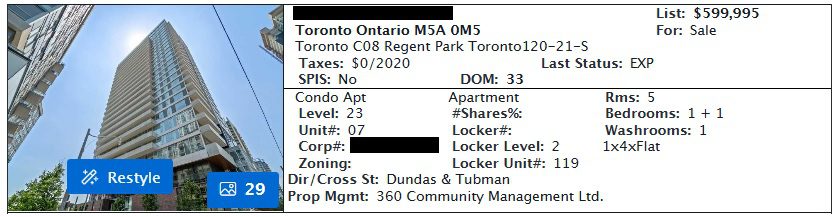
So why wasn’t this condo selling when the average home price was increasing?
Well, perhaps it was so over-priced to begin with that, despite the increase in demand, increase in average home price, and the $100,000 in price reductions since the first listing, the seller still wasn’t in line with the market.
This listing expired on October 30th, 2020.
The property was eventually leased for $2,000 per month:
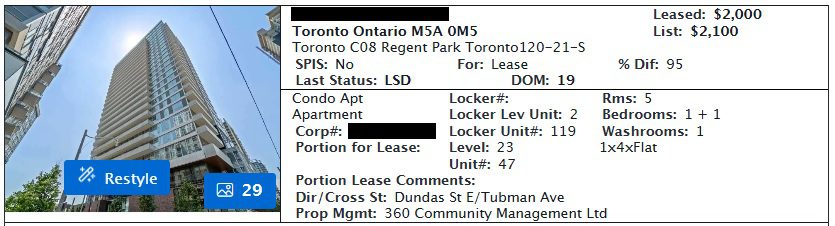
We didn’t see the property listed again until 2024.
September 9th, 2024, the property was listed as follows:
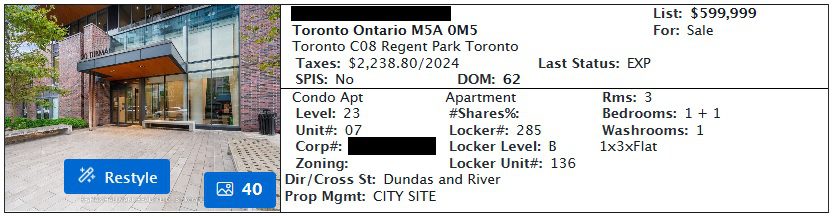
The property sat on the market for 62 days until the listing expired on November 4th, 2024.
On November 5th, 2024, the property was re-listed:
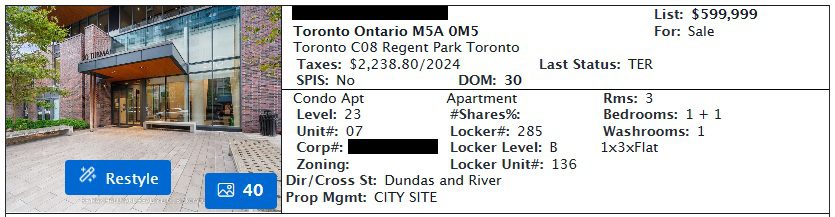
At the same price!
The unit was on the market for only 30 days until the listing was terminated on December 5th, 2024.
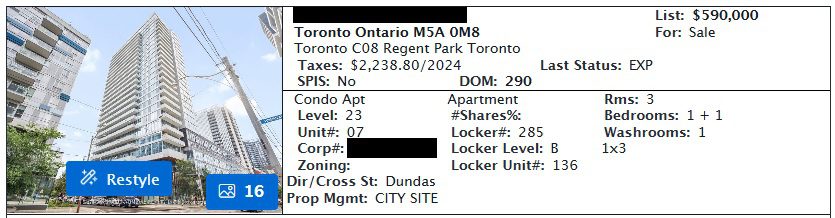
On December 9th, 2024, the seller switched to his or her fifth listing agent, and put the property back up for sale:
The same price, once again!
Er, well, maybe not the same price exactly. There was a “reduction” of $9,999.
Regardless, the property sat on the market for a ridiculous 290 days.
The listing expired on September 25th, 2025.
We didn’t see the property again until July 22nd, 2026 when it was re-listed:
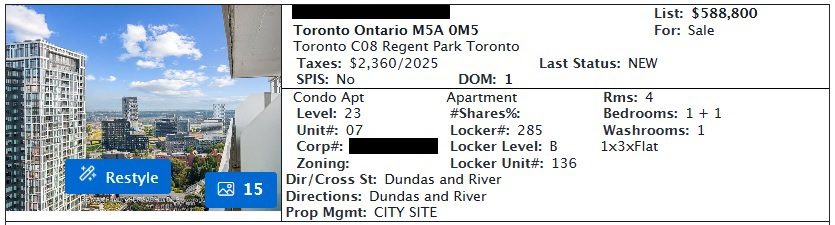
This time, however, the property was being sold as a Power of Sale.
At some point between the previous listing and this new one, the owner defaulted, and the lender/creditor forced the sale.
But here’s what I find fascinating:
The asking price hasn’t really moved since September of 2024.
The average 416 condo price is down 6.0% since then.
If the property wasn’t selling in September of 2024, when it was listed for $599,999, then it might have been worth, what, maybe $550,000? Or less?
And yet, the lender listed it for $588,800.
That’s almost as bad as what the previous owner did.
Now, for those of you wondering what this condo is actually worth, let’s go back to the last sale for this identical model unit:
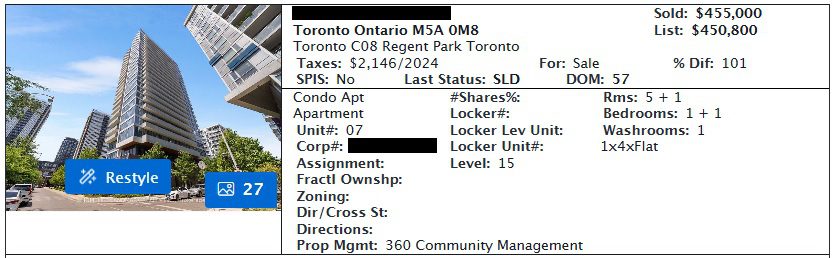
This sale is from January of 2026.
$455,000 on January 23rd, 2026, and yet for some strange reason, the power of sale for the other unit has a price tag of $588,800 on it.
If you were expecting the takeaway from today’s blog post to be, “People who were foreclosed on were all out to lunch on price,” then, sure, that’s part of it.
But I have to add something else, based on my recent experiences in the condo market:
The prices of some properties being sold under power of sale make absolutely zero sense.
I do not work for a bank, nor do I work for a law firm that handles power of sales, so I can’t comment on the regulatory processes that each and every creditor has during a power of sale.
Creditors might be obligated to list the property for a certain price, for a certain amount of time, or to try to recoup amounts owing, even if the list price is well beyond anything resembling fair market value.
I don’t know. I don’t work on that side of the ledger.
But what I can say is that there’s an incredible misconception out there that “you can get a great deal on a power of sale.”
We hear this all the time.
Google the words; any combination of words regarding foreclosures, auctions, power of sales, defaults, et al, and you’ll surely find an article, blog, or story about people buying, somewhere in the world, for pennies on the dollar.
But in Toronto, in 2026, I’m seeing a lot of listings for properties where the prices are egregious.
Not only that, if you do end up attempting to buy a property under power of sale, the regulations will make you back off.
Case in point: would you buy a condo where the previous owner, who defaulted on her mortgage and is since deceased, also happens to be a non-resident of Canada?
Would you take on the risk that the Canadian Revenue Agency comes calling for a fat stack of dough?
That is exactly what we’re dealing with right now.
Hardly seems worth it, unless you’re getting an incredible deal.
There are currently 380 properties on the MLS system with some form of “power of sale” as the seller’s name.
That also means there’s no shortage of stories I could be telling about them.
Maybe today’s blog is just the start of a regular feature here on Toronto Realty Blog?



























Appraiser
at 8:31 am
Most credible lenders have the property appraised by two different appraisers before listing the property for sale on MLS. This is to cover legal requirements.
Most lenders are realistic about market value and do not want to hold on to the property for long as they are responsible for property taxes, insurance, condo fees etc. while in possession.
Sometimes the second mortgagee pays out the first and forces the power of sale. In that case the lender might be trapped under water and totally unrealistic on list price.
Marina
at 9:39 am
That second point is the key one. The carrying costs can absolutely bury the lender, so most of them will take a small haircut to avoid keeping the liability on the books for too long.
But there is sometimes a disconnect between the people at the top making decisions, and the people actually executing the “strategy”, i.e. the foreclosure, dealing with the lawyers and realtors, etc. Some lenders can be surprisingly slow to make changes to minimize losses.
Different David
at 3:20 pm
Banks have a reserve for delinquent loans. If they take a haircut on the sale price, they can use their reserves to net out the loss so there is no impact on future earnings.
Ongoing servicing costs would affect their current fiscal period and reflect poorly on quarterly earnings, so given a choice, they choose the former.
Graham (the real deal somewhere between Detroit and Toronto)
at 1:57 pm
Somewhat related to a power of sale, is there a market in Toronto for tax sales, where the City sells property by public tender to try to recover unpaid property taxes?
I live down the 401 now in London, but back in May, the City of London posted 28 properties for sale by public tender, including vacant commercial land, dilapidated houses, but also some houses that appear in decent shape (e.g., 51 Ski Valley Crescent). The City can only list the property for the amount of property taxes owing, but obviously anyone can bid above that.
Anyway, just curious.