

I was looking at a floor plan for a condo last week, wondering how in the world this ever came to be.
We’ve reviewed a lot of bad floor plans over the years here on TRB.
Case in point:
“The Problem With New Condo Floor Plans”
The truth is, the floor plans reviewed and analyzed in the blog post above are much worse than the one I’m about to show you, but let me come back to that in a moment.
First, just look at this:
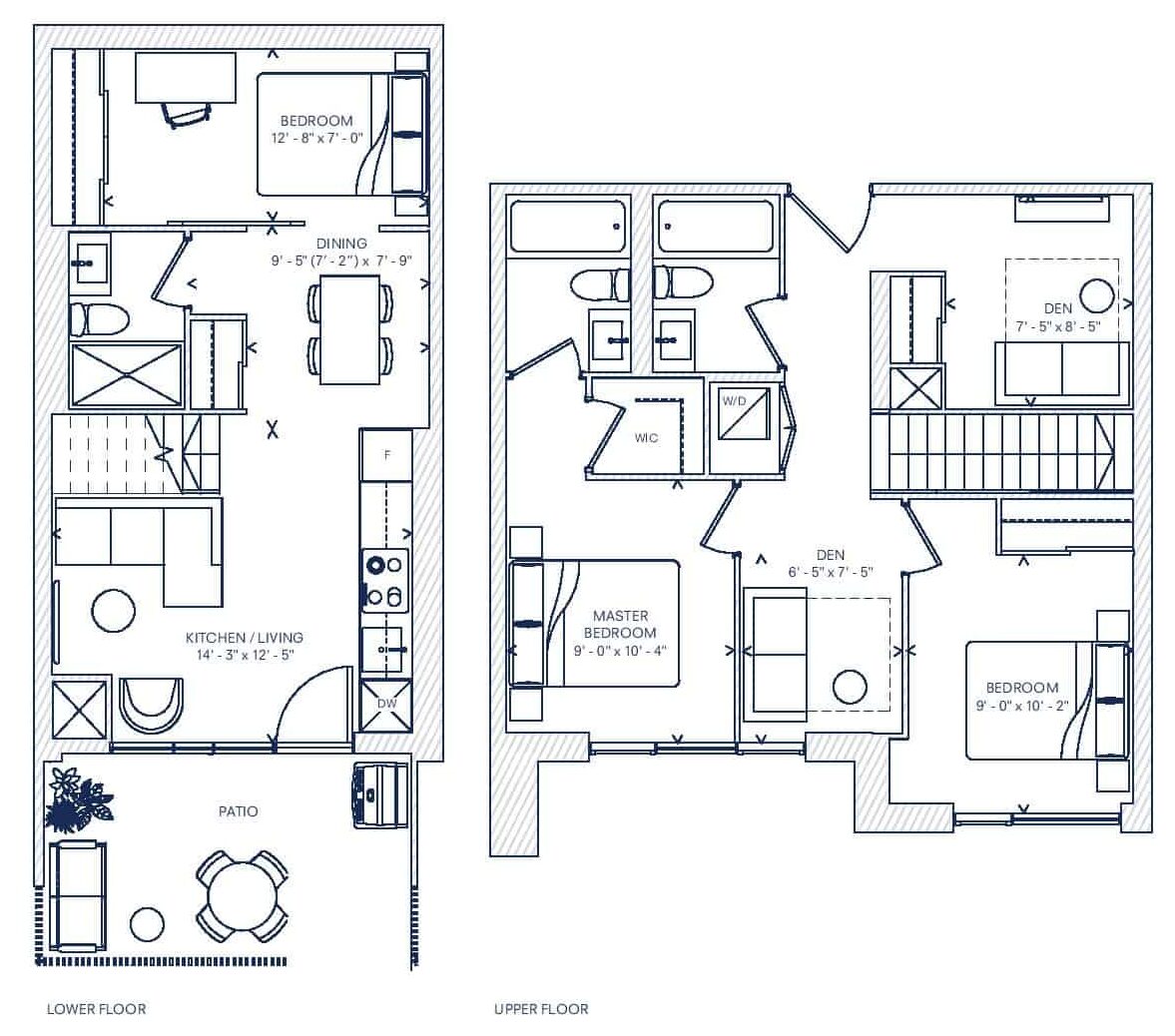
Don’t glaze over this, please and thanks.
Have a serious look at it.
The front door opens into the dishwasher. And there is no coat closet.
The living “room” isn’t a room. There’s an HVAC stack on the left, and your couch (which looks like a sectional, but isn’t) can’t be more than a loveseat, otherwise it would block the stairs.
The dining “room” is a hallway at best, and it’s so crowded, you can probably flush the toilet from the dining table.
The back “bedroom” has no window, is merely deep enough to fit a bed (picture yourself squeezing sideways to get past the bed and over to the closet), and would be dark as heck.
Then upstairs. Oh Lord.
There are three bedrooms plus a bed that, for some reason, is in between two bedrooms. They call this a “den” but in reality, it looks like this:
(photo)
When all is said and done, you effectively have five beds in this condo.
And how large is this unit?
A mere 1,100 square feet.
Here’s my point:
Nobody ever wanted a condo like this. Never. Not even close.
This is a miserable, nasty, useless condo design that lacks functionality, let alone logic.
This was designed and built specifically to be sold to investors, either those who didn’t know any better and were merely buying from floor plans, or who intended to jam five international students into those “bedrooms,” slumlording all the way to $7,500 per month in rent.
When the market was absolutely ripping, people would line up to buy this garbage.
But now that the proverbial music has stopped and nobody is buying these resale units, let alone continuing to buy over-priced pre-construction, this condo is virtually unsellable.
So the big question becomes:
Who is actually going to buy all these condos under construction?
Whether the units belong to the developer, or whether they belong to buyers who are going to default, the question needs to be answered.
Much has been made of the idea that investment firms, pension funds, or wealthy families will start to purchase condos in “bulk.” The first such article I saw this year appeared in January:
“As Toronto Condo Sales Flounder, One Group Is Betting Big And Buying Up Units In Bulk”
Toronto Star
January 26, 2026
From the article:
“There’s a lot of funds that we work with, like equity funds, and they’re buying them in bulk,” said realtor Jonathan Zadegan, managing partner at the Zadegan Group.
“They’re buying them, they’re renting them out, they’re keeping them until 2030, 2031, and they’re flipping them.”
I know what you’re going to say: this quote is from a Realtor, so you take it with a grain of salt.
That’s fine.
You might also say that “they’re keeping them until 2030, 2031, and they’re flipping them” is using a future event in the present tense, and I would agree with that. There’s no telling what a buyer today is going to do in five years; there’s merely a hypothesis.
But this was the first time we really saw the word “bulk” used to describe condo purchases, and as the winter wore on, we saw more stories like this.
Here’s one from February:
“As Canada’s Condo Market Swoons, Private Equity Is Circling”
Financial Post
February 7, 2026
From the article:
There are thousands of unsold condominiums in Canada’s two priciest cities for housing, with not many buyers in sight. Who blinks first — buyers or sellers — is the biggest question that will determine whether sales pick up.
A wildcard could be private equity groups, which are already eying inventory in Toronto and Vancouver, hoping to profit from a turnaround in the same way corporate buyers did in the United States during the 2007-2010 U.S. subprime housing crisis.
Mark Goodman, a principal broker at Vancouver-based Goodman Commercial Inc., said he believes there is going to be wholesale massive acquisitions in the sector at some point.
“I have been approached by some major players across the country who have floated the idea for me to assist them in acquiring distressed condo projects that are built and sitting empty,” said Goodman. “They would come in and buy hundreds, if not thousands of units in one fell swoop.”
Now, that’s a sexy sound bite, but is this real?
Could we actually see “hundreds,” if not “thousands,” of units move in this manner?
Here’s another quote:
“The private equity is real, just smaller groups,” said Shaun Hildebrand, the president of Urbanation.”
“We talk to groups who say they will buy units today and sell in peak values in a few years,” said Hildebrand, who doesn’t think that scenario will play out. “We see small batches of maybe 20 units changing hands. Nothing huge.”
Alright, so we’re talking “maybe 20 units changing hands,” but still nothing that’s going to shake the earth.
Over the last few months, we’ve started to see much bigger stories with much larger financial figures being thrown around.
Here’s one:
“Real Estate Firm Bulk-Buys $30 Million Of Downtown Toronto Condos”
Toronto Star
June 4th, 2026
Alright, so now we’re talking about one firm buying $30 Million worth of condos, which, assuming these are smaller units (which are the ones most readily available, and being sold at the largest discount), means this could represent 50-80 units.
But here’s a much, much larger headline for you:
“Real Estate Developer Jesta Plans To Buy $500 Million Of Unsold Toronto Condo Stock”
The Globe & Mail
May 12, 2026
Now we’re on to something!
From the article:
“We’re approaching developers saying, ‘Would you like to sell all of your inventory?’ ” said Anthony O’Brien, Jesta’s senior managing director. Mr. O’Brien would not provide the exact number of units purchased in the initial deal or the name of the building or developer.
Jesta, which manages rental apartments and other commercial property in Montreal, Europe, the United States and Britain, has been trying to expand into Toronto’s residential rental market for some time.
In 2017, the developer bought a hotel in Toronto and planned to turn it into rentals. Instead, it capitalized on the boom in commercial land and sold the property a year later.
Today’s real estate climate has prompted Jesta to act.
It’s not just because there are deals to be had with developers that are sitting on heaps of unsold condo inventory.
The housing industry is predicting that by 2030 there will be a shortage of new homes coming to the market since there are very few condo projects breaking ground today. That, along with forecasts that the country’s population will grow, means there will eventually be more demand for housing in Toronto.
“It’s a very good economic opportunity,” said Mr. O’Brien, adding that he could buy newly built condos at a cheaper price than it would take to develop and deliver a condo project over the next three to five years.
You might think the key point here is that there’s a “shortage of new homes coming to market” in 2030.
But it’s not.
The key point is this:
He could buy newly built condos at a cheaper price than it would take to develop and deliver a condo project in the next three to five years.
BINGO!
This is why, among many other reasons, big-money is looking to buy up Toronto condos in “bulk.”
If you can buy something for less than it costs to produce, then it’s a deal. So long as there is still demand for that product, it’s an absolute no-brainer.
The irony is: if big-money continues to buy existing units instead of building them, this will further exacerbate a future shortage.
Now, what is a company like Jesta going to do with these units?
They’re not keeping them empty, right?
No.
The next headline makes the intention crystal clear, however, connect the dots when you read this…
“Real Estate Firm Plans To Turn $500 Million Worth Of Condo Stock Into Rentals”
CBC
May 14, 2026
This is great, right?
We need more purpose-built rentals in the city! We’ve been saying this for years!
So this company is going to “turn $500 million worth of condo stock into rentals.”
Except, well, they’re not.
Don’t get me wrong – they’re going to rent the units out. But they’re not turning them into rentals.
This headline is so exceptionally misleading.
There have been instances of a company buying a condominium that’s already under construction, cancelling the purchase agreements (a real F.U. to those pre-construction buyers!), then converting the building into rentals.
But that’s not what this is.
Not even close.
The headline makes it sound like these are going to be purpose-built rentals but these are merely condos, like any other, being rented.
This is made clear halfway down the article:
“Our strategy is to buy it, rent it and then resell the units back into the market,” said O’Brien.
Wow, CBC. Do better!
Then there’s this:
“We’re not pretending to be the affordability saviour, but I think strategies like this are going to help stabilize the market.”
I never thought these people were going to be the affordability saviour. Maybe the CBC did?
So what’s really happening here?
A firm is going to spend $500 Million on bulk condos in order to make a profit at a future date.
They are not “converting” the units to rentals.
They are not the affordability saviour.
These are units that will be leased at market rent, and nothing less.
And then what happens in five years?
The firm sells the condos!
The quote above specifically details the plan: buy it, rent it, resell it.
So all that’s happening here is these units will be rented out for 4-5 years, then the tenants will be kicked out (or incentivized), and the units will flood the resale condo market.
While the public would love to believe that there’s some white knight out there, looking to buy bulk condos, rent them for below-market rates, convert them to long-term rentals, and save society, that’s just not feasible.
Then again, what if there was some sort of public-private partnership?
What about this:
“Public-Private Partnership Launches $1.3 Billion Fund To Purchase Unsold GTA Condos”
Financial Post
March 18, 2026
This is what people are clamouring for, right?
A partnership between the private sector and the public sector, looking to save the day!
From the article:
A private Canadian investment firm has teamed up with a provincial Crown agency to purchase and convert some of the growing inventory of unsold condominiums in the Greater Toronto Area (GTA). If all goes according to plan, the condos will be converted into long-term, affordable rental housing.
In a press release, High Art Capital, a Toronto-based real estate investment firm, said it was launching the $1.3 billion fund in partnership with Building Ontario Fund (BOF).
They lost me at “if all goes according to plan.”
Not only because nothing goes according to plan in life, let alone “all,” but also because this seems like a built-in excuse to change directions at any time, for any reason.
But here’s where the reality of capitalism and the free market sets in:
High Art Capital says the fund will hold the units for at least five years before selling them to qualified investors. In the meantime, affordable units will be rented at 25 per cent below local market rents or at 30 per cent of the GTA’s median household income, with protections aimed at maintaining affordability over the long term.
Ah, I see, I see, said the blind man.
This is just another firm that’s looking to buy units, rent them out, then sell them.
“At least five years,” as the article notes, which is essentially the same timeline as Jesta, whom we discussed in the previous article.
I’d love to know what they mean by “selling them to qualified investors.”
Let me rephrase this: “selling them to anybody.”
That’s better.
What I don’t see in the article is whether the condos being earmarked as “affordable units,” being leased at 25% below market rents, are going to be resold in five years, or whether those will remain in a portfolio owned by High Art Capital. Maybe they’ll be bought by the public sector and continue to be managed as long-term affordable units?
I don’t know what to make of all this.
I think you can feel my cynicism through and through, but it’s in my nature to question this. It’s also, rather unfortunately, in my nature to doubt things as well.
In this case, I doubt that public perception and understanding of condos being bulk-purchased and “converted” into rental units has any overlap with the tragic reality.
So let me return to the question being asked in the title of today’s post:
Investment funds bulk-buying unsold condos: is this good or bad?
Well, ignoring the fact that these condos are simply going to come back to the resale market, the follow-up question I would have to this is: would you rather have a mom-and-pop landlord or a large conglomerate as a landlord?
Because that’s where all this is headed.
Say what you want about mom-and-pop landlords, and I know that the unresponsive, overseas landlord has been miserable over the last decade.
But the investment fund that buys thousands of condos is probably worse.
And that’s where all of this is headed.
Don’t say I didn’t warn you…



























Paul
at 6:35 am
This is market manipulation. They already own millions of dollars worth of condos. To stop the market crash they’re purchasing millions more to manipulate and control the supply. Very scary. Not going to work.
A Grant
at 8:03 am
“While the public would love to believe that there’s some white knight out there, looking to buy bulk condos, rent them for below-market rates, convert them to long-term rentals, and save society, that’s just not feasible.”
I don’t think anyone who’s lived through the past 10 years would consider “private equity” a “white knight”.
Serge
at 9:49 am
Interesting selection, thanks!
methinks it is good. If it is purely private money.
unfortunately, it has been increasingly public.
JF007
at 10:34 am
Bad news for market bears..is what this is. Don’t get me wrong I am all for a EU type of housing support model where finding a decent livable space is not an existential crisis for many, but off late the housing situation was not a WIN-WIN conversation but a you lose and I win type similar to what we see down south with the entire trade rhetoric. Those not on property ladder desperately wants the investors to lose their shirts so that they can buy property at prices their parents bought at and with investment funds buying in bulk it is bad news for all such folks.
Vancouver Keith
at 10:42 am
When something called the Building Ontario Fund teams up with something called High Art Capital my first thought is Hollywood could not come up with better names. My second thought is that below market rents, for private capital in any form need to have compensation for that discount. I have to see the details on that. High Art of the Deal?
Serge
at 11:48 am
There is illusion that “affordable prices” will kill “friendly developers” turned landlords.
According to what I have read, “affordable” means 30% of pre-tax median region income. In Toronto, the median is… I do not rememeber, but around 100K for household. So then “affordable rent” will be over 2500 a month. “Affordable” is the must. “Below market” is not.
Derek
at 11:32 pm
311 Armadale Avenue
Check it out, Appraiser,
We’re back, baby!
Izzy Bedibida
at 4:28 pm
Problem is that way too many condo’s like the one pictured have been built. Even after they are bought in bulk, by REITS, they are still horrible units, and they may still be difficult to rent for the long term. REITS will capitalize on tenant turn over to keep “market rents” high.
The big question is why units like this were allowed to be built in the first place.
Jamie
at 10:27 am
44% of Ontario MPPs are landlords or real estate investors.
Despite having a very substantial stake in the housing market and a clear conflict of interest, they vote to spend tax dollars propping up their investments.
The five year purchase to sale cycle mentioned in this excellent article coincides very nicely with the election cycle – MPPs will be able to get out right before these condos hit the resale market.
Coincidence of course.