
This is one of my favourite discussions!
And yet, I don’t think we’ve actually had this chat as it pertains to the current real estate market, either here or across the country.
You’ve definitely heard this analogy from me before, but here goes again…
Let’s say that a “widget” is trading at $100 and a buyer is contemplating entering the market.
The widget declines in value to $95, then to $90. Then it continues to slide to $85, then $80, then $75.
At $75, the buyer thinks, “I could get in now, and I know the value will come back, but what if it goes lower?”
The buyer elects not to act.
The widget hits $70, and the buyer thinks, “I’m so glad I didn’t buy!”
Then the widget increases to $75, and the buyer thinks, “That’s just a dead-cat bounce.”
The widget increases to $80, and the buyer thinks, “These are just regular market fluctuations.”
The buyer continues to watch the market and ultimately pulls the trigger at $88.50.
Eventually, the widget heads back over $100 and continues to rise, while the buyer brags, “I got in at $88.50.”
What the buyer does not tell anybody, let alone acknowledge himself, is that he could have bought in at $70.
But he didn’t.
Because nobody knows where the market bottom is until it’s already well into the rear-view mirror.
Make no mistake about it, human nature plays out in the real estate market as follows:
Buyers would always rather buy on the way up, even if it costs them more.
It feels better.
It’s less scary.
And as I said above, once those buyers have made money on-paper, they can completely ignore the fact that they could have done better.
Last week, I couldn’t help but notice this article in the Toronto Star:
“Some Toronto Condos Are Selling For Less Than 2017 Prices. Has The Market Hit A New Low?”
Toronto Star
June 6, 2026
A “new low,” eh?
That’s going to catch some eyes!
But I was more focused on the word “some,” of course, since I think that headlines are always going to capture some of the story.
Case in point:
One has a concrete pillar in the middle of the living room, another a balcony that faces a wall of other condos in a neighbouring building. A third spent months on the market.
They are all small downtown Toronto condos, at under 700 square feet, that recently sold for tens of thousands of dollars less than what they went for in 2017 and 2018.
While the average condo price is up over the last 10 years, these sales show just how far the market for smaller generic units has tumbled, real estate professionals say, erasing roughly a decade of potential gains.
So properties with poor design, obstructed floor plans, and terrible views aren’t selling?
No kidding!
But the point has been made here with the words “new low” in the headline. Not only that, but potential buyers are going to see 2017, and their interest will be piqued. Whether or not the type and style of condo and the geographic location they covet have declined in value accordingly remains to be seen, but the bait-and-switch is present in the headline.
Nevertheless, we’re hearing more discussion about “market bottom” these days, and it’s really ramping up.
Last week, the Bank of Canada made an interest rate announcement, which was a ho-hum-hold, but rather than simply noting that in newspaper headlines, we saw media and respective journalists equate the interest rate hold with the market trough, like this:
“As Bank Of Canada Holds Key Rate, Expert Says Housing May Be At An ‘Affordability Bottom’.”
Toronto Star
June 10, 2026
An “affordability bottom,” you say?
This isn’t quite the same thing as “market bottom,” but as with the article above, this is going to draw eyes!
From the article:
Homebuyers and sellers aren’t likely to see significant changes in the real estate market anytime soon, but it’s possible that prices have reached their lowest point, mortgage experts say.
Interesting.
The headline says “affordability bottom,” which would, theoretically, have more to do with interest rates, mortgage pre-approvals, and carrying cost, but then the first sentence of the article talks about “prices.”
In this article, we start to hear more about the action of buying, as it relates to the “market bottom,” or rather the lack thereof:
“If you’re a motivated buyer, and you’ve been keeping an eye on conditions, this might be the window where you consider, ‘OK, I’m going to make my move now,’ because it’s likely not going to become more attractive in the near future,” she said, adding “we might be at an affordability bottom.”
While many prospective buyers have been holding off on purchasing a home due to economic uncertainty, recent national and regional data has shown “modest improvement in sales demand,” which could be an early sign of a slight market recovery, she said.
“We’re starting to see some heating factors in the real estate market that could push prices up,” she said.
So there’s the “affordability bottom” quote that was included in the headline.
In any event, the point is made in the second line: some prospective buyers are holding off.
But when will they act? Or more importantly, why aren’t they acting?
I would offer two answers:
1) They’re waiting for market bottom.
2) They’re afraid.
And consider that every buyer who falls into category #2 tells themselves that they’re in category #1.
People can talk about the economy, oil prices, Donald Trump, and interest rates, but the reality is, they’re just afraid to act. They might be afraid that the market goes down further, but they also might just be afraid to act, and/or actually sign a mortgage contract and own a home.
Now, we could start to divide the market into segments, whether that’s “condo versus freehold,” or “416 versus 905,” or “entry level versus move-up,” and then look at how people are monitoring the market, and potentially waiting for market bottom.
But personally, I don’t think the move-up buyers are waiting for the market bottom. In fact, I would say those buyers are more aggressive than ever, and we’ve covered this here on TRB throughout 2026.
I would say that the folks “waiting for the bottom of the market” are, by a large majority, first-time buyers. And as a result, this is why I’ve included point #2 above, in that they’re afraid.
Imagine a would-be, first-time condo buyer who’s eyeing a condo, priced at $529,900, for which a comparable unit sold for nearly $700,000 at the market peak in February of 2022.
That buyer can take the on-paper discount and feel pretty darn good about it!
But then human nature takes over.
Fear is present in all of us, no matter the situation, and here’s a classic example of when “great” just isn’t good enough…
It’s human nature for that would-be buyer to think, “What if this condo is selling for $519,900 in two months? What if it’s selling for $499,900 in six months?”
It’s the complete opposite of what was happening in 2021.
Consider the condo that had just sold for $640,000.
Now the buyer was being told that they could buy the same model for $660,000.
And the “fear” was that if they didn’t jump on that unit, today, at $660,000, then the next time they had a similar opportunity, it would be $680,000.
We all know that as “FOMO,” but what we’re seeing in the market today is “FOLM,” or fear of losing more.
Yes, I just coined that, and no, it’s not real. But this is the most prevalent form of fear in our real estate market today, and it’s why so many would-be buyers are remaining on the sidelines.
And you know what’s crazy?
This might just be my opinion, but I don’t think these buyers are most afraid of the financial implications; rather, I think it’s the “I told you so” that they would experience from their sphere of influence, the media, and the rest of society if they bought a home, and the market did decline further.
Buying for $520,000 and seeing the unit one floor above you sell for $510,000 two months later might affect your pocketbook, but I don’t think it’s as impactful as the emotional result of all the finger-wagging in your face.
Timing the bottom of the market is a lot harder than you think.
But finding an article about timing the market being harder than you think, is easier than you think!
Check it out:
“Why Timing The Bottom Of Canada’s Roller-Coaster Real Estate Market May Be Harder Than You Think”
Financial Post
April 13, 2026
The subtitle reads: “The spring market will be major test for prices but timing your purchase to hit the absolute bottom is a game few can win.”
Exactly.
But it won’t stop people from trying!
Let me put on my old man clothing for a moment, and clench my fist as I shake it and yell at a cloud rolling by, but this kind of reminds me of the gambling predicament that we find ourselves in.
The house always wins. Always.
And yet we have a country full of young men who constantly wager on sporting events, even though 99.999% of them will be left behind.
Why do they keep doing it?
For the same reason that scores of Canadians who want to buy a home will continue to wait on the sidelines for some sign of the “market bottom,” while most of them will actually end up buying on the way back up.
We all think we’re smarter than the person next to us. We think we’re smarter than the market in which we’re attempting to operate, even if we have no experience.
Years ago, I was at a farm north of the city around Halloween (parents with young children know what this is all about…), and my wife’s friend’s husband said to me, “Hey man, you know anything about football?”
I said, “Yeah, sure, a little.”
He said, “Who do you think is going to win today between Pittsburgh and Cincinnati?”
I said, “I dunno, but I guess I would take Cincinnati.”
His eyes widened, and he said, “Really, eh?” Then he swiped on his phone and changed his pick.
He said, “Who do you think is going to win today between New England and Miami?”
I said, “Hmm, well, I guess I would take Miami at home.”
He swiped on his phone again and said, “Alright, awesome.”
This is what gambling is about in our society in 2026: people who have absolutely zero clue what they’re doing, simply looking for something to do with their time.
The individual described above should not be wagering on professional sports. I mean, nobody should, since the house always wins, but most people, whether they know it or not, fall into this category.
Alright, so now that I’m done being the Fun Police, what’s the parallel to the real estate market?
Young, first-time buyers who have no real estate experience are probably the last people in society who will be accurate in their attempts to time the real estate market. I’m not suggesting that they should all run out and buy today, but rather I’m just hoping that they, along with other market onlookers, can agree with this.
From the article above:
So what are consumers to do? Should they wait and try and time the bottom of the cycle? There are factors that make that difficult, Clayton said. Aside from needing to separate housing by segment and geography, the bigger picture — what is happening with the economy, including tariffs and the Middle East war and their potential effect on inflation and interest rates — makes predictability harder than ever.
Even within segments, there is variation.
“I will say condos are definitely not at the bottom; there are just so many condos,” Clayton said.
But single-family homes are another story.
“The demographics across the country do support single-family houses in a huge way,” he said. “There is just no further to go down.”
There’s the rub.
We’re trying to predict the market bottom, but the market is divided into a host of different, smaller markets.
Can the housing market bottom be in the rear-view mirror while the condo market bottom remains ahead?
Absolutely.
So now we’re playing roulette and the slot machines!
Then again, it’s hard to predict the condo market lays ahead when we’re reading headlines like this:
“Toronto’s Condo Market ‘Hits Bottom’ With Some Developers Looking At Selling Units Below Cost”
Financial Post
April 21, 2026
From the article:
Canada’s largest condominium market has “hit bottom” as first-quarter sales for new projects in Toronto fell 52 per cent from a year ago to a 35-year low, according to an Urbanation Inc. report, and no projects were launched for the first time in three decades in the period.
“What stood out here was that there was for the first time in decades zero new project launches; the market basically came to a standstill,” Shaun Hildebrand, president of Urbanation, said. “It’s probably safe to say that we’ve hit the bottom.”
Well, if stats guru Shaun Hildebrand said that we’ve hit bottom, then what are we waiting for?
Nothing short of Benjamin Tal arguing otherwise should stop us from firmly locking in the trough on our chart!
But as a stats nerd myself, I don’t really see any reason why we’ve reached the market bottom, at least in terms of average sale price.
The last time we saw a month with a year-over-year increase in the 416 average condo price was December of 2024, when the $719,774 average sale price was 1.5% higher than the $709,283 recorded in December of 2023.
Since then, during a period of seventeen months, the average 416 condo sale price has been lower on a year-over-year basis.
While the true “trough” was reached in January of 2026, with an average sale price of $631,932, and every month since then has been higher, the year-over-year prices are all lower.
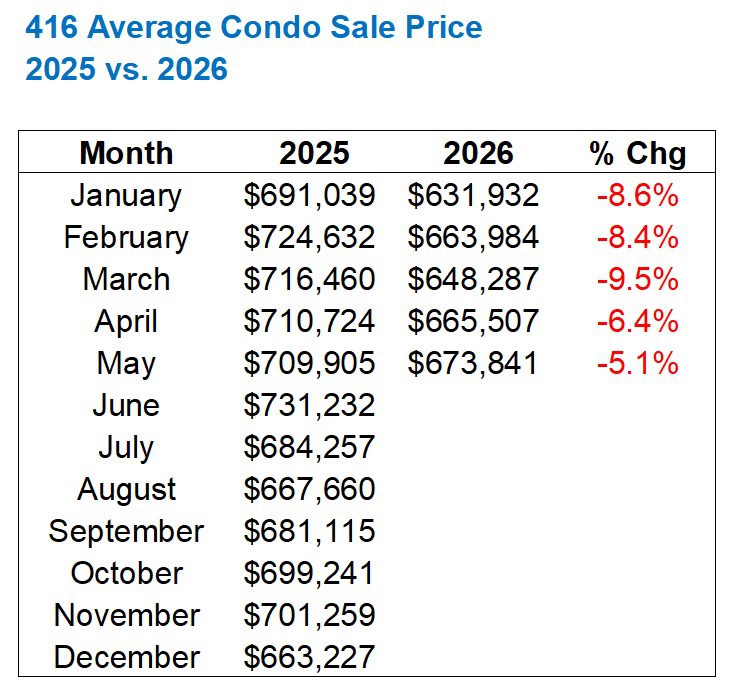
See what I mean?
January’s $631,932 is the lowest, post-peak in 2022, but each month is still lower than the same month in 2025.
The only way we can say that the “bottom has been reached” is if we see year-over-year prices higher.
Not only that, we’d have to see several months of higher year-over-year prices to call it anything other than an outlier. I would think a minimum of three consecutive months, but ideally 4-6.
Maybe, just maybe, there’s an argument to be made that the diminishing year-over-year prices in the chart above point to a recovery, or a “bottom,” but that’s a stretch.
So for now, we wait!
And we will only be able to confirm we’ve hit true “market bottom” when the market is well on the way back up…



























Serge
at 8:28 am
We know the bootom price for a used car. It is it’s scrap-yard price.
Is there is a scrap-yard for condos and what could be the price there?
Serge
at 8:29 am
PS sorry, bottom, not bootom
Marina
at 10:37 am
Making decisions is hard. Making decisions about massive assets that you will have to pay into for years is even harder.
It’s the same when the market goes up too – you have people who are worried about buying at the “top” and keep speculating when the market will correct.
Same with the stock market, but a bit less because you invest at different points. With houses it all goes in at one time.
But I think you’ll be fine if you buy your residence when the time is right for you at a price point you can afford, and you buy an investment property when the financials make sense for you. It will work out in the long term. Oh, and don’t buy crappy condos that nobody will want to live in 🙂
Ace Goodheart
at 12:49 pm
If you look at any historical real estate price graph, you see peaks and troughs. You also see that the long term trend is always up.
If you are old (like me) you remember the 1990s crash, and you remember people saying “there is no way property values will ever go back up again”.
You remember conversations about prices being too high, about market peaks, about how there was just no way a house could ever increase in price past its 1990s value.
If you ignored all that and bought a Toronto house anyway, you’re probably a millionaire now.
But what I find really interesting about this current market correction is the cottages and waterfront land.
The price for waterfront land in Muskoka has roughly halved.
The land is still not selling, so I guess there is more downside?
A piece of land listed for 500 k that didn’t sell is now 250k, and not selling.
So what to offer? 90k? 75k?
Whatever your offer, it will be the only one on the table.
So the thing that now seems to set cottage and waterfront land prices in Ontario is, how desperate is the seller?
The seller has to find a Canadian to sell to (foreign buyer ban). That person has to have cash or financing (call up your bank and tell them you want a cottage mortgage – then wait for them to stop laughing).
Is this now the perfect time to buy cheap muskoka waterfront land?
Or will it be cheaper in October after yet another failed selling season?
Serge
at 2:55 pm
Changed demographics? Less people aching to enjoy nature on Muskoka waterfront?
Ace Goodheart
at 3:41 pm
Honestly I much prefer swimming in a pool. No mosquitos, no Pike or Muskie (especially Muskie – the teeth are ridiculously sharp), no snapping turtles, no green slime to slip on….Up there you get a week in the spring before the black flies start biting and a week in the fall before it gets too cold.
Rest of the time, hope you brought the bug spray.
Some people really like it….
Serge
at 10:55 pm
Yes, they do, but their numbers, according to property valuations, are dwindling.
Muskoka is not Long Island anymore.