

I have a plan.
A strategy. A system.
Don’t get me wrong, this is not some sort of “get-rich-quick scheme.”
It is, however, a tactic to make a lot of money, and FAST!
Alright, I have to come clean: I didn’t make that up. Free coffee to whoever can tell me the infamous television character who provided us with this epic line.
But with that introduction, I think you know where today’s blog post is going, right?
Every so often, I write a blog post that I just know is going to piss off a lot of people in the real estate industry.
Today’s blog post is one of those posts.
But first, I want to take you back to 2009…
It’s a Saturday night, I’m at my old condo, and I’m “flipping” channels.
For you youngsters who only know Netflix, Paramount+, Amazon Prime, and the like, I want you to picture me sitting on my couch with a rye and gingerale in a pint glass, my ADHD on fire, watching twelve minutes of Die Hard on FOX, then at the commercial, flipping to AMC to watch twelve minutes of Terminator, then at the commercial, flipping to Showcase to watch twelve minutes of Rambo.
And so on.
I miss those days.
Before kids? When I used to drink? When I could stay up late on a Saturday night?
Yeah, those things too. But I miss flipping channels…
In any event, during one commercial break, after an enthralling fourteen minutes of Executive Decision with Steven Seagal, I found myself not changing the channel.
I was hooked on the commercial.
It was some guy screaming, “I want your gold,” and offering to buy gold from people through the mail.
He described gold as “broken”, or “scratched,” or “unwanted,” which I found interesting, since gold is valued by weight and not by whether it’s broken or unwanted.
He talked about gold “sitting around, gathering dust,” which was really odd, since nobody thinks of their shares of Scotiabank stock as “gathering dust.”
The commercial encouraged people to mail their gold to an address, after which money would be mailed back to the person who sent the gold.
No prices. No valuation. No agreement. Just people mailing gold to an address they found on television.
I thought this was the most insane thing I’d ever seen in my life.
In fact, I wrote about it in the early days of Toronto Realty Blog:
October 16th, 2009: “The Friday Rant: The Dumbest Thing I’ve Ever Seen”
I miss the Friday Rant. Don’t you?
In any event, who knew that this crazy idea would not only work, but that it would turn into a multi-billion-dollar industry?
PT Barnum famously said, “A sucker is born every day.”
Today, I want to talk about common real estate sales gimmicks. These are ten gimmicks, schemes, strategies, offerings, or promises that are very common, and with which you will likely be very familiar.
Now, fair warning: there’s a very high percentage chance that you’ve participated in one or more of the ten schemes on our list. So rather than being defensive right off the hope, just hear me out, and give it some thought.
Also, fair warning to the agents reading this: you’ve likely participated in some of these as well. I know I have! We all have!
But today is just an open and honest conversation about whether or not some of the proposals or advertising mediums that agents use in 2026 are actually effective or not.
And trust me when I say: there is an exception to the rule for every item on the list.
Now, let’s start with one that’s going to ruffle the feathers of a lot of real estate agents…
10) Marketing your property internationally.
There. I did it. I just pissed off a lot of agents.
And many of those agents are within my own firm!
Look, I’m a full-service agent, working for a family brokerage, via a traditional business model.
Companies like mine all have “affiliate” companies that they work with to market properties around the world. So I’m offending my colleagues at Chestnut Park, Harvey Kalles, Royal LePage, Sotheby’s, and yes, Bosley Real Estate too.
But here’s the thing: marketing your property internationally was effective once.
Once, as in the past.
But in 2026? I’m not so sure.
Why?
Because have a foreign buyer ban!
Boom.
Minds stunned. Brains explode.
But seriously, this isn’t rocket science, is it?
What good is marketing a property internationally when we’ve had a foreign buyer ban for four years, and when we have “non-resident speculation taxes” at the Toronto and Ontario levels that levy a combined 35% penalty to foreigners who move here and want to buy a home?
For an agent to market the fact that he or she can “expose your listing to the international market” is a gimmick in 2026, plain and simple. This shouldn’t need to be explained, but perhaps not every seller is aware of the foreign buyer ban and/or the non-resident speculation taxes?
But even before the ban and the taxes, I still felt like agents used the idea of “international marketing” as a gimmick.
Here’s a story that I hope will not make me look like too much of a jerk…
Back in 2018 or thereabouts, I was interviewing with a seller for a listing on Main Street. And while I know I typically make up names and addresses, like “Anytown” or “XYZ Brokerage,” this house actually was on Main Street, just north of Gerrard Street.
The seller told me that she had already spoken to two other agents and she wanted to know…
…wait for it…
…how I was going to market her property internationally.
I asked her, “What do you mean?”
I thought my question was quite poignant, but in hindsight, I was the one who looked clueless.
She said, “I mean what I said. I want to know how and through what mediums you’re going to market my property internationally.”
She explained that the first agent that came through her home had promised to “get millions of eyes on her property all around the world.” This agent told her that the key to selling Toronto real estate was to “think outside the box” and get the listing outside of Toronto.
I thought really carefully about what I was going to say next, then I decided to check in with the seller.
I asked her, “Can I be frank with you?”
She said, “Absolutely.”
I responded, “You are really, really not going to like what I say, however.”
She smiled and said, “Alright, well, now I’m even more intrigued!”
I leaned in, smiled to try to soften the blow, and said, “Nobody in Europe is interested in your $799,000 semi-detached bungalow with an unfinished basement and no parking.”
(mic drop)
Whatever happened to, “Honesty is the best policy?”
I might have been too direct, but that didn’t make me wrong.
Marketing internationally is great for luxury homes, and in specific locations, at specific times, it can be effective elsewhere.
And back before the foreign buyer ban and the 35% “speculation taxes,” marketing run-of-the-mill condos internationally had its place.
But that was 2017.
In 2026, the agent interviewing with the owner of a one-bedroom in Liberty Village, saying, “I can get eyes across the world on your listing,” is a classic huckster.
–
9) Almost any sales statistic there is.
I remember being in a listing presentation once, and a seller asked me, “What is your sale-to-list ratio?”
I said, “I honestly couldn’t tell you.”
She replied, “Well, that’s concerning. I would think this is something you’d know off-hand, unless, well, unless your number isn’t very good, in which case you don’t want to share it.”
I smiled and said, “I love math.”
Then I added, “I have a saying that I use in this business and on the Toronto Realty Blog all the time. Can I share it with you?”
She nodded.
I told her, “You can make numbers say anything you want.”
I asked her, “If I listed your house, which is worth around $1,000,000, for $100,000, and then sold it for $1,000,000, then my sale-to-list ratio would be 1,000%. Would you be impressed?”
Unlike in the previous example, this seller laughed outrageously, threw her hands up, and said, “Okay, okay. You made your point.”
She and I did end up working together, and have worked together since then as well. From time to time, she still jokes about sale-to-list ratios.
But it’s important to know that when she interviewed an agent before me, the “value” he tried to drive home the most was his impressive sale-to-list ratio. He shared it at multiple points in his presentation, while going over his past sales and while comparing his sales statistics to industry averages.
My point is this:
If you listed a house that was worth $1,000,000 for $799,000, and that resulted in nine offers, and you sold it for $950,000, your sale-to-list ratio would be 119%. But you did a terrible job and achieved a terrible price!
And yet, every single day in this business, listing agents are touting their magical “sale-to-list.”
It’s an absolutely meaningless statistic, and a complete and utter gimmick.
There’s nothing I hate more than seeing this:
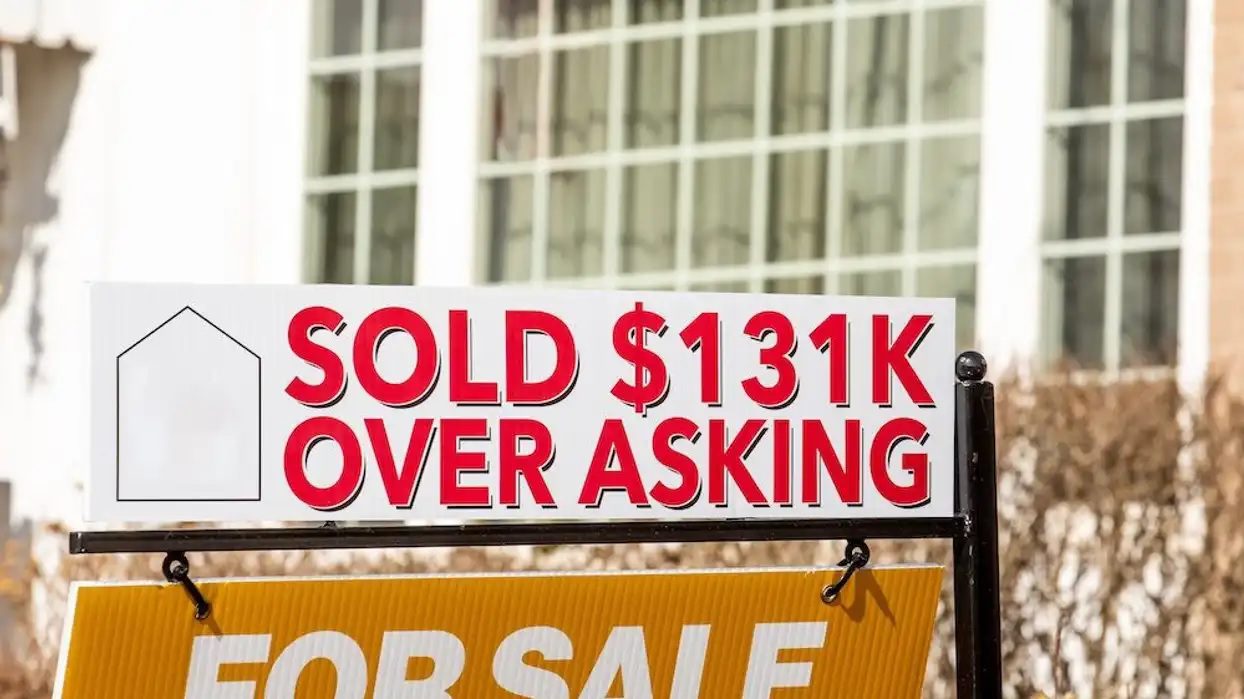
When I see this, I think, “Had you listed for $100,000 less, then you could advertise ‘SOLD $231K OVER ASKING.'”
Another sale statistic that gets thrown around way too often is “Days On Market.”
There are markets around the world where the average days on market for a listing agent’s properties could be important, but that’s typically in a buyer’s market where the product has little variability.
The cynical side of me thinks that if I were a consumer and a listing agent was saying, “My average days on market is 31% lower than average,” I might simply assume that he pushes his clients to sell as quickly as possible, regardless of the offer price.
You just don’t know whether low, medium, or high days on market is good, do you?
Consider that some listings come with different strategies than others in relation to the time on market. For example, in a seller’s market, I will always list a house on a Tuesday and review offers the following Monday, so my days on market would be six.
But what if a competing agent, in a vacuum where we’re listing all the same properties, bragged, “My average days on market is only 2.3”; what then?
Maybe his strategy is inferior to mine, and maybe he doesn’t work as hard.
Then consider how real estate agents manipulate the “DOM” on listings by taking a $999,900 listing that’s been on the market for 98 days, terminating the listing, and re-listing at the same price of $999,900.
The “days on market” resets at zero.
Do you think that agent is adding together the total number of days on market when he or she presents their statistics?
Last but not least, every agent who advertises is #1 at something, right?
It’s like how every single car, everywhere, for all of time, touts that they won some special award. There are a thousand car awards!
Or it’s like sports statistics that say, “When it comes to switch-hitting left-fielders, during night games, on the road, in the month of August, he’s second in the league.”
I’ve been the number one agent at Bosley Real Estate for eleven years, but you won’t find that in my advertising.
Because nobody cares.
When it comes to finding a listing agent to sell your home, you’re far better off getting a referral from a friend who used that agent to sell their home and spoke to that agent every day for five months than you are to pick an agent from a billboard that touts they’re #1 and with a great sale-to-list ratio…
–
8) Expose your property off-market to my comprehensive database of buyers.
Can you hear it?
The voice, I mean. The one in which this title should be read.
Think of Leonardo DiCaprio in “Wolf of Wall Street,” and now use his voice to say this:
“When you list your property with me, I will expose your home off-market to my comprehensive database of bona fide and qualified buyers…”
It’s total nonsense.
And yet, we hear about this all the time.
All I can think about when I hear this line is the scene where Leonardo DiCaprio starts at “The Investor Centre” and is selling shares of Aerotyne International:

“Huuuuge upside potential with very little downside risk.”
Yeah. Marketing to a comprehensive database of buyers.
How many buyers?
Who are they? Where did they come from?
Are they all active?
What are they looking for? Are they all looking for something similar to my 3-bedroom, 2-bathroom semi-detached with a mutual driveway?
How did you find these buyers? How often do you communicate with them?
Are they all under contract?
The reason I ask is that everybody uses the MLS system, whether it’s House Sigma, Realtor.ca, or something else. Agents, buyers, sellers, hobbyists, real estate fanboys and fangirls – they’re all looking on the market.
I’m not saying that off-market deals don’t exist, because they do. I talk about them all the time.
What I am saying is that any agent who suggests that they have some sort of hidden, secret, patented, valuable list of magical buyers they can work with to sell your property for the same amount of money that you could get on the open market, rather than exposing your listing to the entire buyer pool, is full of it.
Every property in the city needs exposure. The most possible.
It’s just simple math.
The most exposure, the most eyes, the most viewings, the most interest, the most offers, and the most leverage for the seller.
There are exceptions to the rule, of course. Every item on our list has exceptions.
If you have a $20,000,000 house in Rosedale you don’t need exposure on MLS. You need Jimmy Molloy…
–
7) “Coming Soon” signs.
This gimmick has been around for a while, but it’s not quite the gimmick that it used to be.
Rules surrounding the “COMING SOON” lawn signs and sign-riders changed about two years ago, and in today’s market, the guidelines are quite strict:
- A “Coming Soon” sign or rider can only be placed on a sign 72 hours before the property is listed on MLS.
- The sign must say “Coming Soon To MLS” and it cannot simply say “Coming Soon.”
- There are massive penalties for listing agents who post a “Coming Soon” and then sell the property before it’s listed on MLS.
Regarding that last point – any agent who puts a “Coming Soon” on a lawn had better ensure the property does, in fact, get listed on the MLS system, or they’re in big trouble.
The whole point of “Coming Soon To MLS” is that last part – the fact that the property will be listed on MLS.
Every so often, an agent will put a “Coming Soon To MLS” sign on a lawn, receive a cold-call on the property, and then sell it to an unrepresented buyer. The agent thinks, “This is great, I’m getting both ends of this deal!” But if a complaint is made, as it should be, then the RECO fine will probably cost that agent everything that they think they just made…
Now you might be asking why these new rules came into effect that mandated any “Coming Soon” sign can only be placed on a lawn 72 hours before the listing hits MLS.
Well, it’s the same reason it usually is:
Agents had abused the privilege.
Let’s rewind so that I can explain how.
The “Coming Soon” used to be another marketing technique in our arsenal. It wasn’t anything novel, but just a way to create a little “buzz” around a listing. Exclusivity usually adds value in the minds of most consumers, and at the same time, people naturally are drawn to what they can’t have. So a sign that says “this property isn’t available yet, but will be soon,” typically yields some interest.
When I put up a “Coming Soon,” I typically get a couple of calls.
So let’s say that an agent wanted to drum up business.
What would have been stopping that agent from putting up a “Coming Soon” sign on a lawn, say, three weeks before the listing came onto MLS?
Nothing, under the previous rules, and that’s exactly what some agents did!
Fishing for leads.
That’s what the “Coming Soon” sign was for many, many years, and I always thought it was extremely unethical.
I recall one specific instance where a house on Parkhurst Boulevard in Leaside had a “Coming Soon” sign for over six weeks.
It was ridiculous.
This house was on my running route, and I saw it three times per week, every week, for way, way too long!
Then one day, the sign was gone.
I had a sneaking suspicion about what happened, so I called the listing agent and asked him, “I see the sign was taken down. When is that property coming to market?”
He told me, “Actually, I just sold it a few days ago.”
I have no doubt that he never intended to bring that property to MLS, but rather he was just fishing for leads to try and sell that house. And he did.
What’s worse is that I suspect some houses had a “Coming Soon” sign out in front when they were never going to market. Maybe it was the agent’s own house. Or his cousin’s. But in the spirit of “fishing for leads,” I think agents used to view the Coming Soon sign as a great way to make the phone ring, and even if the house wasn’t actually for sale, those unethical agents could always tell the prospect, “I have another house that I think you’d like…”
–
Well, folks, this post is getting a little long in the tooth, so let’s retire for the day and finish on Thursday!





























Ken
at 9:31 am
I hate the ‘sold over asking’ banners! Everybody in my area (Markham) uses them even when they sell a $1,999,900 house for $2,000,000.
Stacey
at 10:08 am
A: Homer Simpson.
For my coffee I would like a Venti Matcha Crème Frappuccino with an espresso shot.
Different David
at 2:52 pm
So, who are you listing your house with?
Alden Kupferberg
Chester Ming
Robbie Feinberg
Nicky Koskoff
Donny Azoff
David Fleming
David Fleming
at 3:10 pm
@ Different David
“Let met introduce myself to you. My name is Chester Ming, I’m Senior Vice President at Stratton Oakmont, and I plan on being one of the top brokers in my firm next year.”
Different David
at 2:54 pm
So…are you listing your house with Alden Kupferberg or Chester Ming?
Ace Goodheart
at 3:26 pm
It is impossible to have more than 100% of something.
If you want to express a number as a ratio of another number, you use the word “to”.
So you’d say “1000 to 1” to express a difference of 999 between the two items.
You cannot have more than 100% of something. It is mathematically impossible
Marina
at 8:38 am
All know is “I will expose your property off-market” sounds really dirty – like it will be used for p0rn shoots 24/7.
I’ll see myself out.
Cashman
at 12:36 pm
I’m the cash man.
The best commercials of 90s-00s