

For those of you who were looking for “Part II” of this feature last Thursday, my apologies!
But it’s not quite like the “Who Shot Mr. Burns” cliffhanger. Or for those of a previous generation, “Who Shot J.R.?”
I figured we may as well take our monthly look at the TRREB market statistics, and even though August is a bit of a ho-hum month, we might be able to use it as a sign of things to come.
On the one hand, the average home price in Toronto dropped below the $1,000,000 threshold for the first time since January, and only the second time since 2021.
On the other hand, the gap between 2025 and 2026 prices has narrowed significantly, and if the trend continues, we could see a higher year-over-year price for the first time since January of 2025.
In any event, let’s turn our focus back to the idea of “what people will be talking about” this fall.
As I said last week, these aren’t all specifically about the real estate market, ie. the number of home sales, or whether pre-construction makes a comeback, but rather these are far-reaching topics that affect the market and are on the tip of everybody’s tongue…
3) Trade War
This has nothing to do with real estate, and yet, for some reason, we’re talking about it…
We’re talking about it because everybody is talking about it.
So, if it has nothing to do with real estate, then why am I talking about it here on my real estate blog? Well, see the point above.
Not only that, as I wrote in a blog post at the end of August, much of the media is insinuating, speculating, or in some cases, directly making a connection between the trade war and a downturn in the real estate market.
At the risk of repeating not-so-ancient history, I wrote this blog last month:
August 31st, 2026: “How Will Trump’s Trade War Affect The Real Estate Market?”
In this blog post, I dispelled the notion that our back-and-forth tarriff measuring would directly impact individual buyers and sellers in the real estate market. Not only that, I provided examples of recent newspaper articles that tried to connect the real estate market and our country’s trade war with the United States, but failed miserably in their journalistic endeavours.
Since then, we’ve hit an entirely new news cycle!
And the very day that the kids went back to school, we saw Canada hit the United States with retaliatory tariffs.
Now the United States is going to hit back.
And so on, and so on.
It’s exhausting, isn’t it? But despite all the chatter, is it actually having an effect on your life? Maybe a tube of toothpaste is going to cost thirty cents more, but where is the chaos that everybody is afraid of?
Since I penned that blog post in August, we’ve seen a slew of newspaper articles connecting the real estate market with the trade war.
Here’s one:
“Toronto’s Real Estate Industry Was Banking On A Rebound. Donald Trump’s Tariffs Have Thrown In A Wild Card”
Toronto Star
September 8, 2026
From the article:
U.S. President Donald Trump has long been involved in real estate, but he’s now playing a big role in a market he probably never even thinks about.
The reignited trade war with Canada has injected more uncertainty into the upcoming Toronto regional fall real estate season, historically the second busiest time of the year after spring.
Some experts are optimistic, predicting an increase in sales, continued tightening in the market, and only modest price drops. Others are more cautious.
One thing they all agree on is that the rising tension between Canada and the U.S. is a wild card hanging over the sector.
The industry is watching sellers to see if they get jittery, and the continuing wave of mortgage renewals at higher rates that could push more listings into the space.
This is all euphemisms.
“Some experts.”
“Others.”
“They all.”
“The industry.”
Yes, there are quotes from actual people later in the article, including Royal LePage CEO, Phil Soper. But the issue I have with much of the media coverage out there right now is that it’s devoid of evidence. I want real data. I want to hear about impact.
Where’s the downsizing, retired seller – Bob Murphy, who said, “I’m reducing the asking price of my house because I’m afraid of the trade war?”
Where’s the young, would-be condo buyer, Becky Taylor, who said, “I’m not going to buy a condo anymore because I’m afraid the price of my daily Starbucks coffee and individually-purchased Pilates sessions will be driven up”?
Here’s an article that offers a bit more insight:
“Should You Buy A House In The Middle Of A Trade War?”
Financial Post
September 9th 2026
The headline says it all, doesn’t it?
Perhaps this is more of an insinuation than a threat, as it’s posing a question that originates from a place of fear. But bottom line: there’s no beating around the bush with a headline like that, and this is exactly what I’m talking about when I opine on the media’s coverage of the trade war and real estate.
From the article:
One of the main issues for most people when buying a house is job security. People don’t buy homes unless they feel secure in their jobs. They can adjust expectations up and down depending on home prices and financing costs, but purchasing slows during a recession for good reason: You can’t pay the mortgage for very long without a job.
Another searing question for any prospective buyer is whether we have hit the bottom in home prices, something that is almost impossible to see until the market starts rising.
And another key issue that may be affected by an economy in the middle of a trade war is where interest rates may go for mortgage holders.
Job security, market prices, and interest rates.
Those are the three concerns out there right now in the midst of a trade war, and yet I feel as though all three are overblown in the context of one individual’s housing goals.
For argument’s sake, let’s say that a factory closes its doors and 300 people are laid off.
Those 300 people don’t all list their homes for sale tomorrow.
Maybe a good number of these folks are in their 40’s, 50’s, or 60’s, and have owned their homes for decades. Perhaps they don’t have any debt on their houses, or have very little, and the property value has risen.
These people aren’t in danger of “losing their houses,” and yet I feel as though the dots connected via this trade war go something like this:
- Trade war happens
- Factories close
- Workers lose jobs
- Finacial ruin
- Houses listed for sale
- Market overrun
- Home prices collapse
It’s just not that simple.
So while I understand the fear behind the trade war, and I’m certainly not naive about the economic impact that it could have, I think the media coverage is designed to get clicks, eyes, and start conversations.
Conversations like the one we’re having right now, in the midst of a blog about “what people will be talking about this fall.”
Irony…
–
4) Market Recovery
Is your glass half-empty or half-full?
My coffee is about two-thirds empty, which tells me that it’s almost time for me to go get another one, but I digress…
Are you inherently a positive person or a negative one?
We’d all like to think we’re the former, but when it comes to the Toronto real estate market, cheering the market down became a spectator sport many years ago.
Since the very day that I started in this business back in 2004, people have been cheering for the market to collapse. They wanted the “bubble” to burst, and many of them put their money where their mouths were by not buying real estate, and thus missing out on a lifetime of tax-free capital gains in the process.
As history has shown us, despite Toronto’s home prices increasing every single year from 1997 through 2017, then again from 2019 through 2022, we’ve seen three years of price declines, and that will be joined by a fourth in 2026.
But who doesn’t love a good comeback story, right?
Even though misery sells well, and much of society has loved watching the real estate market decline over the past four years, a lot of people, and much of the media, are starting to talk about the market recovery.
Is it possible that positivity trumps negativity?
I mean, if that were the case, then all you people consuming the “True Crime” genre like crazy would be watching cake-baking shows instead, but I further digress…
Over the past several weeks, I’ve noticed a massive increase in positive real estate coverage in the media.
Not only that, we’re starting to see the words “market” and “recovery” used together.
Then, there’s another word being used, one that’s highlighted in this article from August:
“There Are Signs Of Hope In Canada’s Housing Market. But is It Time To Use The B-Word?”
Financial Post
August 5th, 2026
While my daughter has recently informed me that she knows what the “B-Word” is, thankfully, it’s not that we’re discussing today.
No.
It’s bottom, as in market bottom.
From the article:
It’s been more than four years since Canada’s housing boom came to an abrupt end in 2022, and throughout that period the perennial question hanging over the market has been, how much farther will it fall?
Now, a handful of economists are cautiously floating the ‘b’ word, positing that we may finally be nearing the bottom.
They’re careful not to signal a recovery. They repeatedly caution against expecting one. Instead, they suggest the market’s long, drawn-out correction may simply be reaching its end.
“Canada’s housing market is stabilizing — dare we say bottoming,” BMO Capital Markets senior economist Robert Kavcic in a July 17 note to clients, titled Bottom Fishing in Canadian Housing. He said that lower borrowing costs, rising incomes, and more balanced market conditions have helped prices find a floor.
This is pretty positive news in the face of a trade war, isn’t it?
Well, maybe not everything you read is doom-and-gloom. Perhaps not every headline has to be negative, and (gasp!) some people might mouse-click on an article that offers a positive slant, for a change.
Here’s a headline that’s trying to be positive, but just can’t really get over the hump:
“Canada’s Housing Market Is Healing – But Far Too Slowly To Feel It”
Canadian Mortgage Professional
September 1st, 2026
It’s cute, right?
It’s got that sort of, “if a tree falls in the woods and nobody is around to hear it” vibe going for it. Like, the market is healing, but you won’t feel it, so will you even notice?
It feels like they’re straddling the fence here; afraid to pick a side.
Now, finally, here’s a more transparent article:
“Canada’s Housing Market ‘Finally’ Moving Toward Recovery This Year”
Canadian Mortgage Trends
September 1st, 2026
Love that headline!
Y’all who are my age know which GIF is coming, right?

Kip was so underrated.
From the article:
“The key to the outlook will be the extent to which sidelined homebuyers make their way to market,” Robert Hogue, an assistant chief economist at RBC, said in the report.
“We think there could be hundreds of thousands of Canadians who put plans to buy a home on hold in the past several years due to sharp increases in ownership costs. Many of them are living longer than preferred in rented accommodation or delaying upsizing or downsizing current digs.”
Excellent!
This plays perfectly into our last point…
–
5) Consumer Confidence
We’re not going to experience a market recovery without an increase in consumer confidence, right?
These two items go hand-in-hand, and that’s why I think we’ll hear a lot of talk about consumer confidence this fall.
Of course, “consumer confidence” can go by other terms as well.
However you choose to phrase it, as evidenced by a comment from TRB reader CYBER last week:
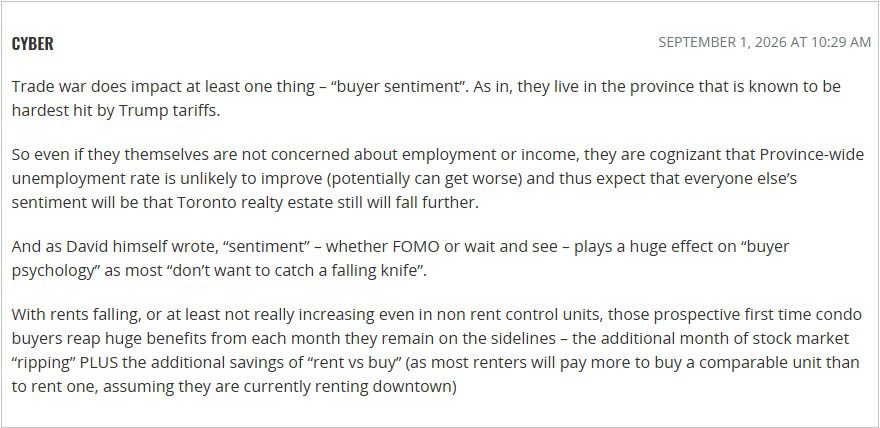
Consumer confidence. Consumer optimism. Consumer sentiment. Consumer trust. These are various economic terms used to describe how individuals in the market feel about that very market.
Of course, if you choose to split the real estate market into buyers and sellers, you will undoubtedly look at the point that CYBER is making.
If a particular buyer is confident, optimistic, and trusting of the market, but believes that the trade war could have a negative effect on the real estate market, then does this impact the buyer’s decision and timing?
Potentially, yes.
If this were the stock market, and we seemed to know that prices were coming down, or we were heading for a bearish period, the buyer would choose not to act.
But with a primary residence, is the consideration different?
If you flipped a coin with respect to the home prices in your target area going up or down, is that a trade you would make? What if you knew with 55% certainty that house prices were going to decline? Would you choose to wait? What about your new job? What about the move? Or the baby on the way?
I have no doubt that there are people who will remain on the real estate sidelines because of the trade war, and to CYBER’s point, people don’t want to “catch a falling knife.”
But there will be an equal, if not greater number of people who will focus more on their own individual situation, personally and financially, and display confidence in moving forward.
This recent article in the National Post seems to point to a substantial increase in consumer confidence:
“Are We On The Verge Of A Home-Buying Tidal Wave?”
National Post
September 2nd, 2026
From the article:
RBC Economics estimates more than 400,000 potential households have been suppressed since 2019, many of whom have been renting for longer than they’d have hoped and so they may finally be ready to make the plunge.
“Timing shouldn’t be underestimated because many would-be buyers have been working hard toward making a purchase with savings near a 25-year-high rate, and 25- to 34-year-olds employed at an above-average historical rate,” the report said.
“We see this influx of financially ready house hunters easily outweighing the lull in homebuyer demand from newcomers to Canada.”
Despite the escalating trade war, prospective homebuyers are increasingly optimistic about the economy and thus more likely to come off the sidelines in the near future, RBC said.
Ah ha.
“Increasingly optimistic,” you say?
Well, that sounds quite…confident.
More from the article:
This positive mindset comes as Canada’s real estate market appears to be stabilizing.
“No matter where you are in Canada, more moderate housing market conditions can be expected to continue to bring buyers off the sidelines going forward,” CREA chair Garry Bhaura said in a statement last month.
Words like “positive mindset” weren’t being bandied about in 2025, let alone earlier this year.
Bringing “buyers off the sidelines” would most certainly signal an increase in consumer confidence, wouldn’t you think?
But whether you feel consumer confidence is increasing or whether you see it waning, you’re talking about it nonetheless…
–
Well, there you have it!
Those are the five real estate-related topics that I think people are going to be talking about non-stop this fall.
Once the fall market gets underway, I’m sure we’ll discuss that crazy sale down the street, and I’ll regale you with stories about that wild offer night. But on a macro level, and looking at the real estate market as a whole, I think this fall will offer a lot of “big picture” discussions.
Now, who’s got a hot new listing to share?


























Serge
at 8:33 am
There was stats that about 50% of people between 35 and 35 yo in Toronto live with parents. If one counts many of them towards “financially ready house hunters”, so, yes, it is a great cohort to revive the market. For sure they feel the pressure.
Graham (the real deal one out making sweet moola with Uncle Rico)
at 9:06 am
David, don’t be jealous that I’ve been chatting online with babes all day. Besides, we both know that I’m training to become a cage fighter.