
Do you care who buys your home?
Maybe. Maybe not.
Do you care who rents your home?
Abso-freakin-lutely!
I’m always amazed when market participants can’t distinguish between the two very different thought processes that a property owner has with respect to selling versus renting.
To be more specific, I’m shocked when prospective tenants and leasing agents don’t see the difference between the process of selling a property and the process of renting one.
When you sell your home, the price is the most important part.
Sure, you care about the closing date, the deposit, and the conditions. You might even care to know who is buying your home, but it’s extremely unlikely that this trumps the price being paid.
On the contrary, when you’re renting out your home or investment property, you care a lot about who that renter is.
In fact, there’s an excellent chance that this matters more than the price.
When you’re selling a property, the “relationship” with the buyer ends upon closing. They pay you the purchase amount, you receive it, the deed is transferred, and you go your separate ways.
When you’re renting a property, you really, truly are entering into a relationship with that tenant. You effectively become “partners.”
This partnership can cut both ways. If the tenant pays the rent on time, treats the property with respect, and doesn’t cause any issues, then it’s a solid partnership.
But if the tenant pays rent late or fails to pay, damages the property, or causes issues with neighbours or the condominium corporation, then the partnership becomes a nightmare.
Adding fuel to the fire is that, as we all know, tenants have all the rights in the province of Ontario. Your “partner” could literally light your kitchen on fire, and while the police (or fire department…) might be involved, it’s not like the tenant is forced to leave.
No, and rather ironically, in this metaphoric and seemingly ridiculous example, the tenant might complain to the Landlord & Tenant Board that the kitchen is no longer suitable for use, and that any delay or refusal to pay rent is therefore warranted.
All this is to say that while you might not care who buys your home, you most certainly care who rents it.
Last week, I received an offer on a rental listing.
It was Saturday morning.
The offer was for the full list price, and all of the supporting documents that you’d expect to accompany an offer were present.
The offer “expired” at 1:00pm on Sunday, but I didn’t make anything of it, because I don’t believe in the concept of an “Irrevocable Date” for an Offer To Lease.
Why?
Because there’s more to a lease than just the price and terms.
As a responsible real estate agent or landlord, you want to take all the time you need to perform due diligence on the prospective tenant, regardless of how long it takes.
On Saturday night, the leasing agent called me and asked, “Where are we at?”
I told him that, since it was a weekend and I couldn’t speak to his tenant’s manager and/or H.R. department to confirm employment, I would get back to him on Monday.
He was so snide. Like he knew better than me, he sighed, chuckled, and said, “Um, you can’t get back to me on Monday because our offer expires on Sunday afternoon.”
Oh, really?
Does it?
If this were an unconditional, full-price offer on a listing that had been sitting on the market for 57 days, I would race over to my client’s house, lie down on the front lawn, and have them sign the Confirmation of Acceptance on my back!
But it wasn’t.
It was a lease.
I told the agent, “I need to verify employment. Your client is employed by a company that, like most companies, is not open for business on Saturday or Sunday.”
I was implying that he should have had this reflected in his offer, but this point was lost on him.
“Look,” he shot back. “This offer expires tomorrow, so if you want to work with us, you’d better make it happen.”
Suffice it to say, we did not make it happen.
On Monday morning, I verified the tenant’s employment, spoke to his manager, and spoke to his two references (who didn’t answer on the weekend), but my landlord client still didn’t want to go ahead and accept the tenant’s offer.
The credit wasn’t great, the ratios didn’t look spectacular, and the “vibe” the tenant and the agent were giving off certainly didn’t help.
I tell this story for one reason, and one reason only, and that’s to give landlords a very important piece of advice:
No matter the market conditions, no matter the offer in front of you, don’t ever believe that you’re not in complete control of your property and your decision.
You’re better off keeping the property vacant for a week or a month than rushing to accept a tenant who can make your life a financial and emotional nightmare.
Don’t get lured in by the price of a lease offer, and don’t get caught up in timelines or deadlines that simply aren’t real.
With Q2 of 2026 now in the books, I wanted to provide an updated picture of the rental market here in Toronto.
As always, we look specifically at downtown Toronto condos, not because we’re uninterested in freehold rentals in Roncevalles or Riverdale, but because C01 and C08 condos provide us with enough data that we’re not prone to sample size error or seasonality.
In the first quarter of 2026, lease listings were down about 8% collectively.
That trend not only continued in Q2, but the decline increased, as you’ll see below:
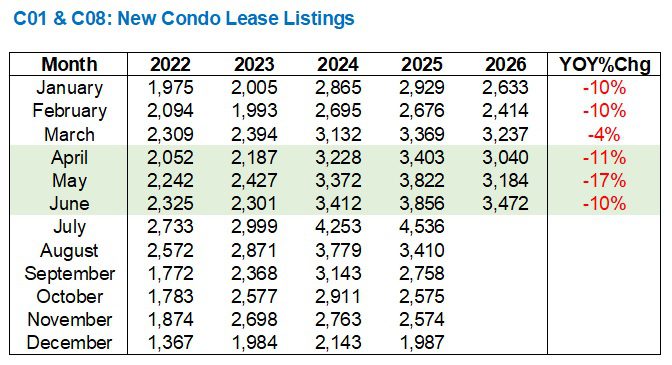
Listings were down a whopping 17%, year-over-year, in the month of May, as an example.
In fact, listings were down from 2025 and 2024 in both April and May.
Plotting these numbers on a graph, however, shows how 2024, 2025, and 2026 are all well above 2022 and 2023:
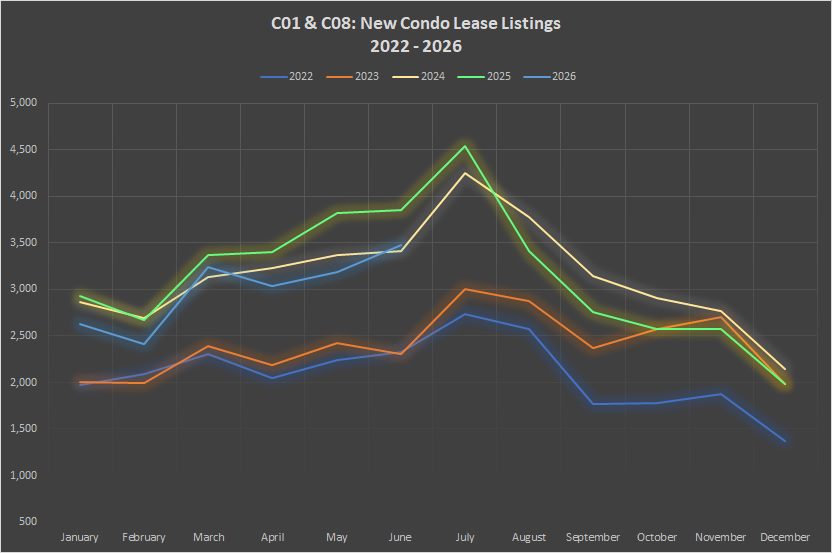
The reason for this, as I’ve been opining for the last two years, is that the condo resale market began to decline in 2022, and many potential condo sellers became unintended landlords.
As a result, the number of lease listings increased dramatically in 2024 and continued to do so in 2025.
Perhaps in 2026, some of these sellers are electing to cut their losses in a declining condo resale market and are listing the properties for sale. That might explain why the number of listings had been increasing every year, but has decreased in 2026.
As for the condos leased, there have been fewer units moved this year than last:
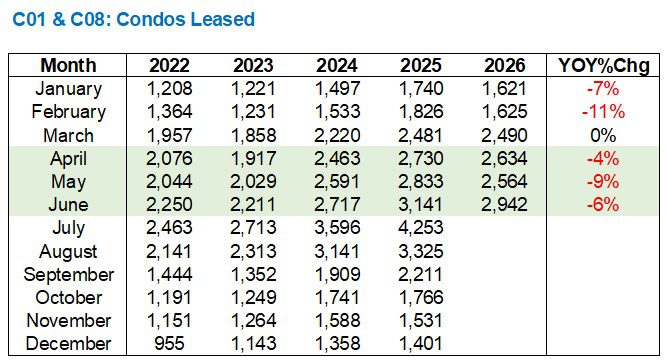
March was the outlier month when it came to condo lease listings, so it seems to reason that it would be the same for units leased.
Regardless, we’re still seeing far more units leased than 2022, 2023, and 2024, as the following graph shows:
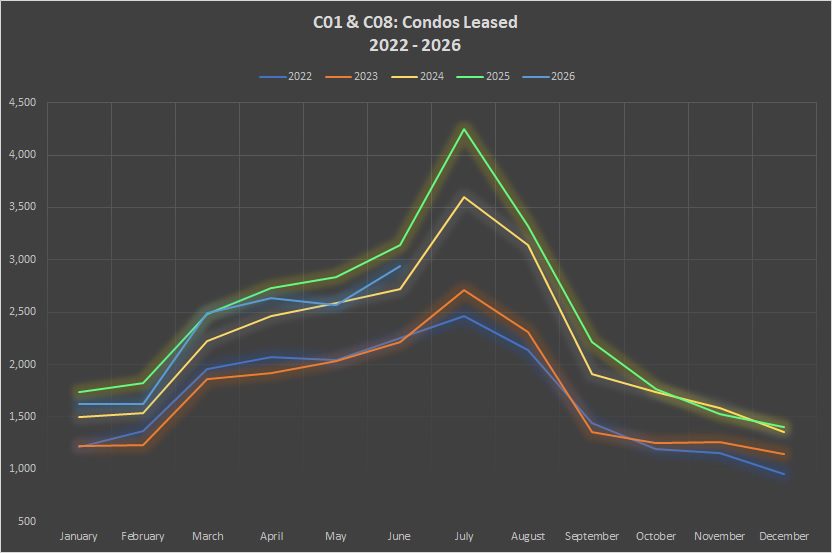
Once again, 2025’s activity makes the previous four years look slow by comparison.
But I really do believe that 2025 will represent the high-water mark for lease listings, for two reasons:
- Many would-be sellers elected to lease their units, as discussed above.
- Fewer and fewer new condo completions are coming online, and this number will decline moving forward.
Since an overwhelming majority of pre-construction condo buyers are investors, it seems reasonable that upon completion, most of these units would hit the rental market.
But with completions down and pre-sales virtually non-existent, I fully expect 2027’s rental figures to be lower than 2025, lower than 2024, and maybe even back in line with 2022 and 2023.
Now, with lease listings down and units leased down as well, we might expect that the market is moving in perfect equilibrium.
It is not.
The ratio of sales to listings, ie., the absorption rate, explains why:
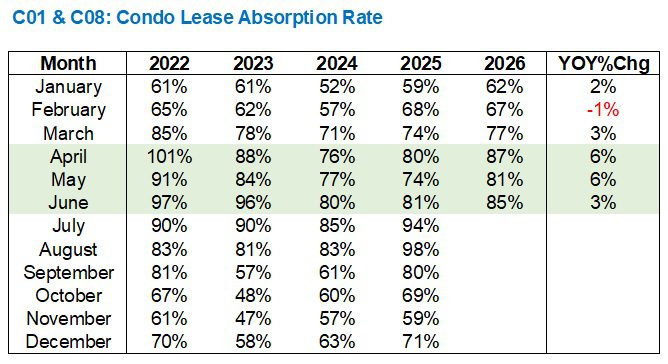
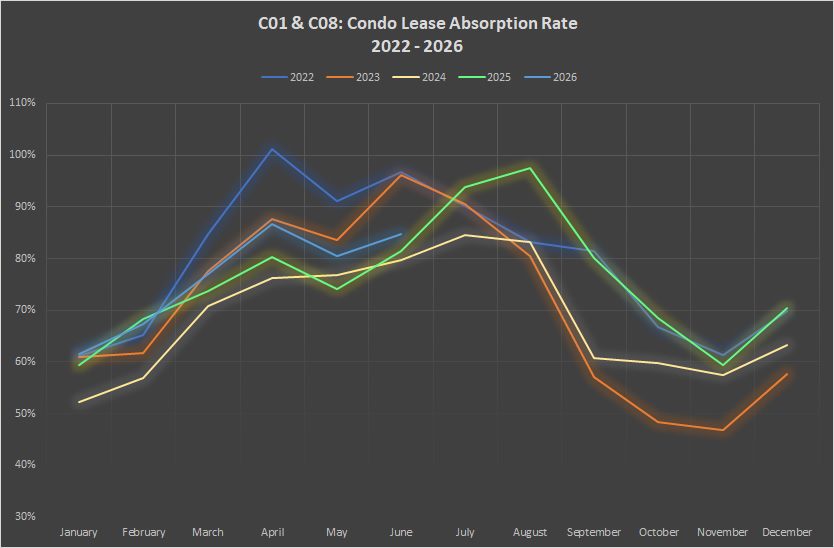
While average rent prices are trending downward (which we’ll talk about in a moment), the absorption rate is actually going up.
In January, we saw the highest absorption rate in five years!
And through the next five months, we saw absorption rates that were, on average, higher than both 2024 and 2025, while trailing 2022 and 2023:
As for prices, here’s where I go to www.rentals.ca for all my information, so thank you to them and Urbanation for tracking and providing all this data.
Rentals.ca tracks sixty cities across Canada, with most of them being in Ontario or British Columbia.
Of these sixty cities, how many do you think have seen an increase in rental prices, year-over-year?
Not many.
1-bedroom rentals: 13 out of 60 are up year-over-year.
2-bedroom rentals, 15 out of 60 are up year-over-year.
I suppose a better way of saying this is:
78% of cities surveyed saw a decline in 1-bedroom rental prices.
75% of cities surveyed saw a decline in 2-bedroom rental prices.
Since this is a Toronto-focused blog, let’s look at the areas inside the GTA:
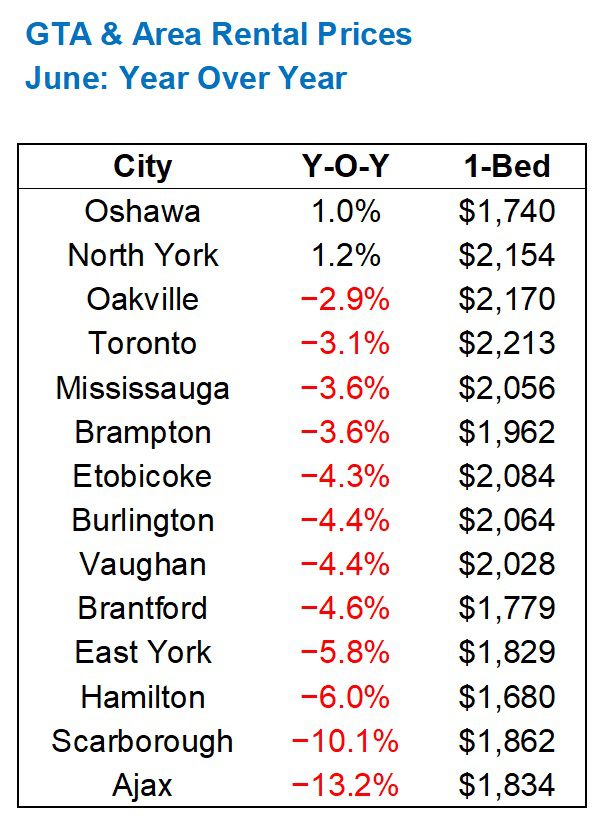
Oshawa, eh?
What a hotbed!
Who knew there was such a contrast between Ajax and Oshawa!
But perhaps we’re making a big deal out of nothing.
Take Toronto, for example, where the average 1-bedroom condo leased for $2,213 per month in June of 2026. Based on the 3.1% decline, that means this same unit was leasing for $2,284 in June of 2025. If $71 per month is going to make or break your investment, then it’s clearly not the right investment for you.
As for the 2-bedroom statistics, five of the fourteen GTA areas are up year-over-year, as opposed to 1-bedrooms, where only two of fourteen areas are up.
What’s going on in Hamilton?
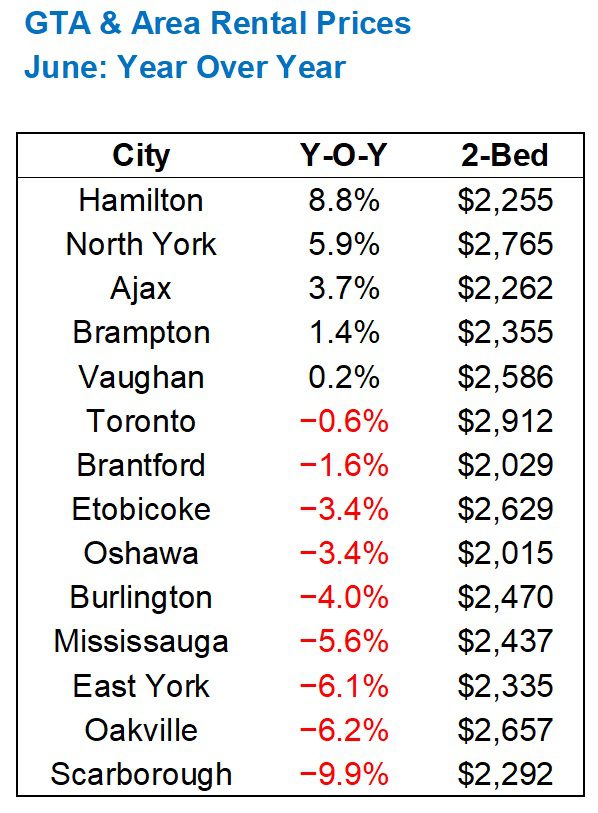
This is where I might question the accuracy of the data.
1-bedroom rental prices in Hamilton are down by 6.0%, but 2-bedroom rental prices in Hamilton are up by 8.8%?
Don’t get me wrong, I don’t question the accuracy of the data collected, but rather I question whether or not the data presents an accurate picture of what’s going on in these markets.
Unless Hamilton has experienced a 2,000% increase in marriages or something, these numbers don’t make a lot of sense.
In any event, the data tells us one thing for certain:
Rental prices are down in the GTA.
So for the landlords out there who are thinking about increasing their existing tenants’ rent by the legally permissible amount, I would remind them how much it costs to find a new tenant, and advise them to think again…





























JF007
at 9:32 am
To be frank David being a landlord is not for faint of heart. its a constant stream of one thing or the other and only thing that you are probably gaining out of it is probably the equity being built. There is no other income stream and lot more headaches than one would want to undertake.
And every time a tenant leaves it is a minimum of a months rent +hst hit plus anything you might need to fix around the house from cleaning, to caulking, to paint etc etc etc.
So yeah not worth letting a good tenant leave for a few bucks
Serge
at 12:28 pm
Times, they’re changin’ What a progress!
The tradition to call a company’s HR to confirm employment has existed long time.
But, if I decided to apply for a lease for 5 condos, and 5 agents called my manager on Monday morning to confirm my character… what a team dynamics it could be!
I wonder if RE gravitates to what many consulates already require for visa support: criminal record, medical statement and copy of bank account flow for last 6 months.
Let’s see what happens, when governments on all levels remove a lot of condo stock from the market, and listings drop to 2017 level.
Different David
at 2:14 pm
You’re also looking at it from a landlord point of view.
From a tenant’s point of view, there are tons of costs in moving – forget about the monetary costs of getting a van, movers (?), plus moving supplies. You have the weeks of disruption to pack up your place, unpack it at the new place, change all of your addresses etc.
Not to mention that you know that your current landlord is responsive, your place is well-kept, and you are familiar with everything.
Is it worth rolling the dice to save $50 a month…$1.66 per day… if you aren’t sure the grass is greener on the other side?
As a landlord, your property taxes are going up, your insurance is going up…how long can you eat the increases before passing it on to the tenant?
Lizard
at 10:35 am
I can’t imagine that a tenant paying 2000-3000 in rent is going to leave based on a 50-60 $ increase in rent. From a landlord perspective it does seem a bit petty to raise the rent by so little, but over time it does add up, especially if you elect not to do so for several years. That said, i did raise the rent on a previous tenant (after a few years of not doing so) and the amount at the time was 95$. The tenants did subsequently elect to move before the rent increase took effect and I lost a months rent + a months rent to the listing agent (David). Months later i came across the paperwork for the rent raise and in one spot realized i added an extra zero and it read $950 … I’ll never know if they left for the $95, for other reasons or due to my typo. Live and learn 😉